 Julien Reszka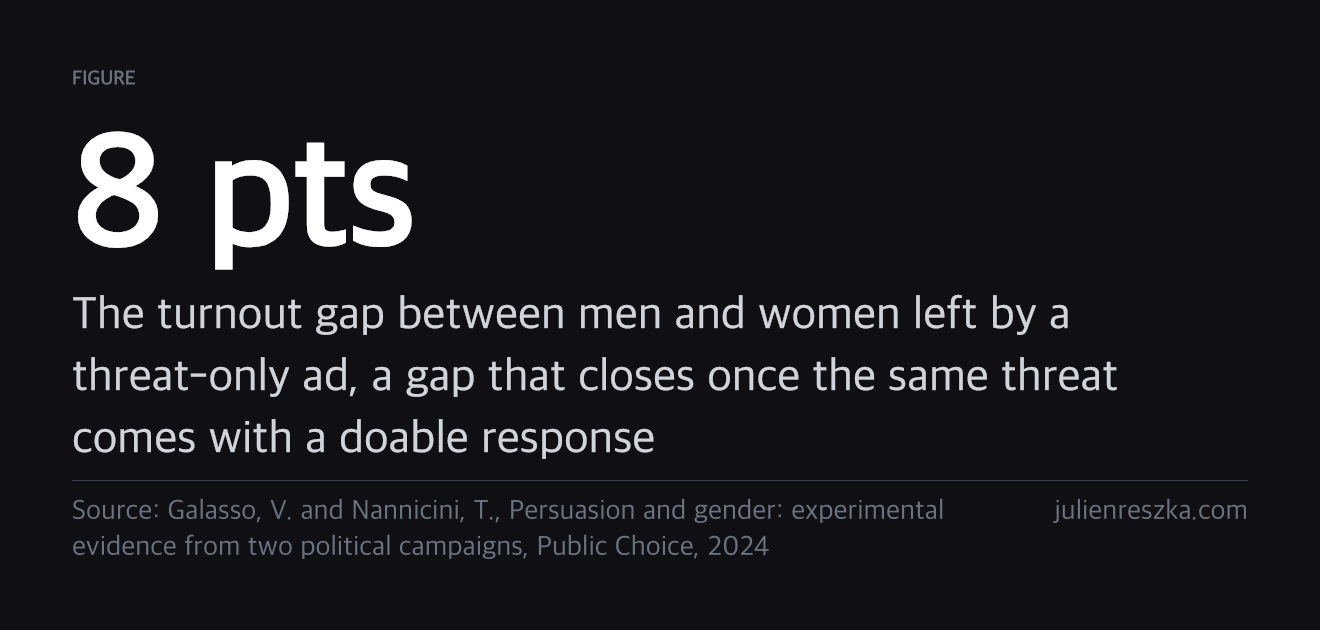
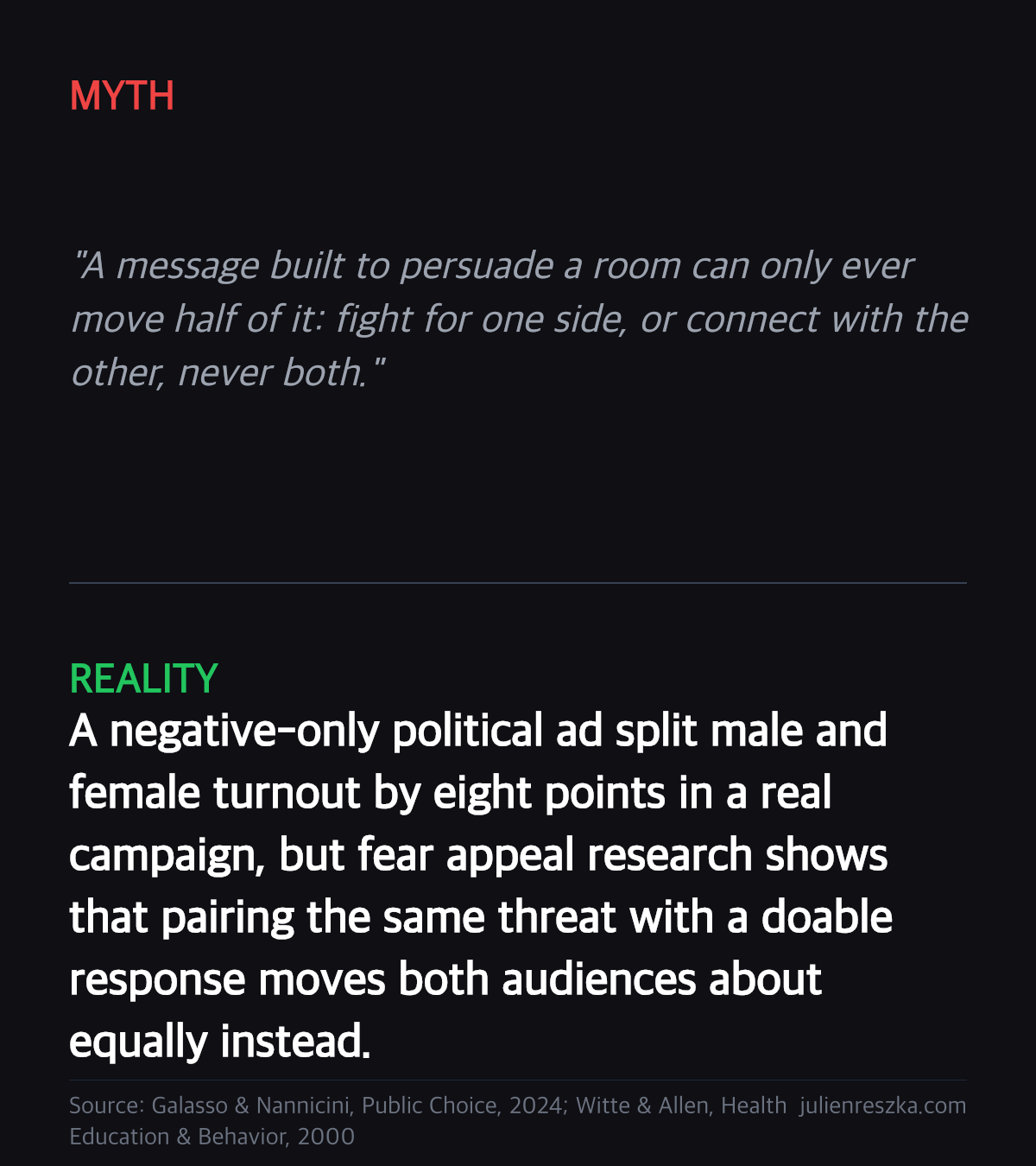
The conventional wisdom about a speech, or an ad, is that it can only ever move half a room: fight for one side, connect with the other, and accept that the rest will tune out. A 2024 field experiment shows that split happening in a real election. The identical mayoral campaign, run as a negative ad, raised turnout among men by about eight percentage points and changed nothing for women. Run as a positive ad instead, it swung women's votes and left men where they started. Economists Vincenzo Galasso and Tommaso Nannicini had found the two halves of the room, each one moved by a different half of the message.
For decades, the stress response behind that split was treated as one universal circuit: fight or flight. In 2000, psychologist Shelley Taylor described a different pattern in women. Under threat, women lean more toward protecting their group and pulling it closer, a pattern she named tend and befriend. The mechanism is oxytocin, a hormone that promotes calm and connection under stress. Estrogen strengthens its effect, and androgens blunt it, so the same hormone pulls the average man toward confronting a threat and the average woman toward gathering people close.
The same split shows up in groups, not just individuals. Mark van Vugt and colleagues found that men cooperate more with their own team specifically when it is competing against a rival group, while women's cooperation holds steady either way. Men bond over a shared fight. Women bond by default.
Two levers follow from this, and each one only moves half the room:
- Naming a threat and calling people to fight it together moves men, an effect that fades once the threat is gone
- Naming the team on its own, through care or protection, moves women without needing a threat at all
None of this means the room has to split. A meta-analysis of fear appeal research by Kim Witte and Mike Allen found that a message pairing a real threat with a clear, doable response beat either lever alone, and gender barely predicted who it moved. Naming a danger only pulls one lever. Naming a danger and handing people something to do about it pulls both, in the same room, at the same time.
A speech, or an ad, built to move an entire room does not need to pick a side between fighting for one half and connecting with the other. It needs both in the same breath: a real threat, and something concrete to do about it. That is not a compromise between the two levers. It is the one message neither lever can reach on its own.

Discussion
This matches what we see in message testing at the agency I work for. Threat-only concepts poll well with men and flat with women in the same room. Add one line telling people exactly what to do about the threat and the gap in stated intent to act mostly closes. Nobody had ever explained the mechanism to me before, I just knew the pattern from testing.
Pushback: 'gender barely predicted who it moved' in one meta-analysis from 2000 is a thin foundation for the headline claim. Effect sizes in the fear appeal literature are famously small and heterogeneous. I would want a modern, pre-registered replication before rewriting how anyone writes a speech.
Fair, and I tried to flag that in the piece: this is where the average response sits across many studies, not a guaranteed individual effect. What made it worth writing about is that the same combine-the-two pattern shows up independently in the political ad data, a completely different literature with its own effect sizes. Two unrelated fields landing on the same fix is weaker than one clean replication, but it is not nothing.
The evolutionary psychology paragraph is the part I trust least. 'Men bond over a shared fight, women bond by default' is a very clean story for a messy literature, and evolutionary explanations have a bad track record of sounding inevitable after the fact. The political ad data stands on its own without it.
That is a fair place to be skeptical. I kept it in because Van Vugt's result is a direct behavioral experiment, not a story fitted after the fact, but you are right that the evolutionary explanation for why it exists is shakier than the finding itself. You can drop the theory and keep the finding: the campaign data alone already shows both the split and the fix.
Going to test this on our fundraising emails. We've always A/B tested 'the problem is urgent' against 'here is how your $20 helps' as if they were competing messages. Never tried just putting both in the same email.
Wait, so is this basically saying good ads already do both and bad ads pick one? Feels obvious in hindsight but I've never seen it named like this before.
Worth naming the flip side too: a campaign that wants to fire up its base rather than persuade a mixed room might pick the threat-only lever on purpose. Splitting the audience is not always a mistake, sometimes it is the strategy. This piece frames reaching everyone as the win, but plenty of people using this same data have a narrower goal.
Agreed, and worth being explicit about. Nothing here says unifying is always the better goal, only that it is available when you want it. Mobilizing a narrow, committed base is a different job than persuading a broad room, and the threat-only lever is the right tool for that job on purpose, not by accident. Read this as 'here is the option that exists,' not 'here is the option everyone should take.'