 Julien Reszka

On a Friday evening, one of you wants to order in and spend the night together. The other thinks delivery is a waste and offers to pick up an extra shift instead. Neither of you mentions economics, but both of you are using a model of it: what an hour is worth, what money is for, and what is worth trading for what. When those models differ, you argue about money, and you also end up spending your time differently, often without noticing.
Couples who both understand how the economy works share a way to think about those trade-offs. That matters in ordinary weeks, not only when money gets tight, and it matters before a couple has fully committed, when dates, distance and early career moves are already deciding how much time two people will have for each other. I could not find a study that measures both partners' economic knowledge and follows them over time, so this is an argument built from several lines of research, not a proven rule. But those lines point the same way.
Start with time, since that is where a person's view of money quietly shows up every week. In experiments by Cassie Mogilner, getting people to think about time rather than money made them plan and spend more of their time with friends and family, and less of it working. Those were priming studies, a kind of experiment that often fails to replicate, so read them as a hint. Larger surveys point the same way. Across studies of more than 4,000 Americans, Hal Hershfield, Mogilner and Uri Barnea found that most people would rather have more money than more time, but those who chose time were happier, even after accounting for how much time and money they already had.
A shared view of time also changes what a couple buys. Ashley Whillans, Jessica Pow and Joe Gladstone analyzed seven studies with nearly 40,000 participants, including 11 years of the UK Household Longitudinal Study. People who spent money to buy back time, on cleaning, meal deliveries and similar services, reported happier relationships. The benefit grew when couples were under more stress, and it was larger when they spent the freed time together.
If one partner sees paying for a cleaner as waste and the other sees it as buying back a Saturday together, they are not arguing about cleaning. They are arguing about whether an hour has a price. Opportunity cost gives them a shared way to ask the real question: what is an evening together worth to us, and is this the cheapest way to get one back? It cuts both ways, though. An evening together is not billable, and someone who prices every hour at their wage will start to see time with a partner as lost income. Understanding the idea well means using it to protect shared time, not to put a rate on it.
What a couple spends on matters as much as how much. Peter Caprariello and Harry Reis found that people valued money spent on experiences shared with others more than money spent on experiences alone or on things, and that much of the known advantage of experiences over possessions came from that sharing. For a couple, a cheap dinner together can be a better purchase than an expensive object one of you uses alone.
The biggest time trade-offs come with work, and they often look like pure gains until you count the hours. Erika Sandow studied more than two million married or cohabiting Swedes and found that the risk of separation was 40 percent higher among long-distance commuters, those traveling 45 minutes or more each way, than among other people. Income and careers often benefited from the commute, and men benefited more. In a US sample of 1,166 married adults, night workers reported more marital instability than day or weekend workers, and earlier work by Harriet Presser linked night shifts to higher rates of separation. Overtime, a side job or a second shift brings in money and takes out time together. A couple that sees only the payslip will keep making that trade without noticing what it costs.
All of this starts before a couple fully commits. Early on, people decide how often to see each other, who pays, whether to move for a job and whether to move in together, and each of those decisions runs on a model of what time and money are worth. Jane Dokko, Geng Li and Jessica Hayes studied US credit records and found that people tend to pair up with partners who have similar credit scores, and that a bigger gap in scores when couples moved in together predicted separation: each additional 66 points of difference raised the odds of separating in the second year by about 24 percent. Credit scores measure habits, not understanding, but habits are where economic views show. Talking about how each of you values time and money while you are still dating costs little. Discovering the difference after the lease is signed costs more.
Careers set the largest trade-offs of all. Every couple with two jobs runs a small economy: two incomes, a limited number of hours, one home and often children. Claudia Goldin, who won the 2023 Nobel Prize in economics, argues that many professions are greedy, paying disproportionately more for long hours and weekend work. When jobs pay that way, a couple can often earn more if one partner takes the greedy job and the other takes a flexible one, at the cost of equality between them. In Denmark, Henrik Kleven, Camille Landais and Jakob Egholt Søgaard found that the arrival of children creates a long run gap in earnings of around 20 percent between mothers and fathers. Mothers were less likely to work, worked fewer hours and earned less per hour. They also moved toward more family friendly employers and became managers less often. Those are economic decisions, even when nobody names them that way.
Academic biology shows how a career can force long hours. Researchers sometimes joke that they end up as the lab rats, and the joke works because a lab rat is not lazy or obsessed. It runs the maze it was given, toward the rewards on offer. In biology the maze is economic. Bruce Alberts and three other leading scientists called US biomedical research hypercompetitive, with most of the work done by graduate students and postdocs on short contracts. Shulamit Kahn and Donna Ginther found that only about one in five biomedical postdocs reaches a tenure-track job, and that a postdoc costs roughly three years of salary over a career's first 15 years. In a self-selected Wellcome survey of 4,267 researchers, most of them in biology or biomedicine, nearly half felt pressured into working long hours. Families pay too. Erin Cech and Mary Blair-Loy found that four to seven years after their first child, 43 percent of new mothers and 23 percent of new fathers had left full-time work in science and technology.
Big law firms run a similar maze. Associates are usually expected to bill 1,800 to 2,000 hours a year, and billable hours count only the time charged to clients, not the rest of the working day. Renee Landers, James Rebitzer and Lowell Taylor called the result a rat race. Firms use billable hours to judge who has the drive to make partner, so everyone works more to send that signal, and associates end up working inefficiently long hours. The authors found evidence of this in data from two large firms. In a recent survey, more than half of Gen Z associates said they would give up part of their salary for fewer billable hours. Claudia Goldin uses lawyers to show what this does to couples. Two graduates of a prestigious law school may start at similar salaries in firms that demand long hours. But when pay rises faster than hours, it is more lucrative for one partner to work 80 hours and the other not to work at all than for both to work 40. Later, one of them, more likely the woman, may move to a smaller practice.
For the partner at home, the economics change what the late nights mean, in the lab or at the firm. Without them, every weekend at work looks like choosing work over you. With them, the hours are the entry fee to a contest with few prizes, and the question becomes one you can answer together: how long are we willing to pay that fee, and what would make us stop?
Partners do give up when a career keeps one of them unavailable, but the research suggests the hours alone are not the trigger. What matters is whether they clash with what the couple expected. In Stefanie Kley's study of 890 German couples, long-distance commuting raised the risk of separation when the woman commuted, but not when the man did. Among more than 40,000 US physicians, women who worked more than 40 hours a week were more likely to have been divorced than those who worked less, while for men long hours went with less divorce. In a one-year follow-up of 40,654 married Korean workers, women working more than 60 hours a week had higher odds of divorce or separation and men did not, though that estimate rests on few cases. These studies show links, not causes, and they measure gender expectations as much as hours. Those expectations can move. Daniela Bellani and Gøsta Esping-Andersen found in US and West German data that, over time, couples who shared the work more evenly became less likely to divorce. The common thread is that unavailability hurts most when it breaks the deal a couple thought they had. A partner who understands why the job demands the hours can renegotiate that deal instead of quietly deciding it is over.
Regret follows these trade-offs, though not always where people expect. In a Pew survey, 42 percent of mothers and 28 percent of fathers had cut their work hours to care for family, and 94 percent of everyone who had done so said they were glad. The cost still fell unevenly: 35 percent of women who cut back said it hurt their career, against 17 percent of men. Regret seems to come less from the trade itself than from a trade nobody really agreed to. Among Harvard Business School graduates, most women expected their careers to rank equally with their partners', while men largely expected their own to come first, and the men's expectations mostly came true. Women who ended up in that traditional arrangement were less satisfied with their careers, and only about 11 percent had left work to care for children full time. The other side shows up too. When Mike Morrison and Neal Roese asked 370 Americans to describe one regret, romance was the most common. Women's regrets were more often about their love life or their family, such as a chance at love they missed or a relationship that never lived up to its promise. Men's were more often about work or education. The career given up and the relationship neglected are both easier to regret when they were decided by default. A couple who names the trade-off, and revisits it, has less to regret either way.
Fertility is where career timing meets biology. The economic case for waiting is real. Amalia Miller found that each year a woman delays her first child raises her career earnings by about 9 percent, with the largest gains for college-educated women in professional and managerial jobs. Biology does not keep the same schedule. In Henri Leridon's model of conception by age, 6 of every 100 women who start trying at 30 remain childless, against 14 of every 100 who start at 35, even with fertility treatment, which cannot make up for all the lost years. Across Europe and the US, Éva Beaujouan and Caroline Berghammer found that women ended up with fewer children than they had intended, and in most countries the gap was largest among highly educated women. Egg freezing is often sold as a career tool, but when Marcia Inhorn and colleagues interviewed 150 women who had frozen their eggs, 85 percent had done so because they lacked a partner, and career planning was the least common reason. For many women, the delay is about a relationship, not a job. But jobs shape relationships. The long hours that strain couples, described above, also leave less room to find and keep a partner, and less room for children once you have one. In a survey of about 2,500 biologists, physicists and astronomers at top US universities, Elaine Howard Ecklund and Anne Lincoln found that 45 percent of women and 25 percent of men said their science career had left them with fewer children than they wanted. Ecklund pointed to the long hours and the pressure to publish and win grants. Among graduate students and postdocs, having fewer children than they wanted was the only factor that predicted thinking about leaving science. I could not verify comparable figures for lawyers, but the hours point the same way. That makes timing a decision for both partners, made with the numbers on the table: what a year of waiting is worth in pay, and what it may cost in children.
How a couple reads a career setback matters too. Alexandra Killewald analyzed more than 6,300 US couples and found that financial factors did not predict divorce, but for couples married after 1975, a husband without full-time work was linked to a higher risk of divorce. She points to the persistence of the male breadwinner norm. The money mattered less than what the lost job was taken to mean. A couple who understands that layoffs rise in downturns regardless of effort has a better chance of reading a lost job as a market event rather than a verdict on the person, though no study I found tests that directly.
Jennifer Petriglieri, who interviewed 113 dual-career couples, describes three ways couples arrange their careers: primary and secondary, where one career comes first for good; turn-taking, where the partners swap periodically; and double primary, where both careers are juggled as equals. Couples who did well, she found, discussed that structure openly instead of drifting into one. A shared understanding of the economy makes the discussion concrete: what the greedy job pays for each extra hour, what the flexible one costs in lifetime earnings, what a long commute costs in evenings, and how exposed each path is if a recession hits.
Then there is money itself. Jeffrey Dew, Sonya Britt and Sandra Huston followed 4,574 US couples and found that, for both wives and husbands, money disagreements were the strongest predictor of divorce among the kinds of disagreement they measured. Once those disagreements were accounted for, how well off a couple was no longer predicted divorce. What hurts is not the amount of money. It is what the couple makes of it. In the family stress model developed by Rand Conger and colleagues, economic pressure leads to hostility and low mood, which then lead to more conflict. April Masarik and colleagues found this in two generations of couples, but couples who were highly effective at solving problems together showed no increase in hostility under pressure.
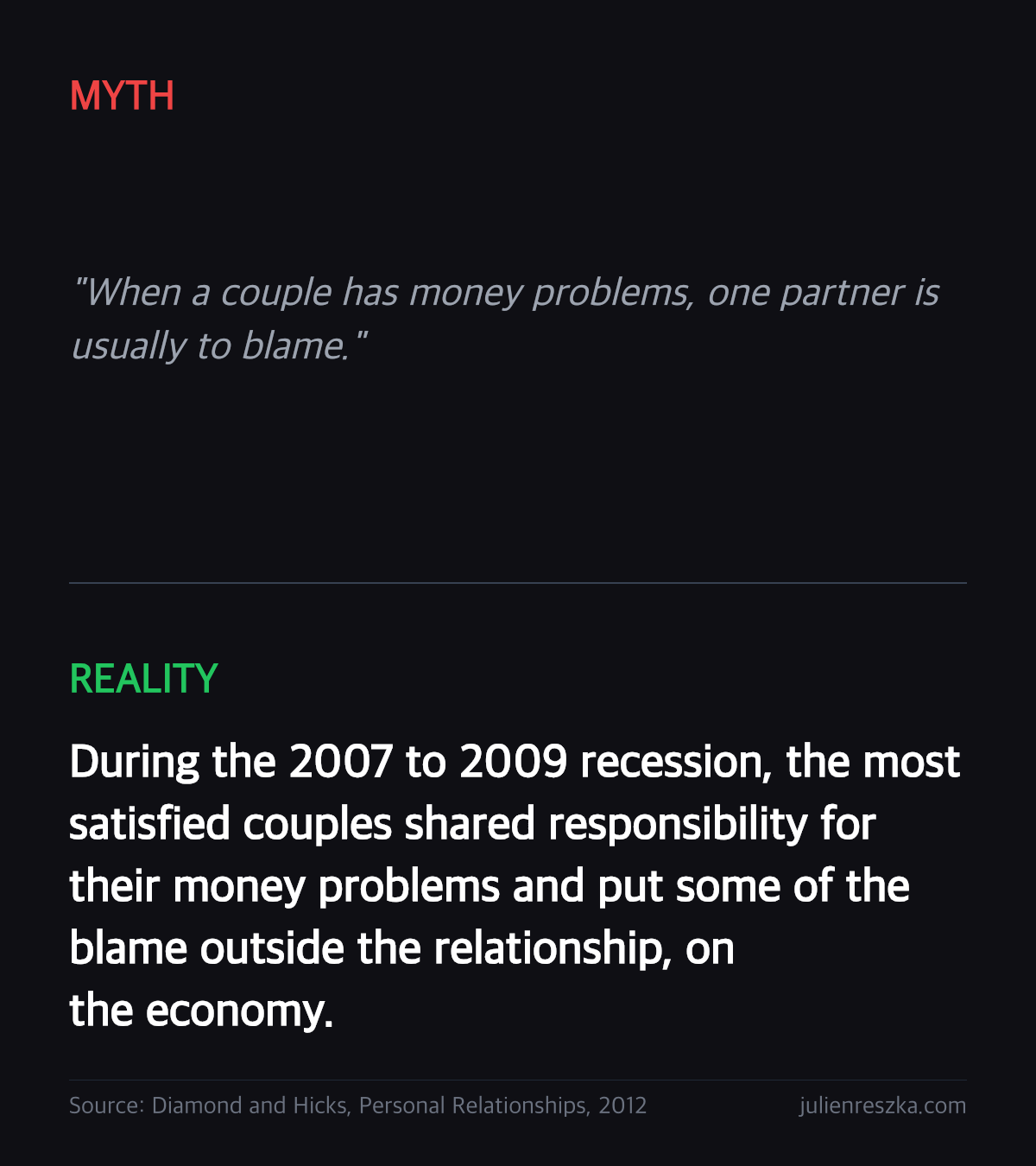
What couples make of money problems depends partly on whom they blame. Lisa Diamond and Angela Hicks surveyed a nationally representative sample of US couples during the 2007 to 2009 recession. According to Diamond, 48 percent blamed the economy and not their partner, and only 3 percent blamed their partner alone. The most satisfied couples shared responsibility and put some of the blame outside the relationship. The study is correlational, so it cannot say which came first. But a recession on every front page makes outside blame easy. Most of the time the economy works more quietly: inflation eats a raise, a rate rise pushes up a mortgage payment, a sector slows down and a layoff follows. If you do not understand those forces, the only visible causes are the two people in the room. And many people do not. When Annamaria Lusardi and Olivia Mitchell asked Americans over 50 three basic questions about interest, inflation and diversification, only about one third answered all three correctly.
Understanding also matters when it sits with only one partner. Many couples let one partner handle money, which looks efficient until it breaks. Tracey West and Elizabeth Mitchell found, in 16 years of Australian data, that above average financial literacy helped people keep their wealth after divorce, with an effect about twice as large for women. When only one partner understands, the other cannot really agree to a decision, including one about how the couple's hours are spent. They can only defer to it. Risk works the same way: Marta Serra-Garcia found in German data on 5,300 couples that couples with the most dissimilar risk attitudes were twice as likely to divorce as those with the most similar.
A shared understanding does not require economics degrees. It means you both understand the handful of forces that shape a household's money:
- Inflation: why prices rise, and why a raise below inflation is a pay cut
- Interest: how debt compounds, and why paying off a high rate card beats most investments
- Risk: why one stock is riskier than a broad fund, and why markets sometimes fall for reasons nobody controls
- Cycles: recessions come and go, and layoffs rise in them regardless of how hard people work
- Opportunity cost: every purchase is also a choice not to spend that money on something else
- Incentives: landlords, banks and employers respond to the market, not to how much you deserve
- Time: hours are a budget too, and buying some back can be worth more than the money it costs
With that shared model, a money fight can start the way I suggested in Making Relationships Work Requires Privacy: by separating facts from interpretations. "Our rent rose 12 percent" is a fact. "You are bad with money" is an interpretation. Between them sits a question only a shared understanding of the economy can answer: how much of this did the world do, and how much did we choose?
In practice:
- If you are still dating, talk about how you each value time and money before you move in together
- Answer the three Lusardi and Mitchell questions together, then look up the ones you missed
- Treat time together as something to protect, not as earnings you are giving up
- Before taking overtime, a long commute or a night shift, count the evenings it costs you both
- When you buy back time, spend at least part of it together
- Prefer spending on things you do together over things one of you uses alone
- Decide openly whose career leads for now, how available each of you will be, and when you will revisit it
- When money gets tight, split the problem into what the economy did, what you chose and what you can change
- Make sure both of you know where every account and debt is and how it works
There is a misuse to avoid. The economy explains the rent, not the impulse purchase, and blaming it for everything is just another way to avoid a hard conversation. Pricing every hour is a misuse too. The point is to be accurate. When you can both see the forces outside your home, you stop treating each other as the cause of everything inside it, and you get better at protecting the hours you have together. Diamond summed up the attitude that helps as "you and me against the world's financial banks." That is a better place to stand than you against me.

Discussion