 Julien Reszka
Building a startup right now feels like defending a castle against cannons. You spend months on a product, then a frontier lab ships a feature that does most of it. In February, Google's head of startups, Darren Mowry, told TechCrunch that startups that lean on a model to do all the work have their check engine light on. The wall you built is the thing being shot at.
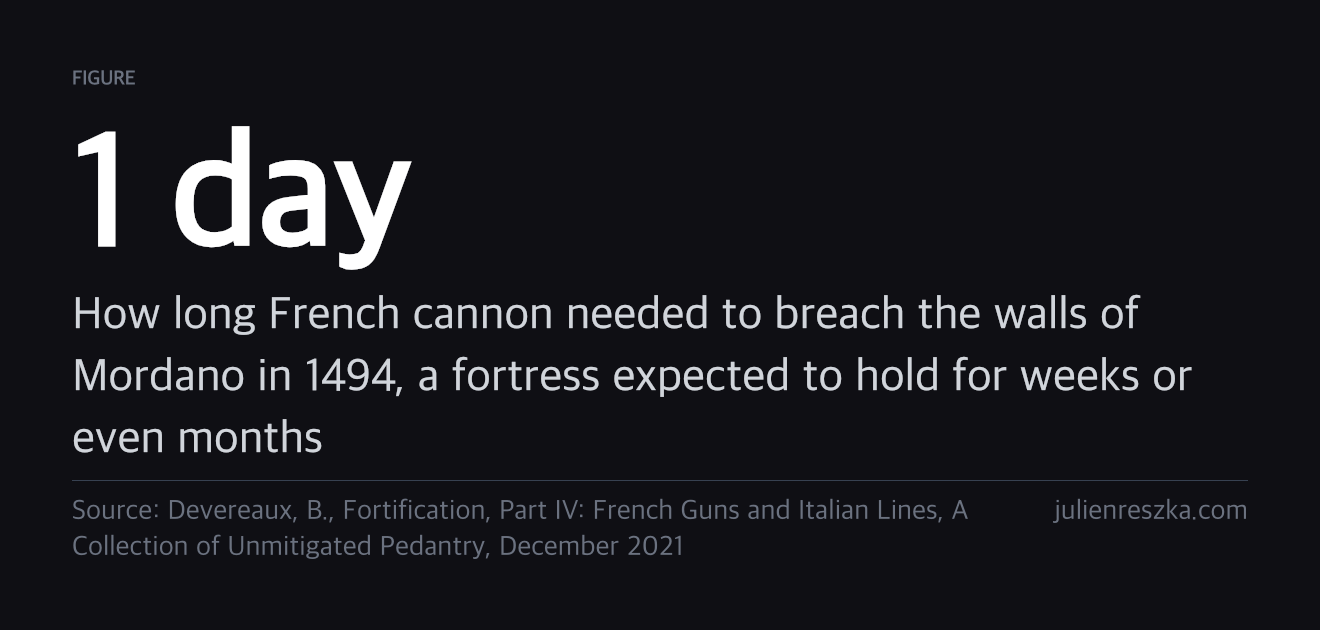
Castle builders lived through the same shock. In October 1494, a French army under Charles VIII put cannon against Mordano, an Italian fortress that should have held for weeks or months. It fell in about a day. The historian Francesco Guicciardini wrote that the guns did as much damage in a few hours as older siege methods once did in days.
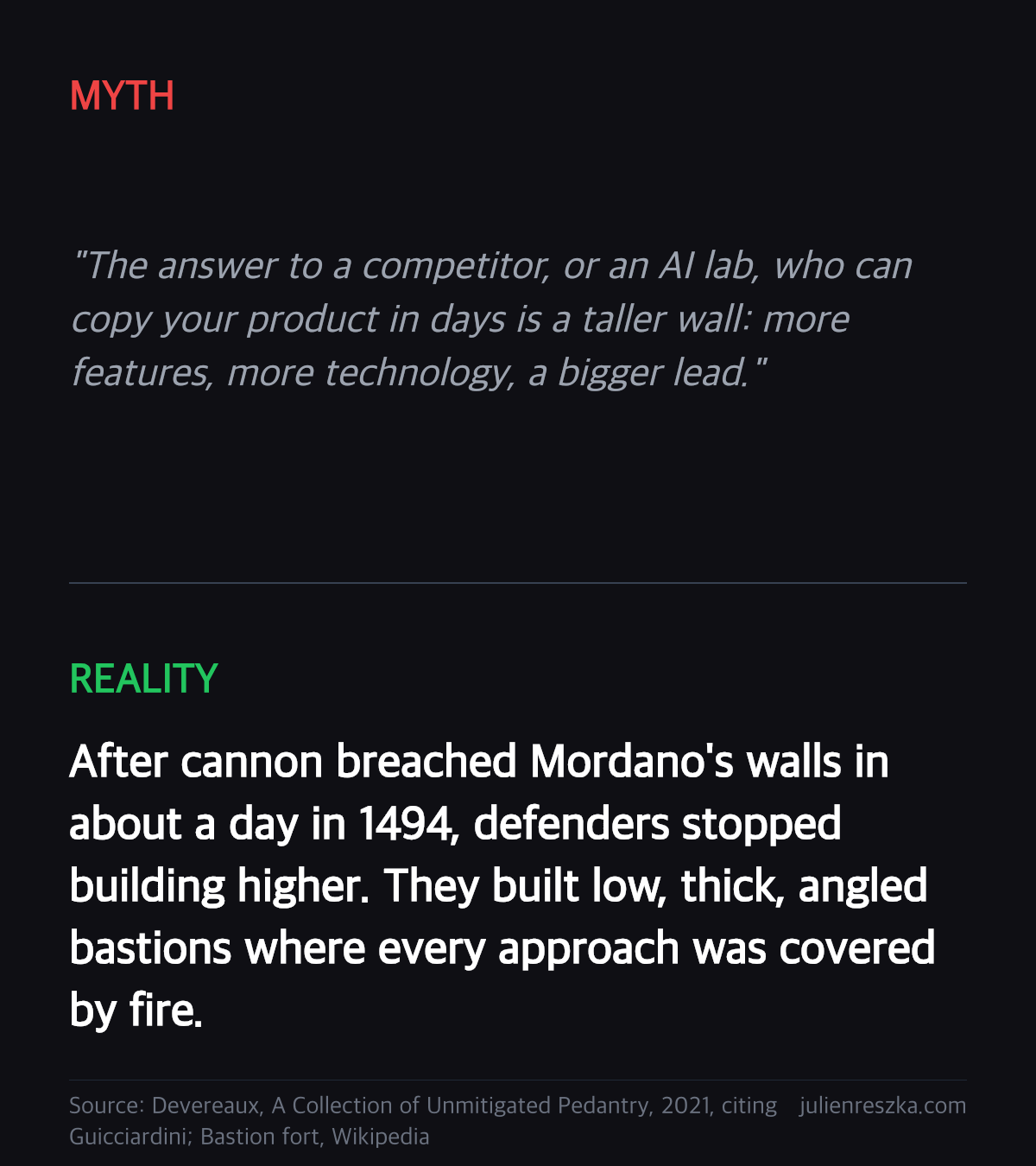
The instinct then, like the instinct now, was to build higher: a taller wall, a bigger lead, one more feature nobody can copy this quarter. But height was the weakness. A tall vertical wall is a big flat target, and cannon fire breaks masonry.
What worked was the opposite. Italian engineers built star forts with low, thick walls sloped so shots glanced off. Packed earth behind the stone absorbed impact instead of cracking. Pointed bastions stuck out from the walls so defenders could fire along them, leaving attackers nowhere to hide. The fort did not try to be unbreakable. It made every approach expensive.
The same three moves translate to a startup:
- Lower the target: a feature lead is a tall wall, and a lab can shell it in an afternoon
- Absorb the hit: customer data, workflows, and habits inside your product cushion the blow of a copy
- Guard every approach: own the channels and relationships around your product, so no route to your customers is left open
Jasper is the closest live test. In October 2022 the AI writing startup raised $125 million at a $1.5 billion valuation. Its wall was turning a prompt into good marketing copy. Six weeks later ChatGPT launched and did that for free, and by 2023 Jasper had reportedly cut its own valuation by about 20 percent.
Jasper's answer was to go low, not high. Brand Voice writes in a company's own tone and rules. A later marketing copilot works from a team's own documents, which stay inside Jasper. Its CEO says large companies are now its fastest growing segment. That is Jasper's own claim, and it is too early to say the low walls hold, but it is the move 1494 predicts, not a better prompt.
Harvey, the legal AI startup, is facing the same cannon now. Anthropic shipped legal tools for Claude in May, and in September Harvey raised at a $15.5 billion valuation, up from $11 billion in March. A rising valuation does not prove the walls hold, but it is the opposite of what Jasper saw in 2023.
The design was not free, and that is the part worth remembering. Siena bankrupted itself in 1544 paying for its defenses, and later only states could afford them. A startup that buys its defense with capital instead of customers is repeating Siena.
The cannon also cuts both ways. The same cheap firepower that threatens your wall lets a small team with a model breach incumbents whose walls held for years.
So skip the question of how tall your wall is. Ask this one instead: if a perfect copy of your product launched tomorrow, which of your customers would not even notice? Those customers are your walls. Everyone else is standing in the breach.

Discussion