 Julien Reszka
You read a headline about a rule that contradicts another rule, an institution doing the opposite of its job, or a public figure saying something that would have ended a career ten years ago. Someone in the replies writes two words: clown world. Sometimes just "honk honk". The phrase is popular because it names a real feeling: nobody seems to be in charge, nothing adds up, and laughing looks like the only sane response.
The feeling deserves to be taken seriously. Using the phrase as a final verdict on the world does not. This post looks at where the phrase came from, what Terence McKenna predicted about a world that keeps getting stranger, what research says about why the world feels absurd and why one simple verdict is so tempting, and how to live with that feeling without letting it make your decisions for you.
## Where the phrase comes from
The clown imagery took off on 4chan and Reddit in 2019, as a clown version of the Pepe the Frog cartoon nicknamed "Honk Honk" or "Honkler". It spread first in far-right corners of the internet. Many of the videos showed someone disgusted with a world they saw as degenerate, which they called Clownworld. That person then gave up and "embraced the honk": instead of fighting the absurdity, they joined in the joke.
Today plenty of people say "clown world" with no idea of that history, the way people say "it's a circus". I am not suggesting that everyone who uses it shares the original politics. But the origin is worth knowing, because the meme came with a built-in conclusion: the world is beyond repair, so stop trying to understand it and laugh. That conclusion is the part worth questioning.
## What Terence McKenna predicted
Terence McKenna was an American writer and speaker who died in 2000. He was best known for his talks on psychedelics, language and the future. In the 1970s he developed, with his brother Dennis, what he called novelty theory: the idea that the universe produces more and more complexity and strangeness over time, and that this process speeds up. He turned it into a model called Timewave Zero, which pointed to December 2012 as the moment novelty would peak.
In a 1998 interview with the filmmaker John Hazard, he described what the years before that date would feel like:
> It's only going to get weirder. The level of contradiction is going to rise excruciatingly, even beyond the excruciating present levels of contradiction.
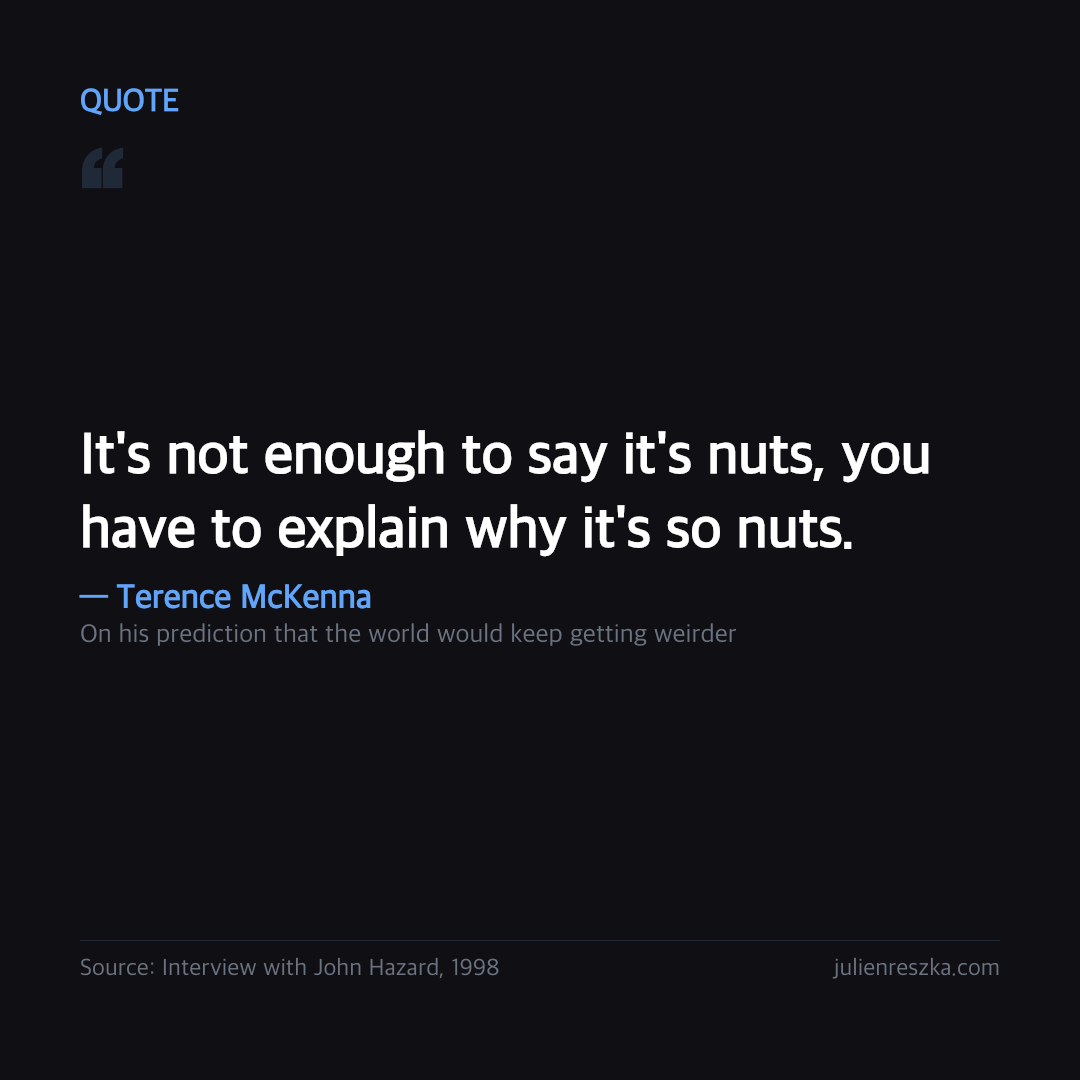
He added that it would get so weird that people would have to talk about how weird it is, and that "eventually people are going to say, 'What the hell is going on?'" That comes close to describing "clown world", two decades before the phrase existed. Then he said the line that matters most for this post: "It's not enough to say it's nuts, you have to explain why it's so nuts."
McKenna is also a cautionary tale, and it would be dishonest to quote him without saying so. In the 1990s, the mathematician Matthew Watkins went through the Timewave calculations and found that the 2012 date was not calculated. It was chosen because it made the curve best fit the historical events McKenna already considered novel. One step of the method, which McKenna called the "half twist", had no stated justification at all. December 2012 came and went. So McKenna named the feeling well, but his own grand explanation for it did not hold. Keep that in mind, because "clown world" is also a grand explanation.
## Why the world feels absurd: what your feed shows you
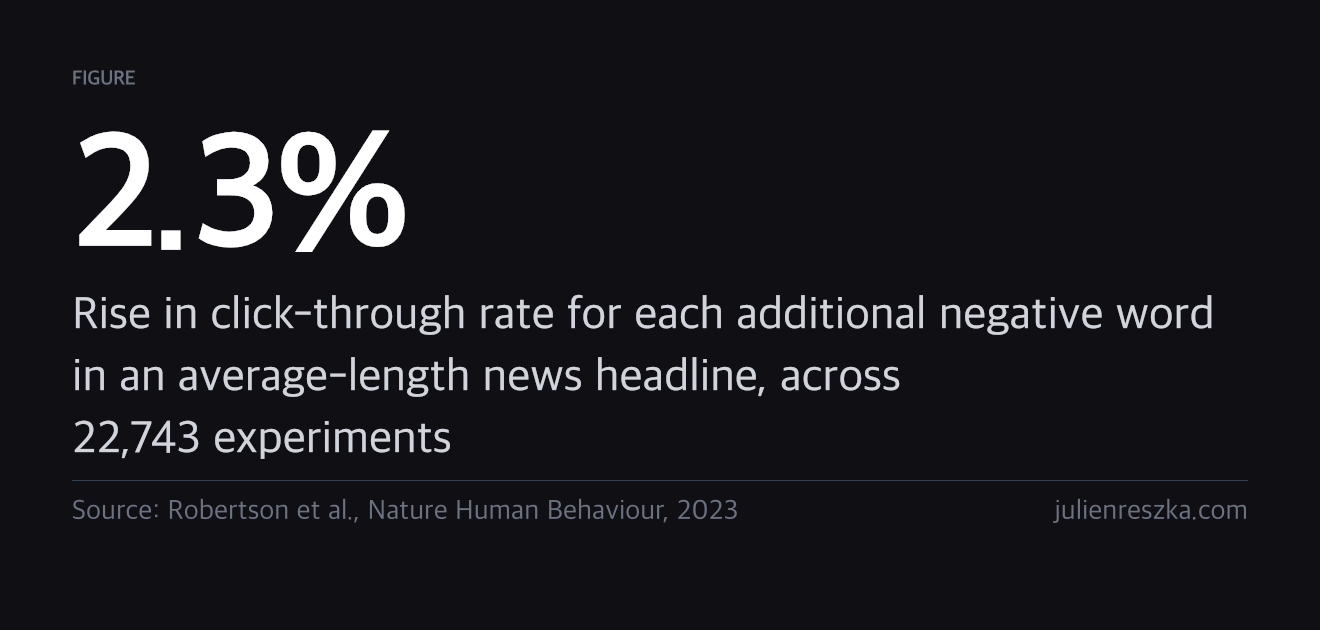
Start with the information diet, since that is where most people meet the absurd. Researchers analyzed 22,743 randomized headline tests run by the news site Upworthy, covering about 105,000 headline versions and 370 million impressions. For a headline of average length, each additional negative word raised the click-through rate by 2.3%. Every outlet and every feed learns from clicks, so over time you are shown a world selected for what upsets you, and absurdity upsets people.
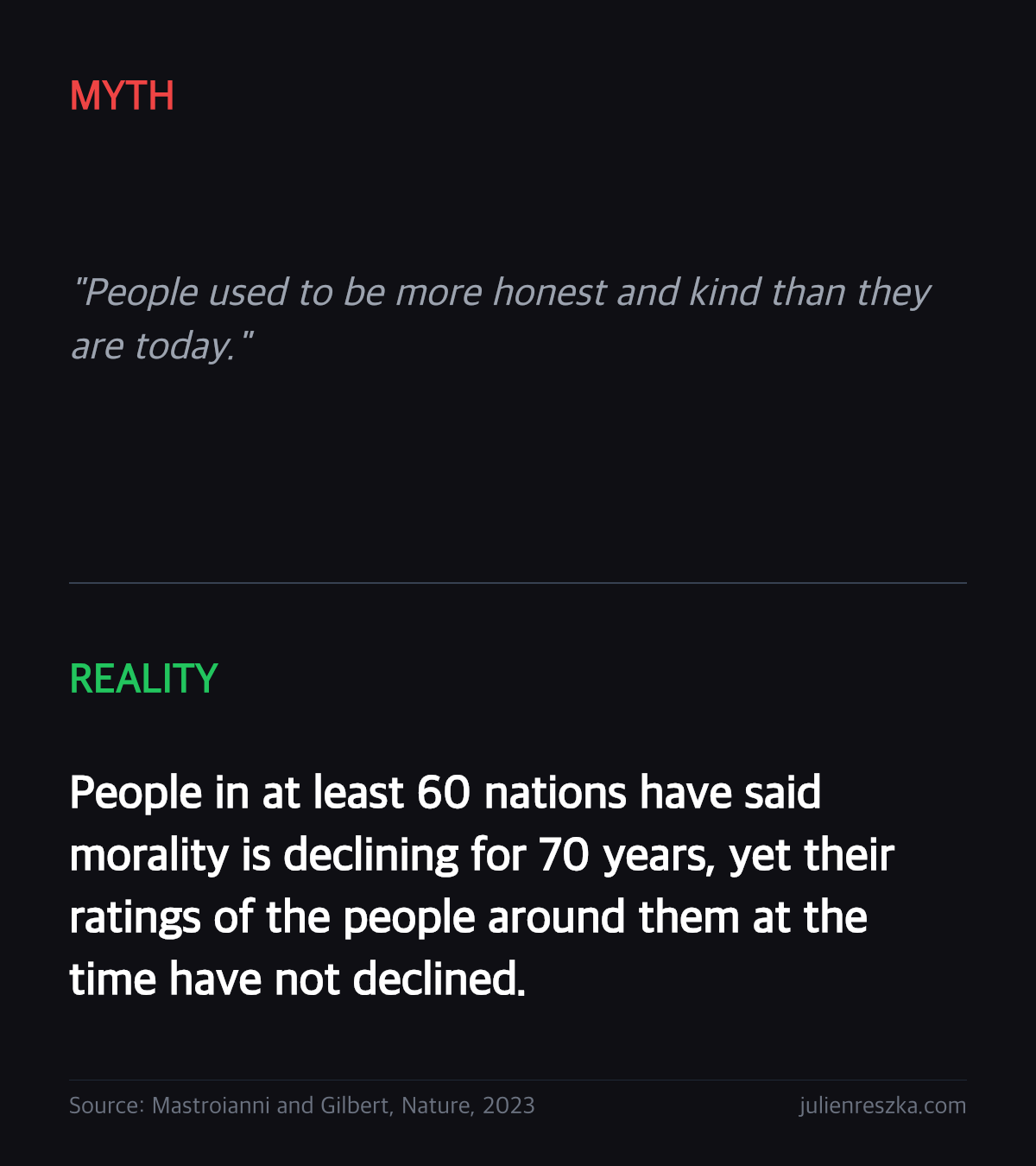
The same selection shapes how we judge other people. In a Nature paper using data from more than 12 million people, Adam Mastroianni and Daniel Gilbert found that people in at least 60 nations believe morality is declining, and have believed it for at least 70 years. Yet in surveys that asked people, year after year, how kind and honest the people around them were, the answers did not get worse over the decades. The authors call the decline an illusion and explain it with two common biases: we are exposed to more negative than positive information about strangers, and our memories of the past soften the bad parts. The present looks like "a moral wasteland" and the past like "a moral wonderland". The illusion weakened, disappeared or even reversed when participants rated people they know well.
That last finding is a good test for the clown world feeling. If the people around you seem mostly decent, and the world on your screen seems mostly insane, at least part of the gap is about what reaches your screen.
## Some of it is real
It would be too easy to say it is all in the feed. Trust in institutions has fallen for real. In Gallup's 2025 survey, an average of 28% of Americans had a great deal or quite a lot of confidence in nine major institutions that Gallup has tracked since 1979. It was the fourth year in a row below 30%, close to the record low of 26% set in 2023. Distrust that high changes how people read everything an institution does. A clumsy decision stops looking like a mistake and starts looking like a joke at your expense.
McKenna's phrase "the level of contradiction" also fits something real. Large systems are full of rules written at different times for different goals, and when they collide in public, the result looks absurd. Usually there is an explanation, such as an incentive, a deadline, the fear of a lawsuit or a metric someone is judged by, but the explanation is rarely in the headline.
A classic example comes from Hanoi in 1902. Fearing plague, the French colonial authorities paid a bounty for every rat tail handed in, and hundreds of thousands of rats seemed to be killed. Within about three months, officials found that people were cutting the tails off live rats and letting them go to breed. Some were farming rats, and others smuggled them in from the countryside, as the historian Michael Vann describes. As a headline, it is pure clown world: a rat control program that bred rats. Once you see the incentive, it makes perfect sense. The city paid for tails, not for fewer rats. Economists call this a perverse incentive. A related idea is Goodhart's law, often summarized as "when a measure becomes a target, it ceases to be a good measure". Much of what looks absurd in large organizations is the same thing: people doing exactly what they are paid or judged for.
Even real absurdity tends to get exaggerated. The anthropologist David Graeber argued that between 20% and 50% of workers have "bullshit jobs" that even they consider pointless. When researchers checked this against the European Working Conditions Survey, with nearly 30,000 respondents in 2015, only 4.8% of EU workers said they did not feel they were doing useful work, and the share was falling, not rising. The frustration Graeber described was real. His estimate of how widespread it was did not hold up.
## What the clown world frame does to you
The trouble with "clown world" as a conclusion is what it does to the person who adopts it. It feels like clear sight: everyone else is fooled, and you see the circus for what it is. Research on cynicism suggests that feeling is often wrong.
In studies on what Olga Stavrova and Daniel Ehlebracht called the cynical genius illusion, people assumed cynics were smarter. But data from about 200,000 people in 30 countries showed that more cynical people generally did worse on tests of cognitive ability and academic competence. The more competent people were cynical selectively, only where their society gave them reason to be. The less competent were cynical about everything. Distrust works when it is aimed. When it covers everything, it is closer to giving up than to insight.
At the far end, the frame turns into wanting the whole thing gone. A study of 12,250 people in the United States, the United Kingdom, Canada and Australia measured what researchers call a "need for chaos": how strongly people agree with statements such as "I think society should be burned to the ground". Between 15% and 19% in each country craved chaos to some degree. Most of them wanted to tear institutions down to rebuild them, but between 3% and 10% leaned toward destruction for its own sake. Earlier research found that this need grows when people feel marginalized by society. "Embrace the honk" is the gentle, ironic version of the same move: if nothing can be fixed, nothing needs to be understood.
None of this means you should stop laughing. In a small study of 156 adults, the people who most enjoyed dark cartoons scored higher on intelligence tests and showed less aggression and a better mood than those who disliked them. It is one correlational study, so read it as a hint, not a rule. Humor about the absurd is a tool for seeing it. The problem starts when the joke replaces the explanation.
## McKenna's better advice
McKenna is often quoted as saying "culture is not your friend". In the 1999 Denver lecture where he made that argument, he said that "any ideological or belief system that offers closure, meaning final answers, is sure to be wrong". He also admitted the cost of thinking this way: "a certain kind of alienation lies at the end of this thought process."
There is a reason closure is so tempting. In one study by Travis Proulx, Steven Heine and Kathleen Vohs, 52 students read either a Kafka parable that makes no sense or an Aesop fable that does. Those who read Kafka then rated their nationality, birth country and first language as more important to who they are, even though neither story had anything to do with identity. Other studies in the same paper found similar effects after absurd comedy and absurd art. These were small studies, and related effects in this field have been hard to replicate, so treat this as a plausible mechanism, not a settled fact. But it fits what we see: when the world stops making sense, people grab whatever framework is nearest, and a tribe or a sweeping story like "clown world" is always nearby.
McKenna's advice runs the other way: question the culture you were handed, its ideologies and its feeds, without buying a ready-made replacement that explains everything. "Clown world" is exactly that kind of replacement. It offers closure: the world is a joke, case closed. His words and his own failed prophecy both warn against that kind of closure. Stay curious about why things are the way they are, and be suspicious of any single story that explains it all, including the one you find most convincing. I am not endorsing the rest of what he advocated, which leaned heavily on psychedelics. The point here is narrower: keep the questions open.
## Ask to what extent, not whether
A simple change of question helps here. "Is it true?" invites a yes or a no, and "clown world" is a yes to a very large claim. A better question is "to what extent is it true?" How often does it happen, to whom, and compared with when? Graeber's bullshit jobs show the difference. "Do pointless jobs exist?" gets a yes. "What share of workers feel their job is not useful?" gets about one in twenty, and falling. Each answer is accurate, but only the second one tells you how worried to be.
This kind of precision is not pedantry. In an analysis of 888,328 geopolitical forecasts from a forecasting tournament, rounding forecasters' numerical probabilities into the vague categories analysts commonly use, words such as "likely" or "unlikely", consistently made the forecasts less accurate. Degrees carry information that yes and no throw away.
## In practice
When something looks like clown world, a few habits help turn the feeling into understanding.
- Ask McKenna's question: why is it nuts? Look for the incentive, the rule, the deadline or the metric that produced it, as with the rat tails in Hanoi.
- Replace "is it true?" with "to what extent is it true?" One absurd story, shown to you because it drew clicks, tells you little about how often it happens.
- Judge society partly by the people you actually know, not only by the strangers your feed selects.
- Keep your distrust aimed. Distrust specific actors with a track record, not everyone at once.
- Laugh, then explain. Notice when the joke has become your conclusion.
- Cut sources that only display absurdity, and keep the ones that explain it.
- Pick one small thing within your reach and fix it. Absurdity feels heaviest when you feel you can do nothing.
## Be the fool, not the clown
In old courts and in plays like King Lear, the fool had a specific job. He was allowed to mock the king, but his jokes pointed at particular nonsense, and they often carried the truth nobody else dared to say. The fool laughed in order to show something. The clown of the meme laughs in order to stop looking.
The world may well keep getting weirder, as McKenna said. That is a reason to get better at explaining it, not a reason to stop trying.
Discussion