 Julien Reszka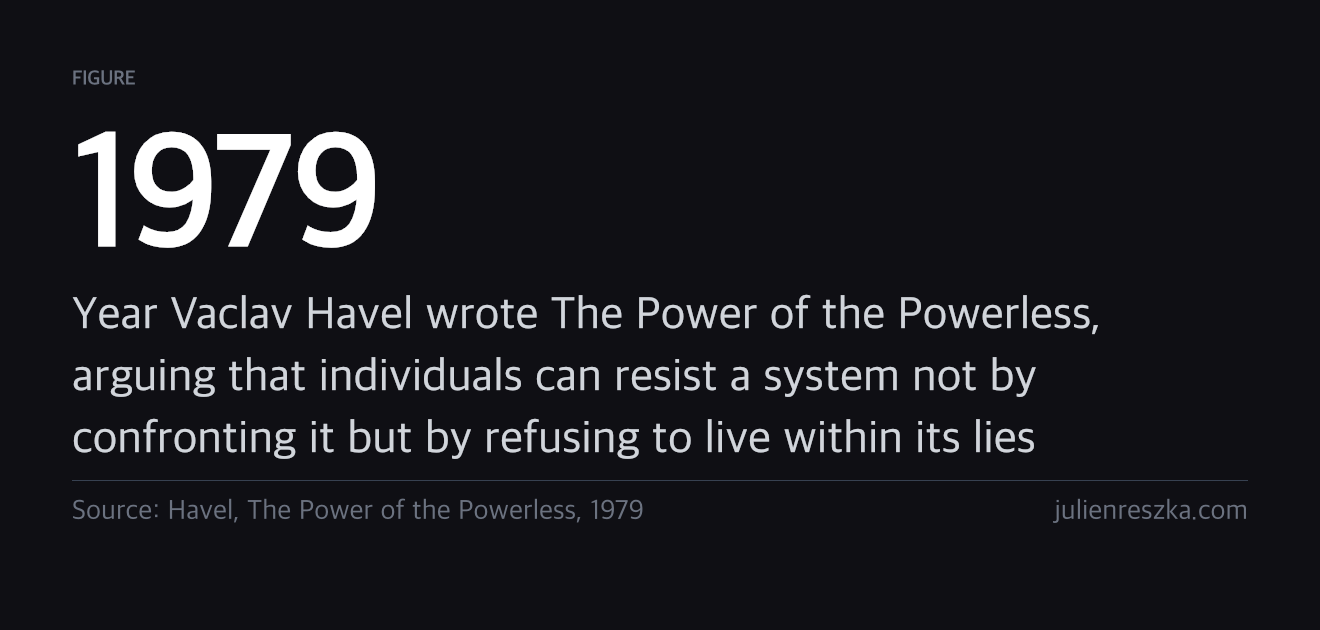
A year in and I keep coming back to the same observation: the people around me have stopped expecting normal things.
Not the virus. The virus is real. I am not talking about whether the restrictions were justified. I am talking about what happens to a person when the expectations of daily life shift so completely that they stop noticing what they have given up.
People stopped making plans. Stopped expecting to see their friends. Stopped expecting to work in the same room as their colleagues, to eat in a restaurant without guilt, to travel without a calculation of whether it was essential enough. People wore facemasks in public swimming pools. After a few months, the absence of these things stopped feeling like a loss and started feeling like how things simply are.
That is the part that worries me.
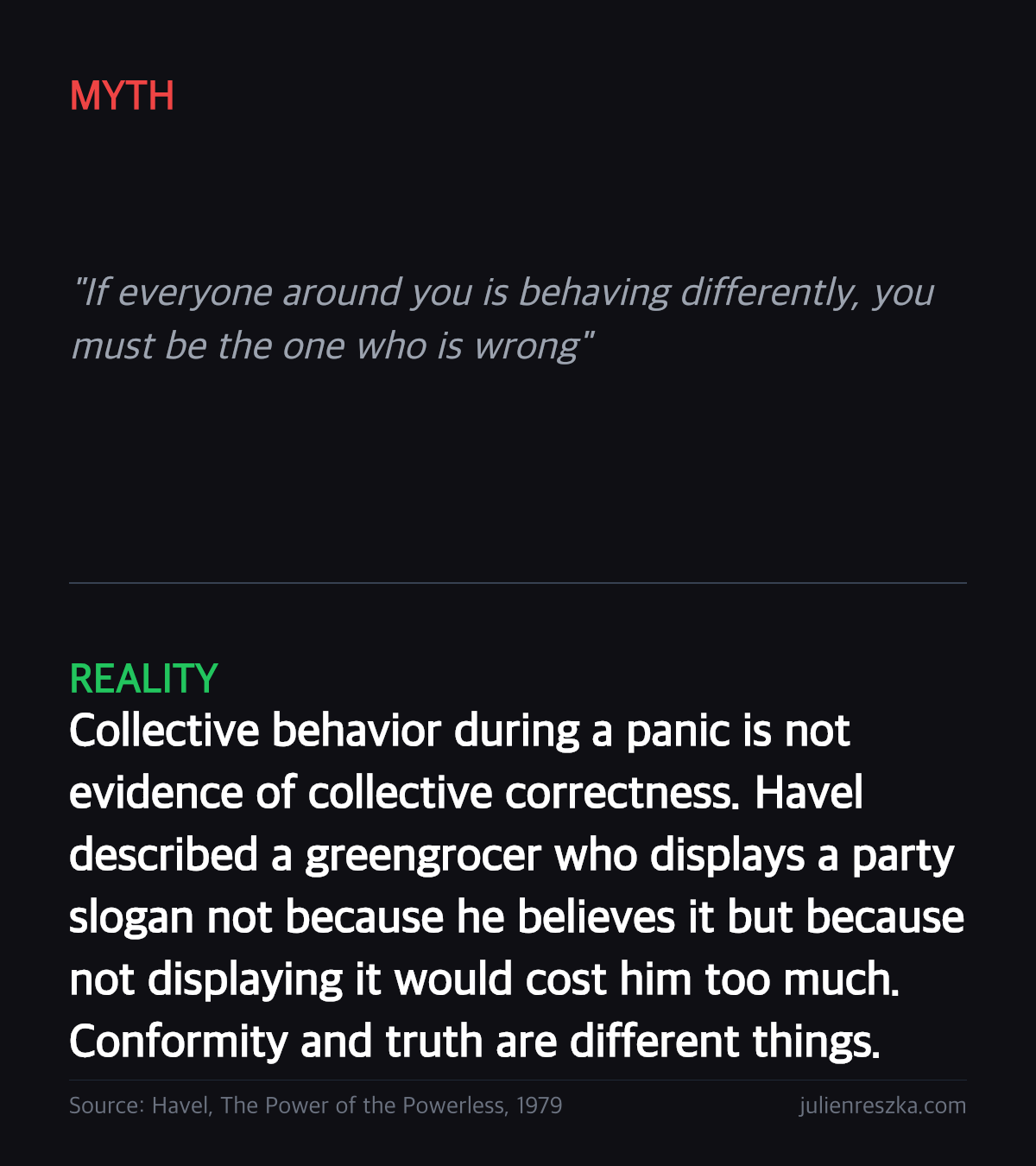
When everyone around you is behaving in a certain way, the social cost of not behaving that way rises fast. You do not have to believe the behavior is correct. You just have to not want to pay the cost of being the person who is still acting normally. So you stop acting normally too. And then normal becomes something you can barely remember having expected.
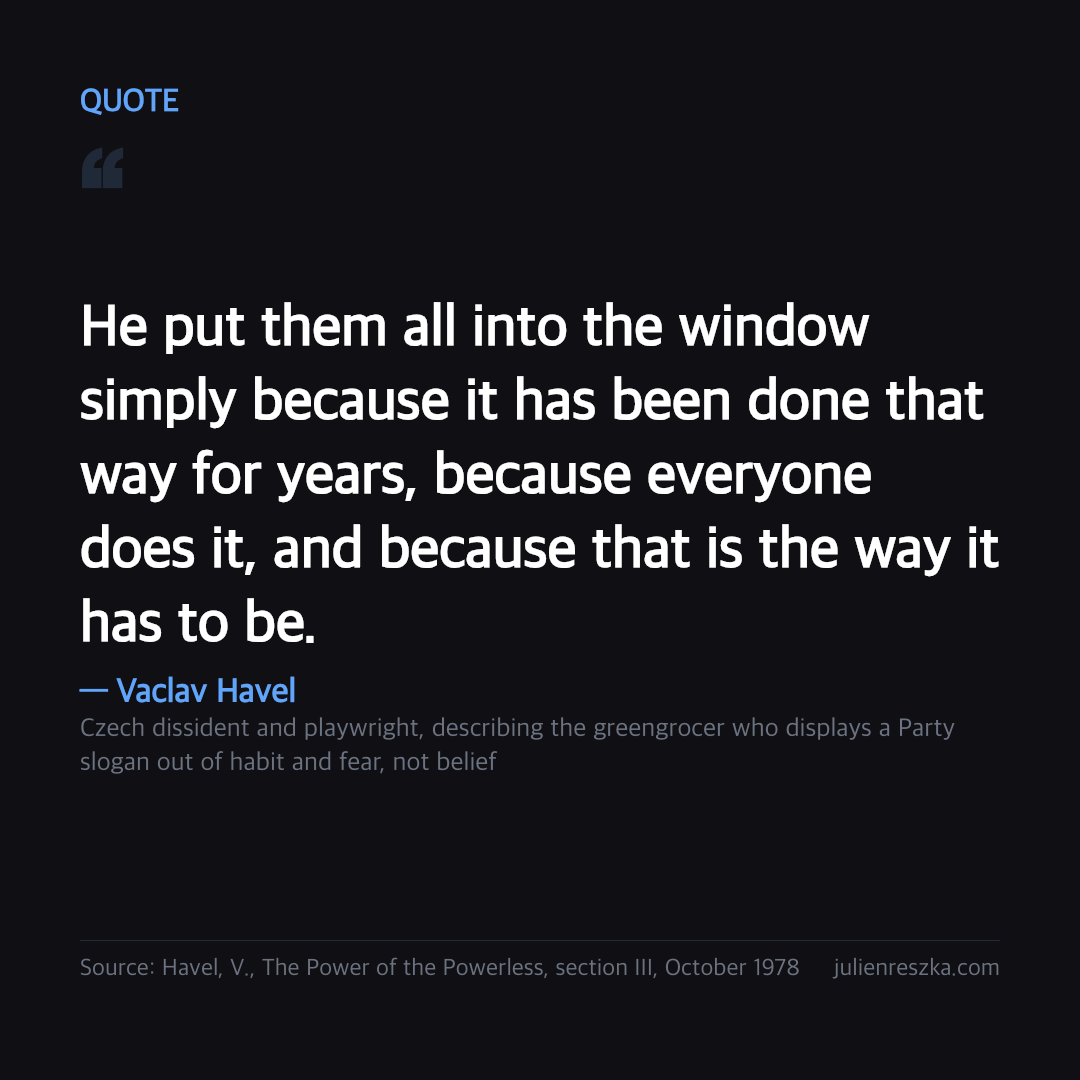
Vaclav Havel described this mechanism in 1979 in The Power of the Powerless. He was writing about life under communist Czechoslovakia, but the structure is the same. His greengrocer puts up a slogan in the shop window not because he believes it but because not putting it up would mark him as different, would cost him something. The ideology is not primarily transmitted by persuasion. It is transmitted by the accumulated cost of non-compliance.
What I find useful in Havel is that his response is not confrontation. It is living in truth. Just continuing to behave as if the normal things are still worth expecting:
- Keep making plans, even when they fall through
- Keep expecting to see people in person
- Keep applying the same standards to arguments you applied before the crisis
This is not denial. It is the refusal to let a temporary emergency become a permanent baseline.
The video below is a year of COVID media in ten minutes.
What made this harder was that the fear was not purely organic. In March 2020 the UK government's behavioural science group SPI-B recommended increasing the perceived level of personal threat via hard-hitting emotional messaging. Governments spent over a billion dollars on pro-compliance campaigns. In April 2021 the New York Times reported that EU Commission President Ursula von der Leyen had exchanged personal text messages with Pfizer CEO Albert Bourla to negotiate the EU vaccine deal. The messages were never produced. The EU ombudsman found the Commission's refusal to disclose them constituted maladministration. Media had its own incentives: fear-driven stories produce clicks, and pharma was already the largest TV advertiser before 2020.
Discussion