 Julien Reszka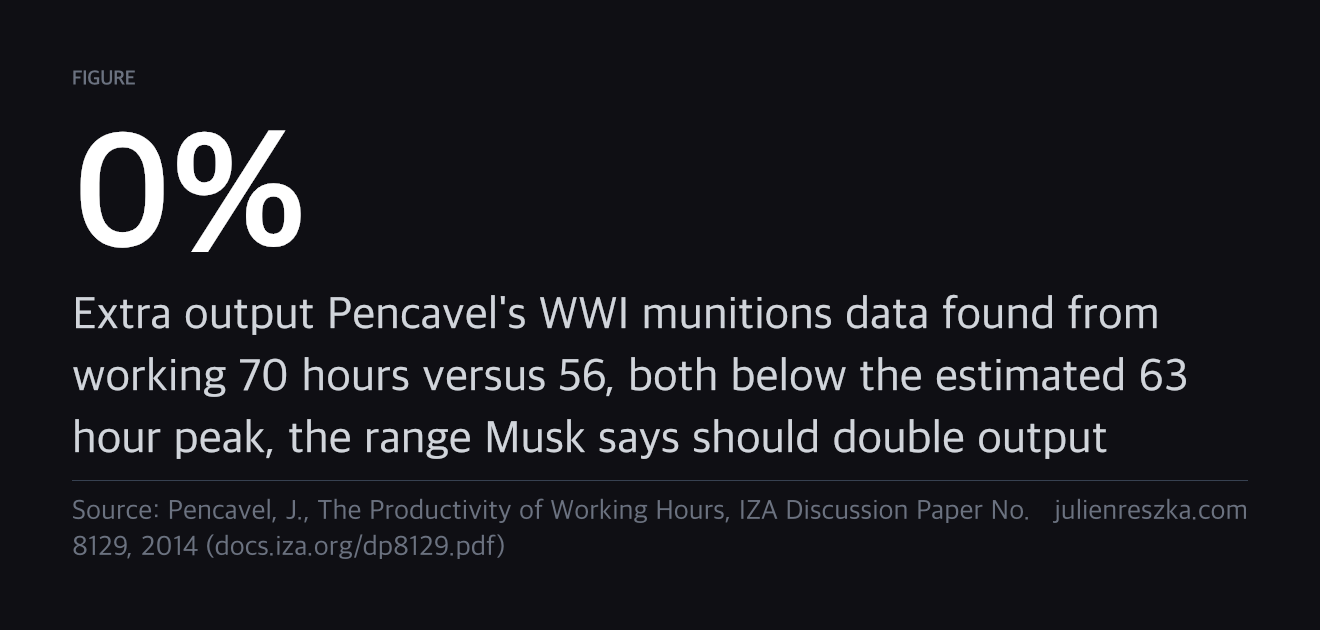
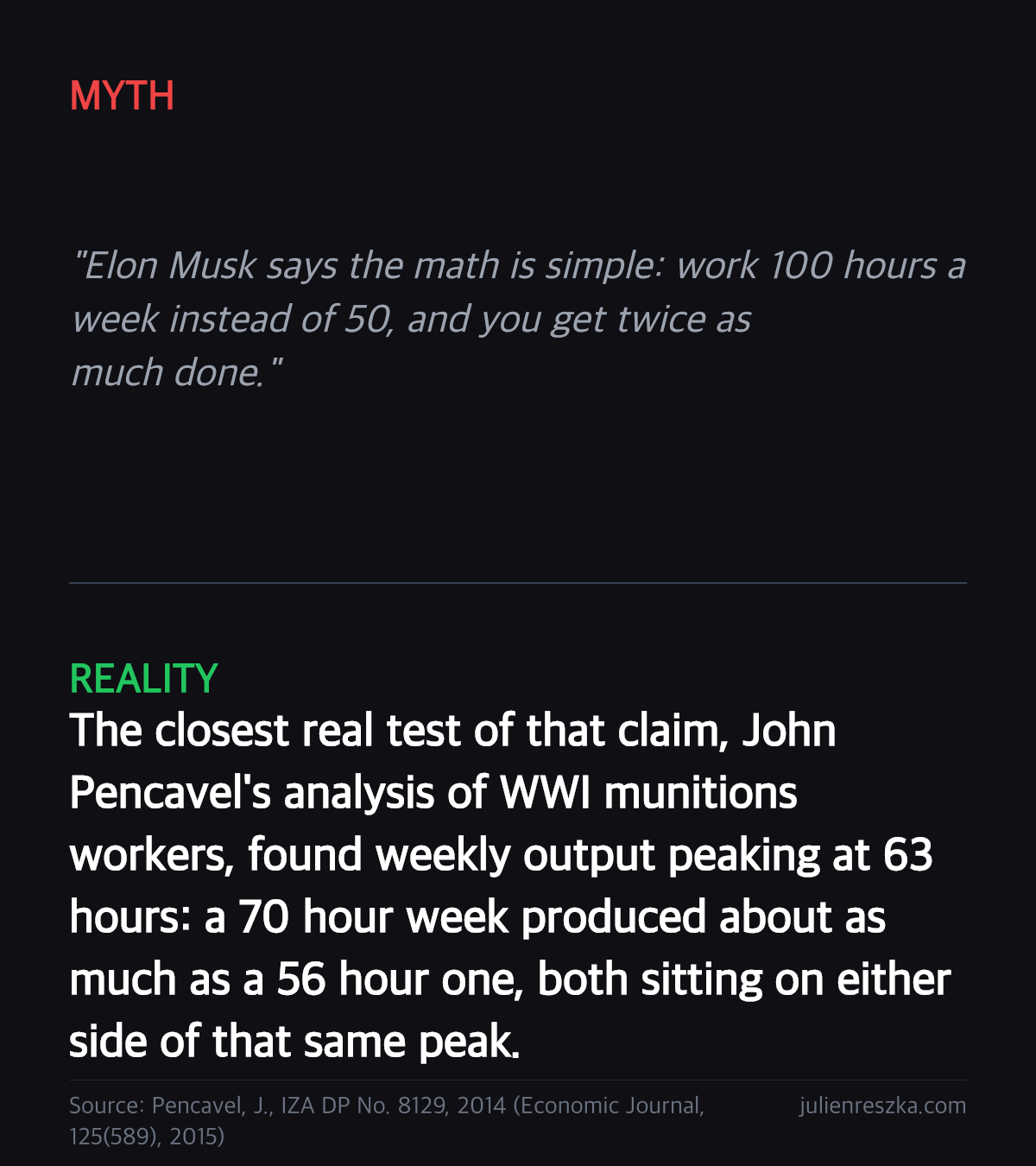
Elon Musk has said some version of this for over a decade: work 80 to 100 hours a week or do not expect to change the world. He has told graduates that working 100 hours instead of 50 gets a company twice as much done in a year, calling it simple math. In 2018 he posted that nobody ever changed the world on 40 hours a week, and told a follower that 80 hours was sustainable, with peaks above 100.
Musk has also described what those hours cost him. During the Tesla Model 3 production crunch, he told the New York Times he was working up to 120 hours some weeks, sleeping at the factory, and that it hurt his brain and his heart. No one should work these hours, he said. Not long after, he was back to recommending 80 hours as the floor for changing the world.
The closest thing to a controlled test of the actual claim is not a founder's schedule, it is a dataset of British munitions workers, mostly women, that economist John Pencavel analyzed in a 2014 IZA working paper. Weekly output rose roughly in proportion to hours up to 49 a week. Past that point it kept rising, but at a decreasing rate, reaching its estimated maximum at 63 hours. A 70 hour week produced about as much as a 56 hour one, both sitting on either side of that same peak, and Pencavel's own data never extended past 72.5 hours, so anything beyond that is extrapolation, not observation. The math Musk calls simple does not hold in the one dataset built to test it.
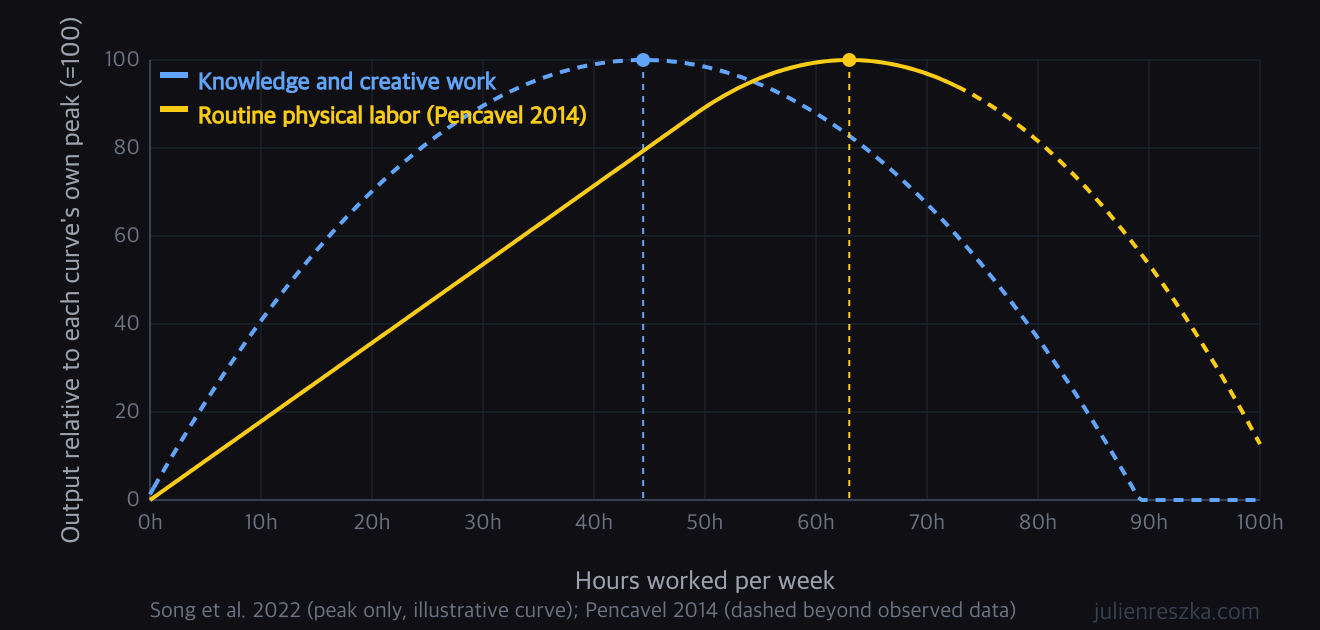
That pattern is not one dataset. A 2022 meta-analysis of 42 studies covering nearly 23,000 workers found the same inverted U shape: task performance peaked at about 44 hours a week, and contextual performance, the collaboration and effort that keeps a team running, peaked at about 48. Past those points, both declined.
The underlying studies only measured average hours up to about 65 a week, so the knowledge work curve above carries the same caveat as Pencavel's: solid within the range anyone measured, illustrative beyond it. The same analysis found something more specific too: hours hurt task performance significantly more in knowledge-intensive industries than in labor-intensive ones, exactly the gap the chart is drawing.
Three factors explain why the extra hours stop paying off:
- Fatigue compounds overnight, one study found: longer workdays raise same day output but reduce next day performance through worse sleep
- Knowledge and creative work show steeper drop-offs than routine physical labor, because focus and judgment degrade faster than repetitive motion does
- Work expands to fill the time available, a pattern known as Parkinson's Law, so extra hours often stretch the same task instead of adding new output
This is all measured on average, and averages can hide outliers, so it is fair to ask whether some people are simply built to sustain more. Pencavel's data offers a partial answer, and a weaker one than it first looks: in his cross-section of 43 individual women, most worked under 45 hours a week, and no clear decline showed up even out to their observed maximum of 63 hours. But most of those hours already sat inside the range where Pencavel's own aggregated data also finds no decline, so this subsample barely tests the region that would reveal one. The meta-analysis found real heterogeneity elsewhere: age, gender, country, and industry all shift how fast performance turns down. But none of those shifts, in either dataset, ever found a group whose performance kept climbing past 80 or 100 hours. Sleep research adds a real mechanism: about a third of healthy adults show trait-like resilience to sleep loss, barely declining under restriction, while a third decline sharply. That describes resilience to lost sleep, not an hours-output curve, so it does not rescue the 80 to 100 hour range.
A UK trial tested the opposite move directly. In 2022, 61 companies and about 2,900 workers cut hours by 20 percent and kept the pay the same. Revenue rose slightly during the trial and by 35 percent compared with the same period the year before. Staff leaving dropped 57 percent, and more than 90 percent of the companies kept the shorter week once the trial ended.
None of this means intensity never matters. Early stage founders describe real stretches of extreme hours, and Musk's own account of sleeping at the Tesla factory during a genuine production crisis is one of them. The research says the same thing about those stretches that it says about everything else: they work as short bursts, and they stop working as a way of life.
OECD workers average about 1,736 hours a year, roughly 33 hours a week once part time work and holidays are counted in, comfortably inside the range every study here calls productive. The 80 to 100 hour week Musk recommends sits in the range his own body already told him to leave.

Discussion