 Julien Reszka
You remember them. The one who made the whole table laugh, who suggested the stupid plan at midnight and meant it. Now they say they are fine, answer in short sentences, and do not laugh at the things that used to make them cry laughing. They do not even seem sad, exactly. They seem absent. Cheering them up has not worked, and you are starting to wonder where the person you knew went.
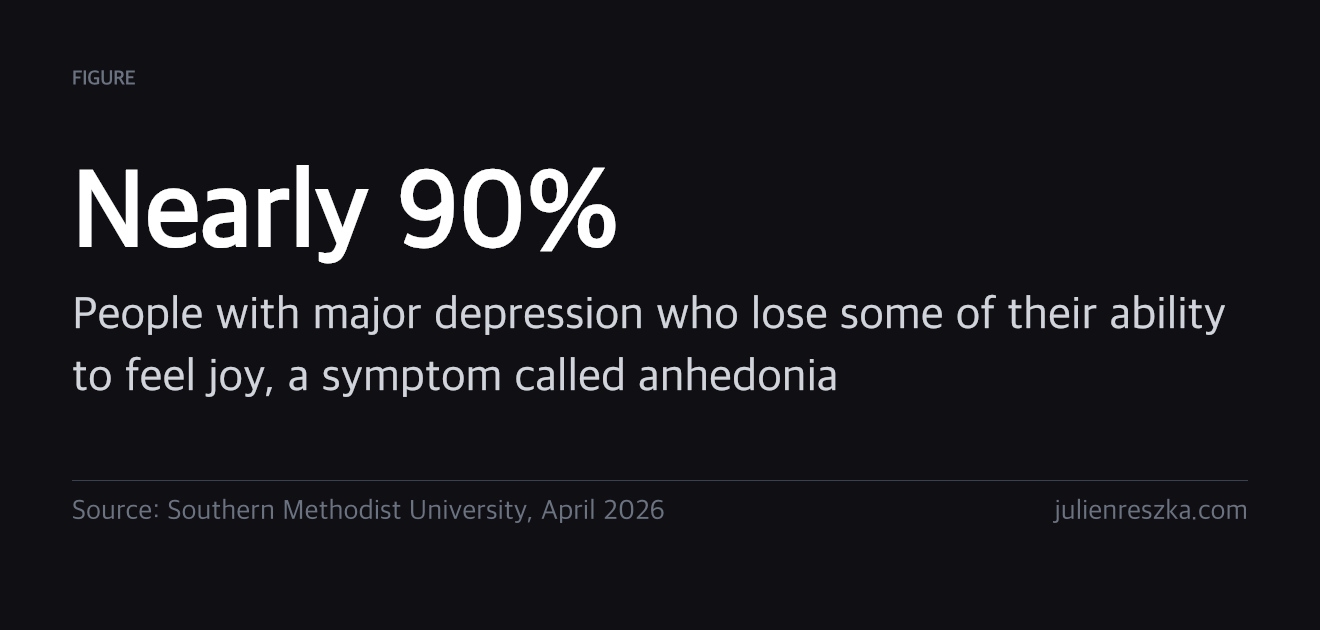
Absent is a good description. We think of depression as too much sadness, but one of its biggest losses is the ability to feel good. This loss, called anhedonia, affects nearly 90 percent of people with major depression. A review of 19 laboratory studies found that people with major depression reacted less to both good and bad material, with the bigger drop on the good side. Yet in daily life, people with depression report more negative mood, and rate ordinary events as more unpleasant and more stressful. So what you are seeing is real and contradictory: nothing is funny, and small problems feel heavy.
One clue is what they stop following: the news they used to argue about at dinner, the team, the series, the group chat. Loss of interest in things they used to enjoy is a recognized symptom of depression. Skipping the news proves nothing by itself, since about four in ten people avoid it at least sometimes, and a break can be a healthy choice. The sign is the pattern: they stopped caring about several things they used to follow, nothing replaced them, and it has lasted for weeks.
For some people, the road there starts with caring. Psychologists Erin Tone and Erin Tully describe empathy as a risky strength: at extreme levels, and combined with certain traits or situations, it may raise the risk of depression and anxiety. The fun friend is often the one everybody brings their pain to. Olga Klimecki, Tania Singer and colleagues showed a version of this in the lab: training people in empathy increased their negative feelings when they watched others suffer. Later training in compassion reversed that increase and raised positive feelings. This is one route into depression, not the only one. Genes, illness, loss, poor sleep and long stress all play a part, and sometimes nobody can point to a cause.
The numbness can also look like protection. If you absorb pain you cannot fix, feeling less is one way out. Nobody has shown that this is what depression does, so treat it as a useful way of seeing them rather than a diagnosis. Randolph Nesse, an evolutionary psychiatrist, has argued that low mood can help people let go of unreachable goals, but ordinary low mood is not the same as clinical depression. Even if the shutdown once helped, the armor does not choose what it blocks. It keeps out the joy along with the pain.
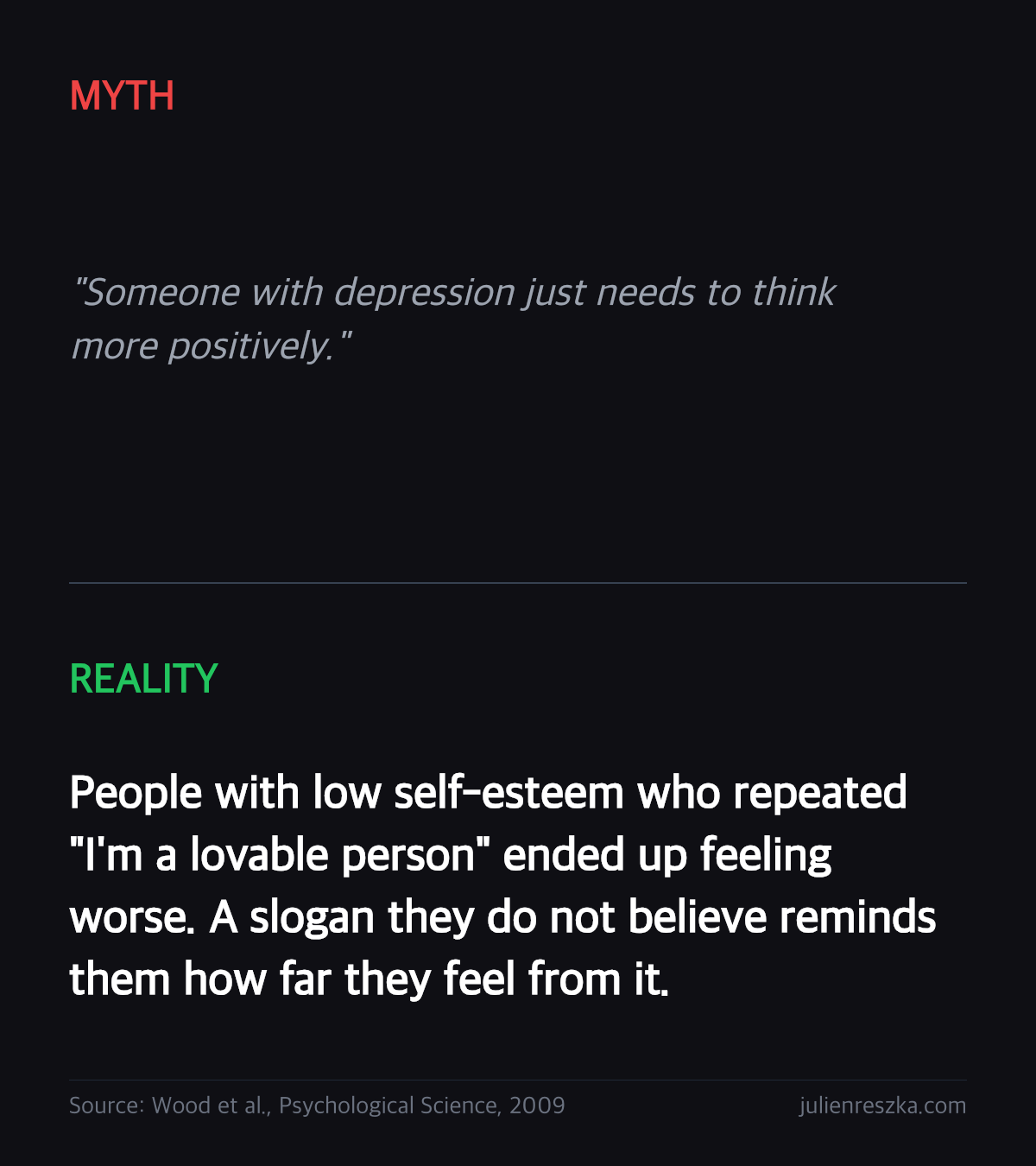
So do not start with positive thinking. In a 2009 experiment, Joanne Wood and colleagues had people repeat "I'm a lovable person." Those with low self-esteem ended up feeling worse than those who did not. A statement you do not believe reminds you how far you feel from it. "Look on the bright side" and "you have so much to be grateful for" can land the same way. So can "you used to be so fun," which tells them the old version was the one you liked.
They do need to come back into contact with good things, but as experiences rather than slogans. Positive Affect Treatment does this on purpose, with exercises that re-engage people with rewarding activities, redirect their attention to positive experiences and practice savoring them. In a trial of 98 adults with severe anhedonia, depression and anxiety, it beat a conventional therapy aimed at negative feelings, and people improved on negative measures too, even though the treatment never targeted them.
There is a hopeful detail here. In the same daily life study, people with depression got a larger drop in negative mood after positive events than people without it. Researchers call this mood brightening. A good moment may be harder to reach, but when it arrives it can count for more than you would guess.
The practical trick is to stop waiting for them to feel like it. Behavioural activation is built on doing first and feeling later. In the COBRA trial of 440 adults, it was no less effective after a year than cognitive behavioural therapy, even though junior mental health workers delivered it. Movement can help too: a review of 218 trials found moderate reductions in depression from walking or jogging, though the authors rated their confidence in that evidence as low.
Here is what that can look like from a friend or partner:
- Make specific, small invitations: a twenty minute walk on Saturday at ten, not "let me know if you need anything"
- If they say no, ask again next week, without guilt or a speech
- Bring back an old ritual: the terrible films, the same cafe, the game you always played
- Afterward, ask what the best part was, even a tiny one, and let them stay on it for a moment
- Tell a specific funny story you shared, rather than telling them to cheer up
- Take one piled up chore off their hands, so there is energy left for something else
- Stop bringing them your crises for a while, and ask others to do the same
If caring too much was part of how they got here, they do not have to stop caring. The Klimecki and Singer work suggests the goal is to move from feeling the other person's pain to wanting good things for them, which is much easier to sustain. In practice, that can mean fewer hours as everyone's listener, less time with the feed that keeps delivering suffering they cannot affect, and permission to enjoy something while other people are still having a hard time.
Taking things less seriously usually comes back late, and you cannot order it. "Lighten up" tells someone their pain is not real. What you can do is keep some lightness in the room: laugh at yourself, be silly, and do not check whether they joined in. A meta-analysis of humor styles found that healthy styles of humor go with better mental health. That link does not show that jokes cure anything, and the style matters. A joke that makes a hard situation easier to carry is a good sign. A joke that always makes them the target, like "I'm useless, ha," is worth taking seriously.
Be ready for what can come after the numbness, because it is not always joy. Especially in men, it can be anger. Depression in men often shows up this way already: in a large US survey, men reported more anger attacks and aggression than women, along with more substance abuse and risk taking. No study I could find tracks anger surfacing as numbness lifts, so treat this as a pattern people describe, not a rule. But it makes sense. Feeling comes back, the pain has to go somewhere, and they go looking for someone to blame. The obvious targets are often the people who gave up on them when they were down. Some of that blame may be fair. If you were one of those people, say what you did without defending it, and do not argue about whether they should be angry. You do not have to accept threats or abuse, and you can step back if it gets there. But someone who is angry is, at least, no longer absent.
If you are the one who feels this way, most of this applies to you too, just start smaller. And two things are yours to do.
First, change your environment, because you may not be able to think your way out of the one you are in. If you have become the listener for everyone in pain, step back from that role. Places matter more than we like to admit. In the Moving to Opportunity experiment, US families in public housing were randomly offered the chance to move to lower poverty neighborhoods, and the adults ended up with lower rates of psychological distress and major depression. You do not have to start by moving. In a study of healthy people, a 90 minute walk in nature reduced rumination, while the same walk in a city did not. In a small study of 20 young adults with major depression, a nature walk improved attention and working memory more than a city walk. Start with a different route, a few days somewhere else or a different feed.
Second, warn people that this is not the normal you. From the outside, depression can look like coldness. You stop replying, you seem bored by them, and they conclude that you changed or stopped caring. Some of them will give up on you, and a short warning might prevent that. No study I could find tests this directly, but it costs little. You could say something like:
- "I am going through a bad stretch. If I seem cold, it is not about you, and it is not the normal me."
- "Keep inviting me, even if I say no."
- "I do not need solutions right now. I just need you to stay in touch."
Choose who hears it. In interviews with people about depression, some messages from family and friends left them feeling labeled, judged, lectured to and rejected. Start with one or two people you trust, and tell them what helps.
To protect yourself before it starts, avoid being too empathetic, in one specific sense. The aim is to absorb less, not to care less. Erin Tully and colleagues found that both very high and very low cognitive empathy went with more depression, and that poor emotional regulation came with more depression especially when empathy was moderate to high. Feeling nothing for anyone is no protection. Feeling everything for everyone is not either. What you want is the difference the Klimecki and Singer work points to: wanting good things for someone without taking on their pain as your own. In practice:
- Notice when their pain has started to feel like yours, and step back until it settles
- Ask what they need, rather than carrying it for them. You are not responsible for fixing it
- Limit how many people you hold up at once, and say no before you run out
- Cut back on people and feeds that only bring suffering you can do nothing about
- Protect what makes you laugh, especially when someone near you is suffering
The same care applies to your own pain. Do not hide it, but do not expect talking alone to fix it. In experiments by Emmanuelle Zech and Bernard Rimé, people who talked about an upsetting event recovered no better than people who did not, even though they felt it had helped. Later work found recovery only when the listener helped people rethink what happened, while plain support brought closeness and temporary relief. Rehashing has a cost too: in a study of 813 children and teens, going over problems with friends improved friendships but predicted more depression and anxiety in girls. So does silence: students who suppressed their emotions when starting college ended up with less social support and less closeness. So tell one or two people, briefly, and choose someone who helps you see it differently rather than someone who only agrees with you. When the same story comes around again, stop telling it and do something.
A small circle makes all of this riskier. With few close friends, one person's crisis can take over your life, and when you go down, there is hardly anyone left to notice. A review of recent long term studies found that in 5 of 8 reports, a smaller social network predicted depressive symptoms or disorder later. The link is not clean: feeling lonely can matter regardless of how many people you know, and depression can shrink a circle as well as result from a small one. Still, it is worth having more than one or two people you can call, and building that before you need them.
Men are especially exposed. In a 2021 US survey, 15 percent of men said they had no close friends, up from 3 percent in 1990. That can leave one person to lean on: a girlfriend or a wife. And some men would rather break up than lean on her. Needing her feels like failing, so they go quiet, pull away and sometimes end it, telling themselves she is better off. I could not find a study that measures how often this happens, so take it as a pattern, not a statistic. The closest research is from John Oliffe's team, who interviewed 47 men about their breakups and found that they tended to downplay problems in the relationship, which fractured it further. If your partner is pulling away and saying you deserve better, it may be the depression talking rather than a verdict on you. If you are that man, relying on someone is not failing. Tell her what is going on before you decide what it means.
If you are worried for their safety, ask directly whether they have thought about suicide. It feels dangerous, but a review of 13 studies found none showing that asking significantly increased suicidal thoughts. If they are in immediate danger, stay with them and call emergency services. In the US you can call or text 988, and most countries have a similar crisis line. If you are the one having those thoughts, this applies to you too: tell someone today.
If you are the one helping, look after yourself too, because you are now standing next to the same risk. You cannot pull someone out by absorbing their pain too. Keep showing up with something small and good, stay steady enough that they can borrow some of it, and let others share the load. If the laugh comes back, try not to make a big deal of it. Just laugh with them.
Discussion