 Julien Reszka
For ten years, keepers at Hong Kong's Ocean Park tried to get two giant pandas, Ying Ying and Le Le, to mate. In April 2020, with the whole park closed to visitors because of the pandemic, they finally did. The park itself treats an audience as a problem: in other breeding seasons it closed the panda exhibit to minimize noise and disturbance. A four year study of captive pandas found that sustained noise raised their stress hormones, most of all during the female's fertile period. The pair went on to have twins in 2024, so being watched did not make it impossible. It made it harder.
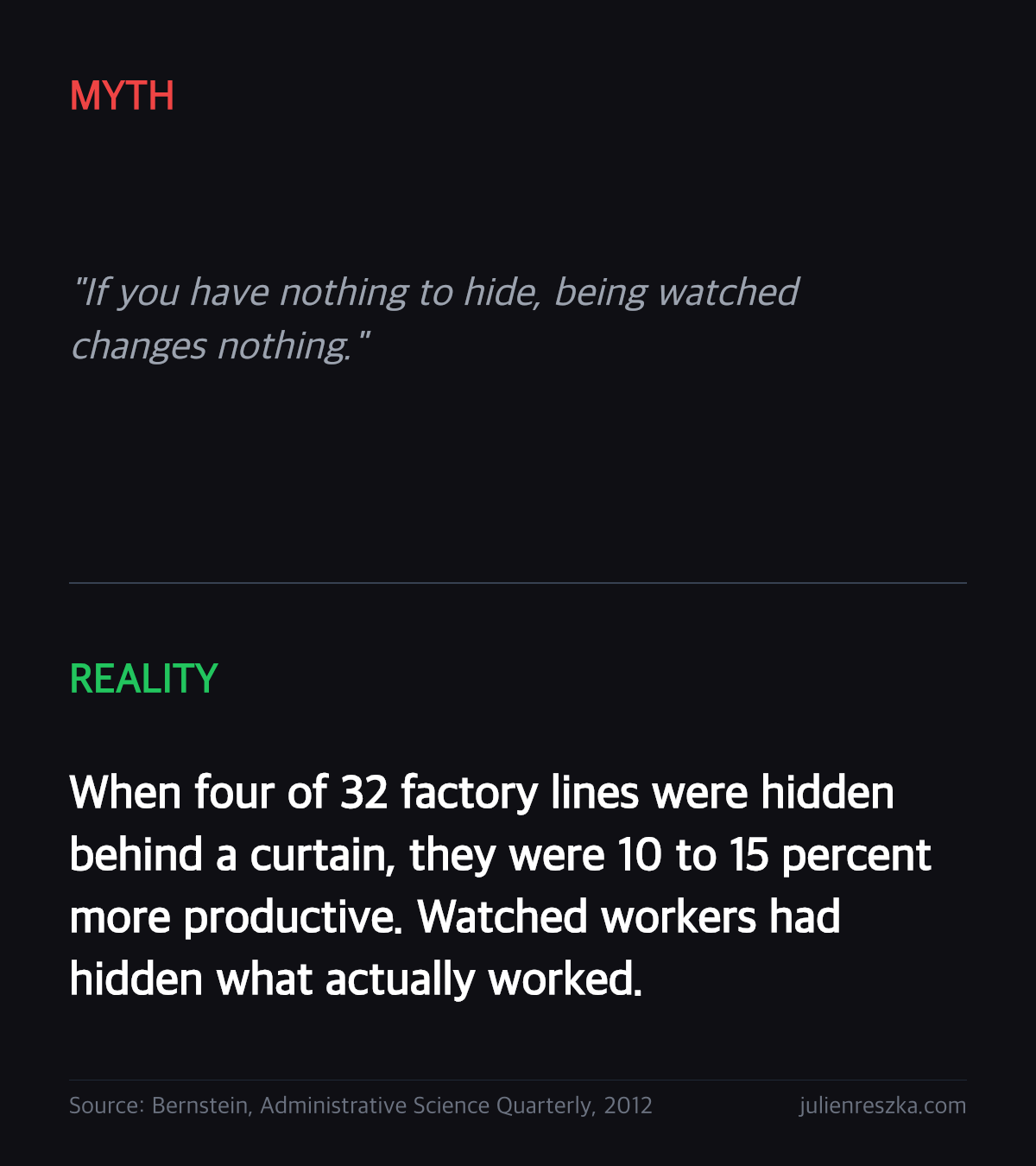
People show the same pattern, and the evidence is better. Harvard researcher Ethan Bernstein had a phone factory hang a curtain around four of its 32 production lines. Hidden from supervisors, those lines were 10 to 15 percent more productive for five months. Under observation, workers had followed the official script and hidden the improvised fixes that actually worked. He called it the transparency paradox.
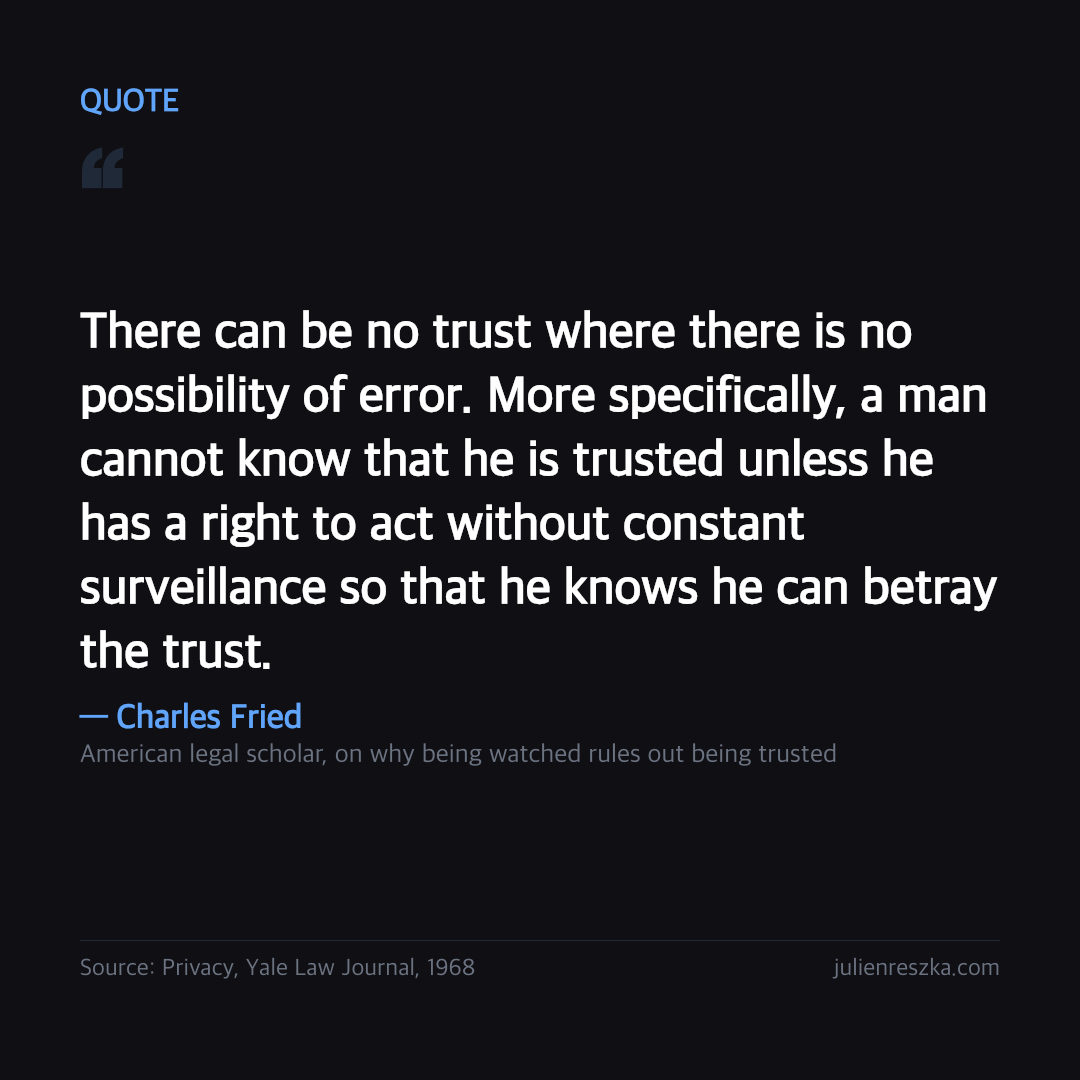
There is no intimacy without privacy. The legal scholar Charles Fried made this case in 1968: privacy does not merely help love, friendship and trust, it is the necessary atmosphere for them, as oxygen is for combustion. Privacy is where people try things, admit mistakes and work things out together. Take it away and two things follow: people stop trusting each other, and they lose the skill of building a shared reality with someone in private. We are taking it away from every direction, and the clearest example is HR.
A breakup now comes with an exit interview. Young singles are auditing their situationships in business jargon and asking their ex for areas of improvement. At the office, couples sign love contracts declaring their relationship consensual and promising to tell HR when it ends. Our private lives now run on the vocabulary of a compliance department. HR is a recent invention, it has failed at its own job, and it should be abolished.
HR feels permanent, but it is barely a century old. The first personnel department is usually credited to the National Cash Register Company, set up in the early 1900s after a wave of strikes to handle grievances, firings and safety. The urge to oversee the whole worker came fast. In 1914, Ford's Sociological Department sent investigators into employees' homes to check they were sober, thrifty and clean enough for the five dollar day. The Nazis took the idea furthest. Through the German Labour Front and its Strength through Joy leisure organization, Robert Ley tried to take total control over people's lives; in his own words, people should have a private life only when they were asleep.
The lineage did not stop in 1945. Historian Johann Chapoutot documents in Free to Obey how Reinhard Höhn, a former SS officer, founded a business school in Bad Harzburg in 1956 that trained a large part of West Germany's business elite in his method of delegated responsibility: staff are free to choose how they reach a goal, never whether to pursue it. Personnel departments predate the Nazis, but they share the instinct to manage the whole person, not just the work.
HR has also failed at its own job. In 2016, the US government's own task force on workplace harassment found that roughly three out of four people who experienced harassment never even told a supervisor or manager. They feared disbelief, blame and retaliation, and the fear was well founded: one study it cites found that 75 percent of employees who spoke out against mistreatment faced some form of retaliation. A process that people are too afraid to use does not protect them. It protects the company from lawsuits, not you.
And it has made people wary of each other. In the How Couples Meet and Stay Together survey, 19 percent of heterosexual couples who met in 1995 met through or as coworkers; by 2017 it was 11 percent. Dating apps explain part of the drop, but fear plays a role too: in a 2019 LeanIn.Org and SurveyMonkey survey, 60 percent of male managers said they were uncomfortable mentoring, working alone or socializing with a woman. The share of US men aged 18 to 24 who reported no sex in the past year rose from 18.9 to 30.9 percent between 2000 and 2018, and among all 18 to 29 year olds it doubled between 2010 and 2024. Phones, porn and money play a part, and no survey isolates HR's share. But a culture that treats every approach as a potential complaint should not be surprised when fewer people approach.
HR is only one tower in a much bigger prison. Jeremy Bentham designed the panopticon so that inmates could be watched at any moment without knowing when, until they policed themselves. We built one without walls. Employers watch: eight of the ten largest private employers in the US track productivity metrics for their workers, often in real time. The state watches: after Edward Snowden revealed mass surveillance in 2013, visits to Wikipedia entries about terrorist groups fell by as much as 30 percent, as people stopped reading what they feared being seen reading. And social media turned everyone into a guard: any remark can be screenshotted, stripped of context and judged by strangers years later. In a 2020 Cato poll, 62 percent of Americans said they had political views they were afraid to share. The watching reaches the bedroom too: 34 percent of partnered adults say they have looked through their partner's phone without that person knowing.
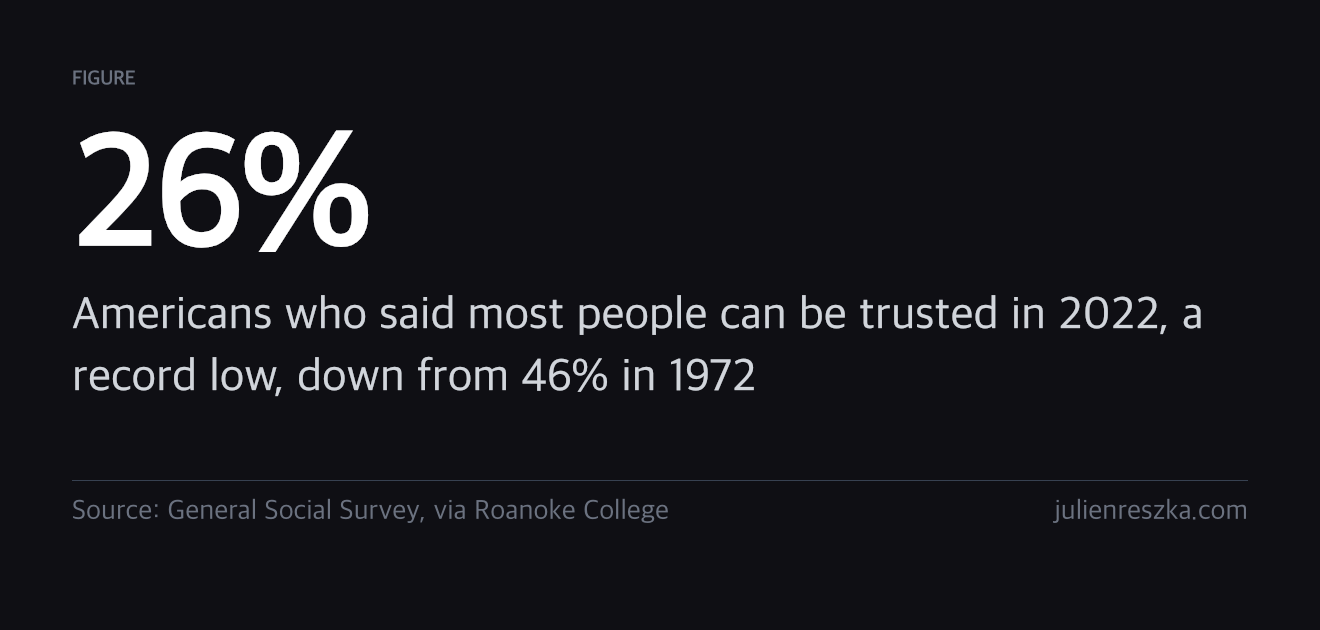
The result is a society of distrust. Every rule, tracker and file assumes the worst about the person on the other side, and people learn to assume the worst back. In the General Social Survey, the share of Americans who say most people can be trusted fell from 46 percent in 1972 to a record low of 26 percent in 2022. Surveillance does not create trust. It replaces it. People who feel watched perform for the watcher, like Bernstein's factory workers, instead of talking to each other.
Relationships are private matters. Yet the HR habit has followed people home:
- Breakups run like offboarding, with exit interviews and feedback for the next role
- Ordinary flaws reported as red flags, as if your partner had violated a policy
- Arguments ended by invoking a boundary instead of talking it through
When a couple gets stuck, couple therapy is often the next stop, and it can work less like a repair shop than an intake desk for divorce lawyers. The historian Christopher Lasch saw it coming in 1977, describing the "helping professions", therapists, counselors and family experts, as a therapeutic arm of the state taking over what families once did for themselves. William Doherty, who trains marriage therapists, describes colleagues who stay neutral on whether a marriage survives, and others who set out to liberate clients from it. In collaborative divorce, therapists already work as coaches on the divorce lawyers' team. Yet in a survey of 2,484 divorcing parents, about one in four still believed their marriage could be saved with hard work.
Nobody should be monitoring a relationship: no department, no coach, no therapist, no group chat keeping a file. Two people settle what is between them, between them. What we need is not more oversight but a skill we are losing, one that only grows in private: resolving conflict ourselves. It is simple to practice:
- Start with the fact, something you both know happened: you came home at eleven
- Then give your interpretation as yours: I took it to mean you did not want to see me
- Ask for their interpretation, and listen until you can repeat it back
- Agree on the facts first, then on what to do next time
Most fights are about two interpretations of the same fact that nobody said out loud. John Gottman found that a conflict discussion that opens with criticism or sarcasm, a harsh startup, tends to end badly, and a fact is a much softer opening than a verdict. Keep facts and interpretations apart and you can build a shared reality, the sense that you see the world the same way. In nine studies, Maya Rossignac-Milon and colleagues found that romantic partners with a stronger shared reality felt closer and more committed. An HR process produces a record. A good conversation produces a shared reality.
Someone could object that this is exactly why work needs HR. Not every relationship should be intimate. You probably do not want your manager as a confidant, or your colleagues knowing what happens in your bedroom, and some distance at work is healthy. But distance is a form of privacy. The philosopher James Rachels argued in 1975 that privacy is what lets us keep different relationships with different people, a boss, a friend, a spouse, by choosing what each of them gets to know. What keeps work from getting too intimate is the same thing that keeps love intimate: a line around private life that nobody else gets to cross. HR crosses that line in both directions. It pulls private life into the office, with love contracts today and, in Ford's day, inspectors at the door. And it pushes office procedure into private life, with exit interviews and boundaries enforced like policy. A workplace that respects privacy needs no file on who you date, and a couple that has privacy needs no procedure to settle a fight.
Abolishing HR does not require a replacement department. Real crimes already have somewhere to go: the police, the courts and labor inspectors, which offer the due process HR never did. Everything else between adults is not a case to manage. It is a conversation to have.
HR was built to manage risk for employers. It has no business managing your private life. Abolish it, close the curtain, and let adults go back to settling their own disagreements, face to face, one fact at a time.
Discussion