 Julien Reszka
The day you are told you are better is a strange day. Your symptoms have eased, the worst has passed, and the people around you relax. You do not feel like yourself, though. You sleep badly, you lose the thread in meetings, and a gray afternoon makes you wonder whether it is coming back. Everyone is waiting for the old you to walk back in, and so are you.
That gap is common, and it starts with what "better" means. Clinicians call it remission: symptoms low enough that it no longer counts as depression. When Mark Zimmerman and colleagues asked 535 outpatients being treated for depression what should count as remission, the items they most often called very important were optimism and self-confidence, a return to their usual, normal self, and being able to do what they used to do. The absence of symptoms came close behind. People do not only want the depression to stop. They want themselves back, and that part takes longer.
Here is why the way back is so slow.
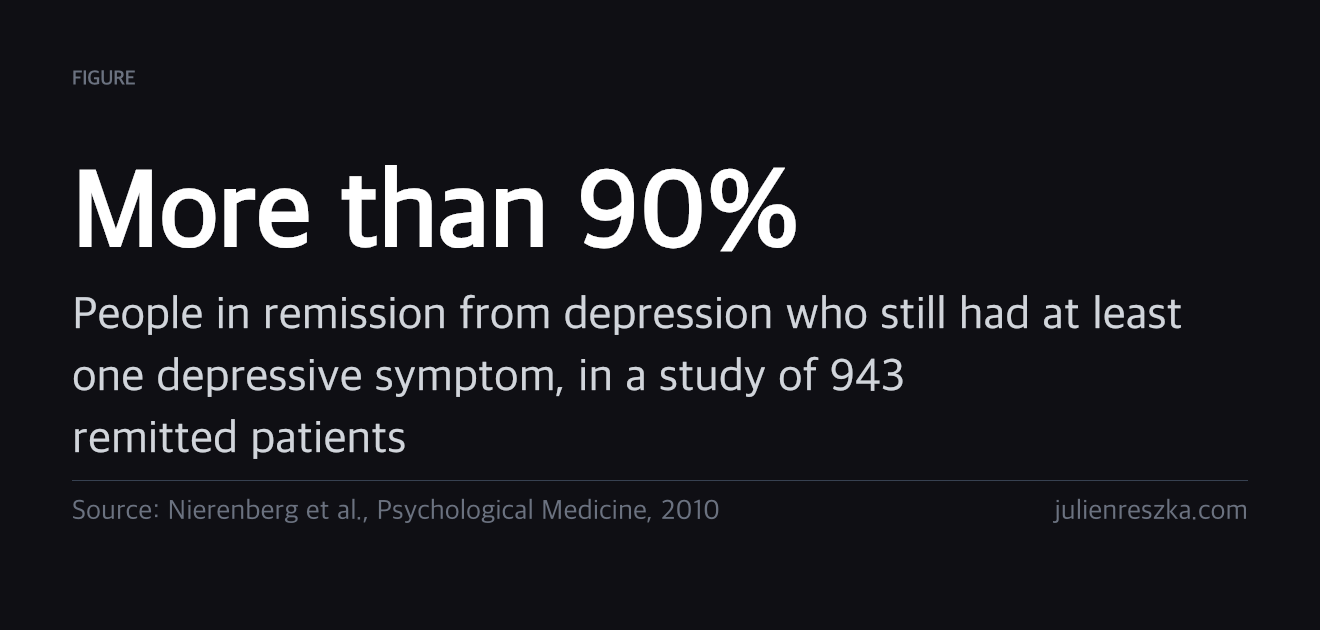
The symptoms do not all leave together. In STAR*D, a large US trial, 943 people reached remission on an antidepressant. More than 90 percent of them still had at least one depressive symptom, with a median of three. Sleep problems were the most common leftover, in 71.7 percent. Those leftovers matter: the more kinds of symptoms people still had, the more likely they were to relapse. An older study by Eugene Paykel's team found the same pattern more starkly. Among people who reached remission, the depression came back early in 76 percent of those with leftover symptoms and in 25 percent of those without, though the sample was small. So when you say you are better but not right, you are describing something researchers measure.
Your mind runs slower for a while. A meta-analysis of studies using the same set of computerized tests found that people in remission still did moderately worse than people who had never been depressed on attention and on executive function, the skills you use to plan, switch tasks and stay on track. Memory differences were smaller and could have been chance. Some of this may have been there before the depression started, and studies like these cannot rule that out. In daily life it feels the same either way: emails take longer, decisions tire you, you lose your place in conversations. If you read that as proof that you are still broken, you make it heavier than it is.
Sad moods feel like trapdoors. After depression, ordinary sadness can switch old thoughts back on. Zindel Segal and colleagues put 99 people in remission through a short exercise that made them feel sad, then measured how much more they agreed with harsh beliefs about failure and worth. Those whose agreement jumped the most relapsed sooner over the next 18 months. Later studies have questioned how reliable that measure is, so treat it as a pattern rather than a test. It fits what many people describe, though. A bad day is never just a bad day anymore, so they start watching themselves, and the watching keeps the mood in focus.
The life you come back to has changed. Depression does not happen in a sealed room. Constance Hammen followed women over a year and found that those with depression had more stressful events, especially conflicts with other people, and more of their stressful events tended to be ones their own situation had helped cause. Her first study was small, with only 14 depressed women, but a later review found the evidence most consistent for exactly this: depression predicting more stress of this kind. Nobody does this on purpose. Pulling away, snapping at people and missing commitments create the stress for you. While you were away, friendships lapsed, work moved on, and some people gave up on you.
Life events can move the baseline itself. In a 15 year German study of more than 24,000 people, Richard Lucas and colleagues found that people reacted strongly to losing their job and then moved back toward their earlier life satisfaction, but on average did not get all the way back, even after they found work again. That study is about unemployment, not depression. But depression often brings that kind of loss with it, and each loss can leave its own mark after the mood lifts.
The old baseline may be part of what got you here. If you went down by being everyone's listener, in a job that drained you, or in a place that kept you stuck, then returning to exactly that life means returning to the conditions that brought you down. That is why changing your environment matters, as I wrote in How to Help Someone Who Used to Be Fun.
The risk of another episode is a reason for care, not panic. In the Lundby Study in Sweden, which followed 344 people after their first depression, about 40 percent had another episode, from 17 to 76 percent depending on how long they were followed. That was a community sample, and the authors note a better outlook than in clinic samples. A review by Scott Monroe and Kate Harkness adds that first episodes are more strongly tied to major life stress than later ones. One reading is that it can take less to set off a later episode, though why is still debated.
Chasing the old you can backfire. Brett Ford and colleagues found that in people in remission from major depression, valuing happiness very highly was linked to more depressive symptoms, and that this group valued happiness more than healthy controls did. The study shows a link, not a cause. But it matches a common trap after depression: holding each day up against your best memory of yourself. Next to the funniest, most energetic version of you, every ordinary Tuesday looks like a failure.
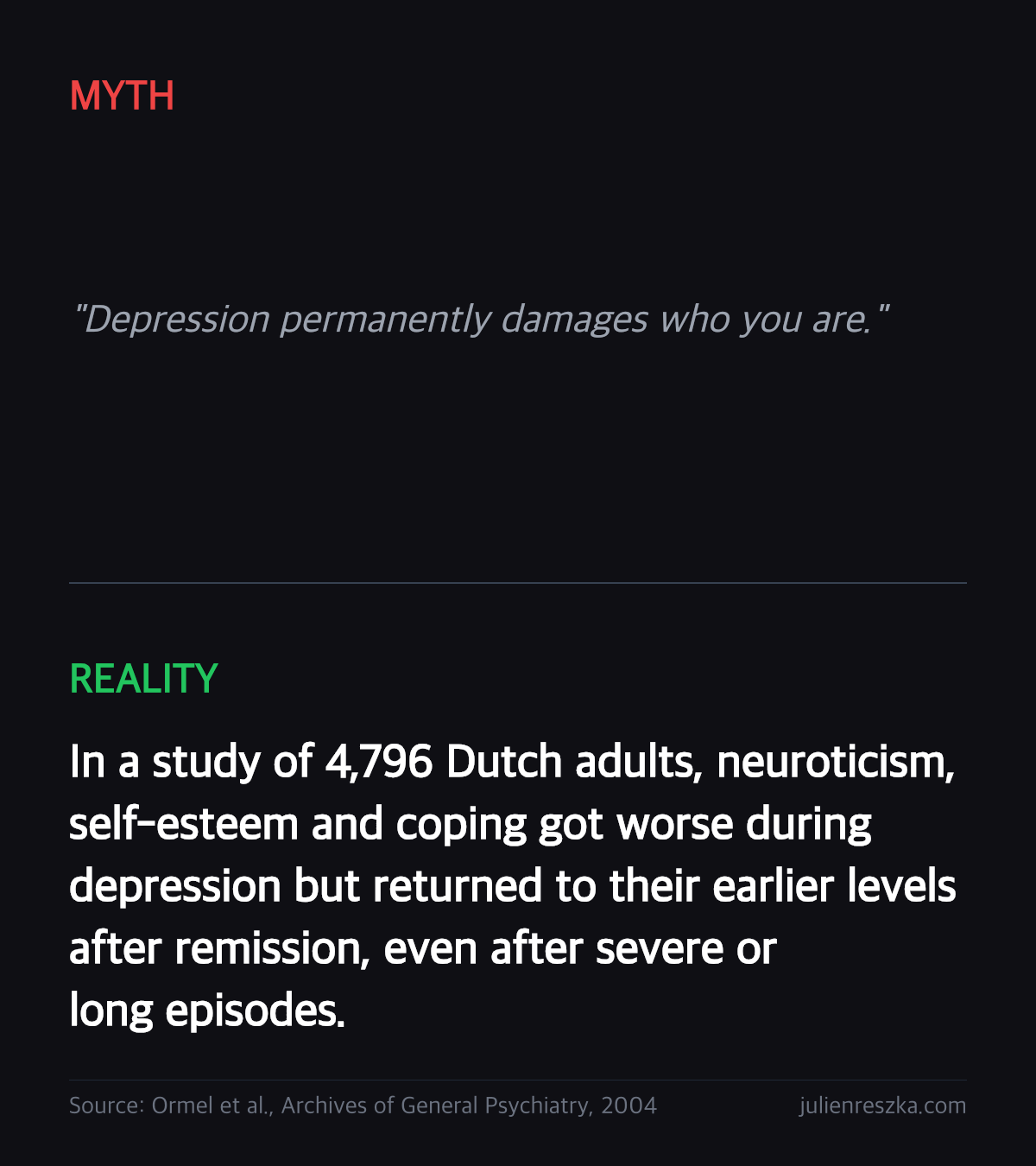
There is good news inside all this. The same research that explains the slow return also suggests you are not permanently damaged. In a Dutch study of 4,796 adults, Johan Ormel and colleagues measured personality before, during and after depression. Neuroticism (the tendency to worry and feel bad), self-esteem and coping got worse during the episode and returned to their earlier levels after remission. They found no lasting scar, even after severe or long episodes. What can look like a scar in before and after comparisons often comes from leftover symptoms. So what lingers is mostly symptoms and circumstances, not a broken self, and both can change.
Two approaches that have been tested treat the months after remission as part of the recovery. In a trial by Giovanni Fava's team, 40 people with recurrent depression who had recovered on antidepressants were randomly assigned either to therapy aimed at their leftover symptoms, with lifestyle changes and well-being therapy, or to routine follow-up. Both groups tapered off their medication gradually under supervision. Over six years, 40 percent of the therapy group relapsed, against 90 percent of the others. The trial was small. A larger analysis of 1,258 patients from 9 trials found that mindfulness-based cognitive therapy lowered the risk of relapse over 60 weeks by about 31 percent, and seemed to help most when leftover symptoms were worse. Both approaches go after the leftovers and train people to notice a dip without spiraling into it.
If you are the one coming back, here is what that can look like:
- Call remission halftime. Expect months of leftovers, and do not read each one as failure
- Track the leftovers, especially sleep, and work on them one at a time
- When a sad day comes, call it a sad day. See whether it lifts in a day or two before deciding it is a relapse
- Lower the bar at work for a while. Slower thinking is a known leftover, not a verdict on you
- Rebuild one connection a week, starting with whoever kept showing up
- Do not rebuild the parts of your old life that helped wear you down
- Aim at what matters to you, not at feeling exactly like before
If you are close to someone coming back, a few things help:
- Do not announce that they are back. Let them be the one to say it
- Do not treat every bad day as a relapse, but do not ignore a run of them either
- Keep inviting them, even now that the crisis seems over
- Expect them to be slower for a while, and do not take it personally
Watch the difference between a bad day and a bad stretch. A sad afternoon that lifts is normal life. Weeks of losing interest, sleeping badly and pulling away are worth taking seriously early, rather than waiting to see whether they pass. If a bad stretch comes with thoughts of suicide, tell someone today. In the US you can call or text 988, and most countries have a similar line.
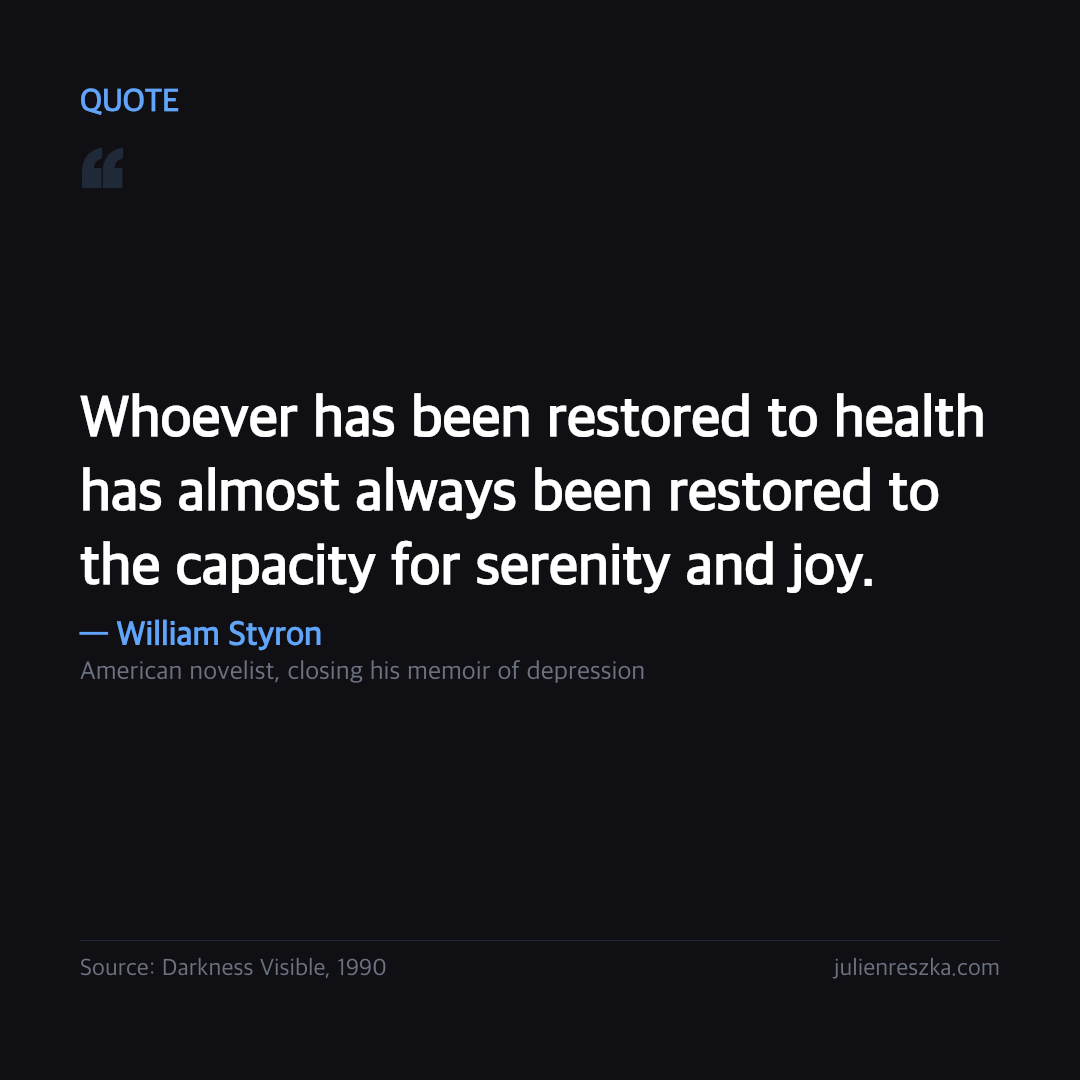
Maybe baseline is the wrong word for what you are trying to reach. The old you is a memory, and memories get edited. Going back to exactly that person would also mean going back to whatever wore them down. The capacity to enjoy things does tend to return, more slowly than anyone would like. The goal is to give it a life that is less likely to take it away again.
Discussion