 Julien Reszka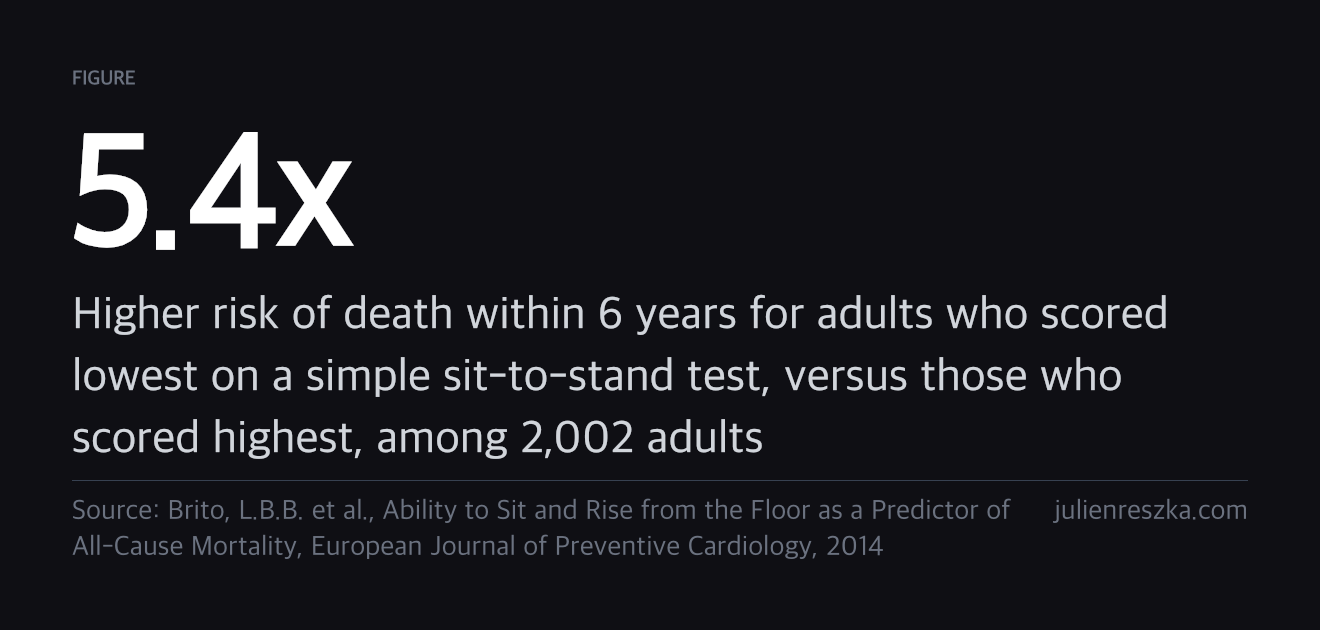
If I had to keep exactly one exercise for the rest of my life, it would be the squat, and not for the reason most people give. It is not that squats burn the most calories or spike some muscle-building hormone. It is that a squat is, functionally, the exact movement a study once used to predict who was going to die within six years.
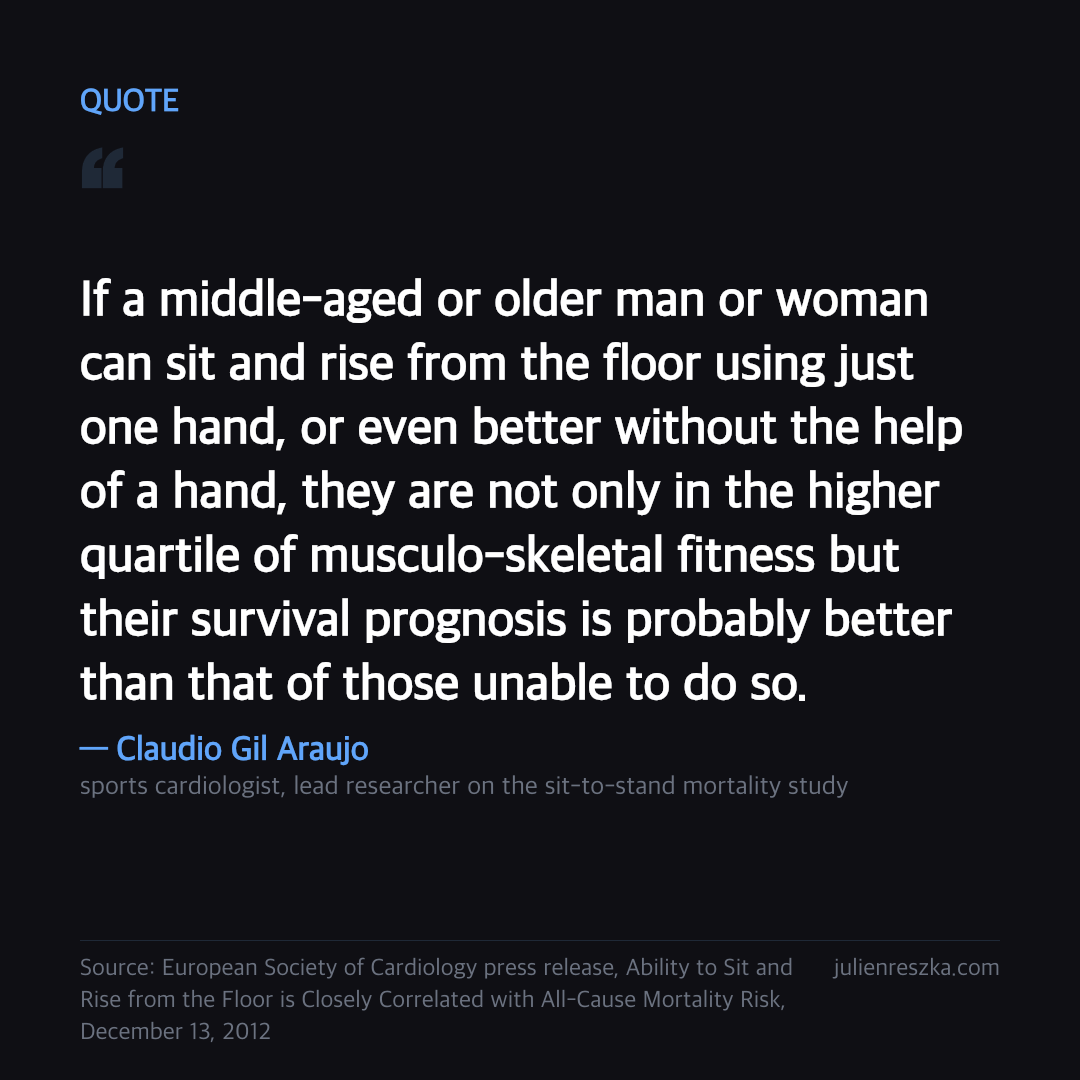
Researchers gave 2,002 adults a simple test: sit down on the floor and stand back up, losing points for every hand, knee, or piece of furniture used along the way. Over the next six years, the people who scored lowest were 5.4 times more likely to have died than the people who scored highest, after adjusting for age and sex. As the lead researcher put it at the time, someone who can sit and rise from the floor without using a hand is not just in better shape, their survival prognosis is probably better than someone who cannot.
That study did not train anyone to squat and then measure what happened. It measured an existing ability and found it predicted mortality, which is a real, useful, and genuinely different claim from squats causing longer life. What it does establish is that the specific movement pattern squats train, loading and controlling your own bodyweight through a full range of hip and knee flexion, is one of the clearest markers of functional aging we have. Training that pattern on purpose is a reasonable bet even without a randomized trial proving the exact mechanism.
- Adults who scored lowest on a sit-to-stand test had 5.4 times the mortality risk of the highest scorers over 6 years
- Each one point improvement on the test corresponded to roughly 21 percent lower mortality risk
- The test itself is functionally the same movement as a deep bodyweight squat
The second reason is more practical than dramatic: squats are an efficient way to hold onto muscle mass, and holding onto it matters more when you are eating less. Skipping a meal reliably works because a protein-heavy breakfast leaves you satisfied, but eating less without any resistance training risks losing muscle along with the fat. Squats, especially loaded ones, are a large-muscle-mass compound movement that gives your body a reason to keep the muscle it has even while running on fewer calories.
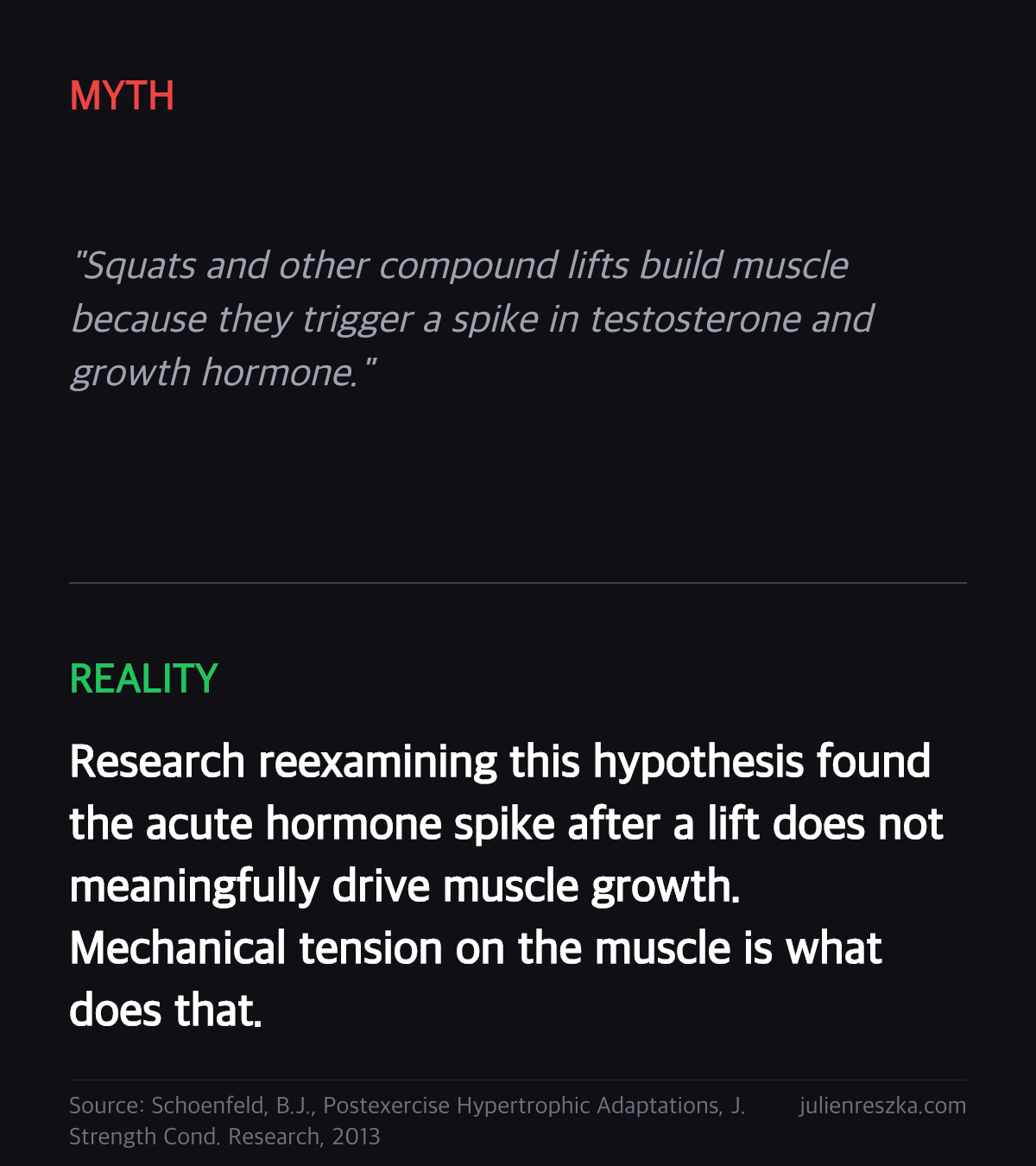
What squats do not do is what most fitness content claims they do. The idea that lifting spikes testosterone and growth hormone enough to drive real muscle growth has been directly tested and did not hold up: the hormone bump is real but small, and does not meaningfully predict who gains muscle. What actually drives growth is mechanical tension on the muscle itself, repeated over time, which a bodyweight or loaded squat provides regardless of what your hormones do afterward.
Squats are also not a proven cure for back pain, whatever some fitness content implies. The honest research says squatting with a neutral spine does not have to hurt your back and can build the posterior chain and core strength that supports it, but no study has shown that squats specifically prevent low back pain. Poor form under heavy load is a real, well documented way to get hurt, not a myth. And squats are not objectively the single best exercise either: deadlifts and kettlebell swings recruit the posterior chain as hard or harder in some studies, and no research crowns one movement as uniquely superior across the board.
What squats are is defensible: the one movement pattern most directly tied to a measurable marker of functional aging, done in a way that protects muscle mass rather than just burning calories. That sit-to-stand test, floor to standing, no hands, is worth trying today. It is a more honest verdict on where you actually stand than anything a mirror will tell you.
Discussion