 Julien Reszka
There are two kinds of pressure. The first kind has a mechanism: if you do not respond, something specific breaks. A deadline passes, a cost compounds, a system fails. The second kind has no mechanism. If you do not respond, nothing breaks except the comfort of the person applying it.
Most people treat these the same way. They feel pressure and they bend. But yielding to the second kind does not resolve it. It trains whoever is applying it to apply more. The next ask will be larger, and the threshold for applying it will be lower.
The diagnostic is simple. Ask what breaks mechanically if you do not respond. If the answer is specific and reproducible, the pressure is real. Any person in your position would face the same constraint. If the answer is that someone will be upset, or disappointed, or will think less of you, that is a social mechanism, not a real one. If you cannot tell because the consequences might be real but you cannot see them, ask directly: "What specifically happens if this does not get done by Friday?" Real pressure survives the question. Nonsense pressure either dissolves or gets louder, which is itself the answer.
How to tell them apart:
- Real pressure is reproducible: a different person in your position would face the same constraint
- Real pressure gets clearer when you ask why. Nonsense pressure gets louder.
- Real pressure has a timeline attached to something external. Nonsense pressure creates artificial urgency.
- Real pressure comes with evidence. Nonsense pressure comes with repetition.
- Yielding to real pressure solves it. Yielding to nonsense pressure escalates it.
The confusion happens because both feel similar in the moment. Social discomfort and genuine urgency produce the same physical response. This is why most people never develop the skill of distinguishing them. They learn to treat all pressure as real because it costs less in the short term.
The long-term cost is that you become a person who bends under nonsense. And people who produce nonsense pressure are very good at finding people like that.
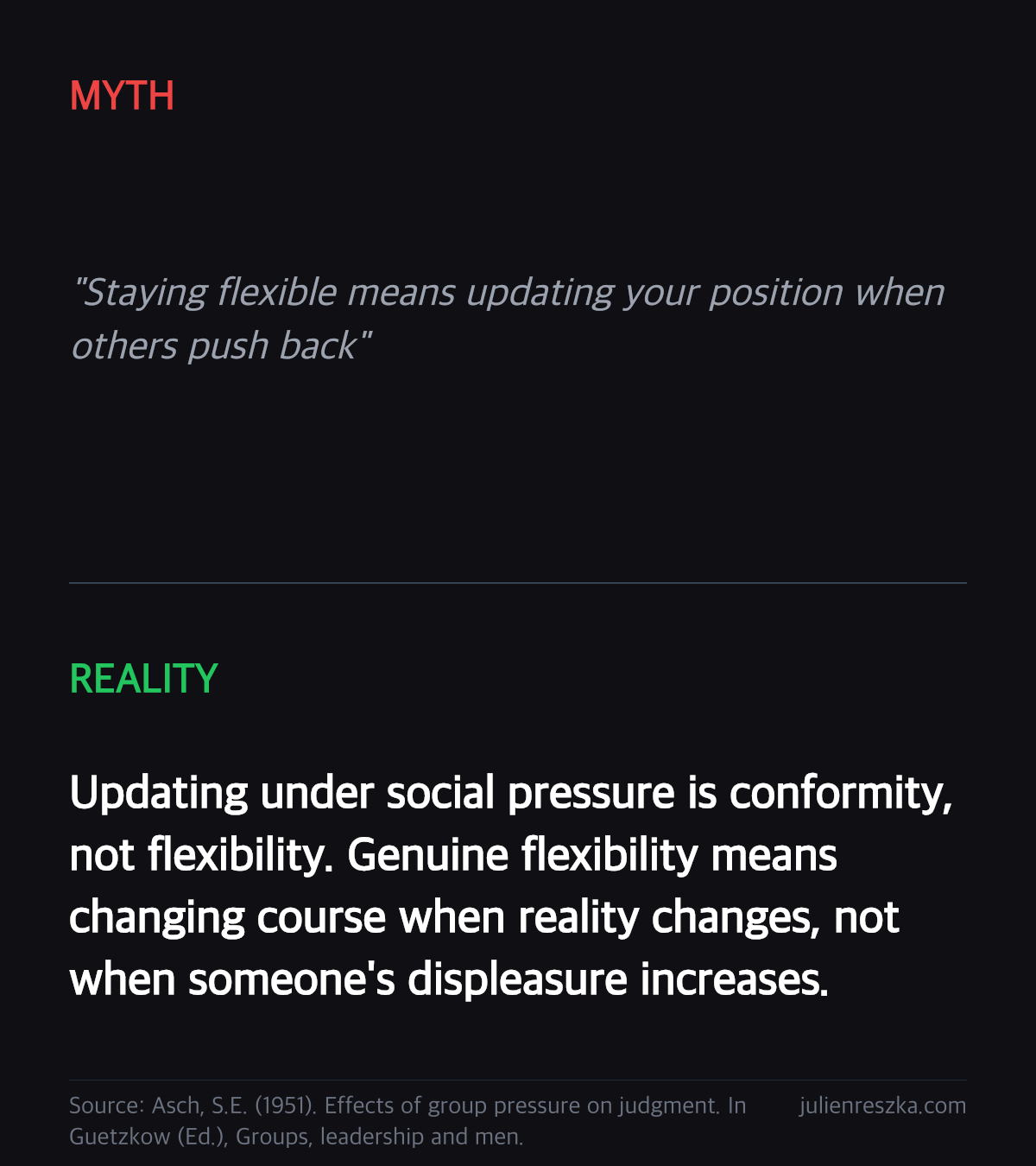
The fix is not to become rigid. Flexibility under real pressure is essential. The fix is to become precise. Before you change course, ask what breaks if you do not. If the answer is nothing except someone's mood, hold the line. The discomfort is temporary. The precedent is not.

Discussion
This is such a useful framework. I used to think of pressure as just pressure, but now I can see how much of it is actually nonsense. It gives me more confidence to hold my ground when I know the mechanism is social rather than real.
I will never forgive to the people who bended to the woke nonsense where some maniacs try to make people say that men dressed as women are women. This nonsense has to stop.
I hate that we let the woke maniac force children to learn to submit to their ideological trash. I regret putting the pronouns in my email signature. I will never do it again.
I wonder if there are cultural differences in how people perceive pressure and when they decide to bend. In some cultures, social harmony might be valued more, which could make people more likely to yield to social pressure even when it's nonsense.
That's a great point. Cultural norms around conformity and individualism could definitely influence how people respond to different types of pressure.
I hate to admit that I've been guilty of bending under nonsense pressure in the past. This article has given me a new perspective on how to evaluate the pressure I feel and make more informed decisions about when to hold my ground. Fear really do shrink the brain.