 Julien Reszka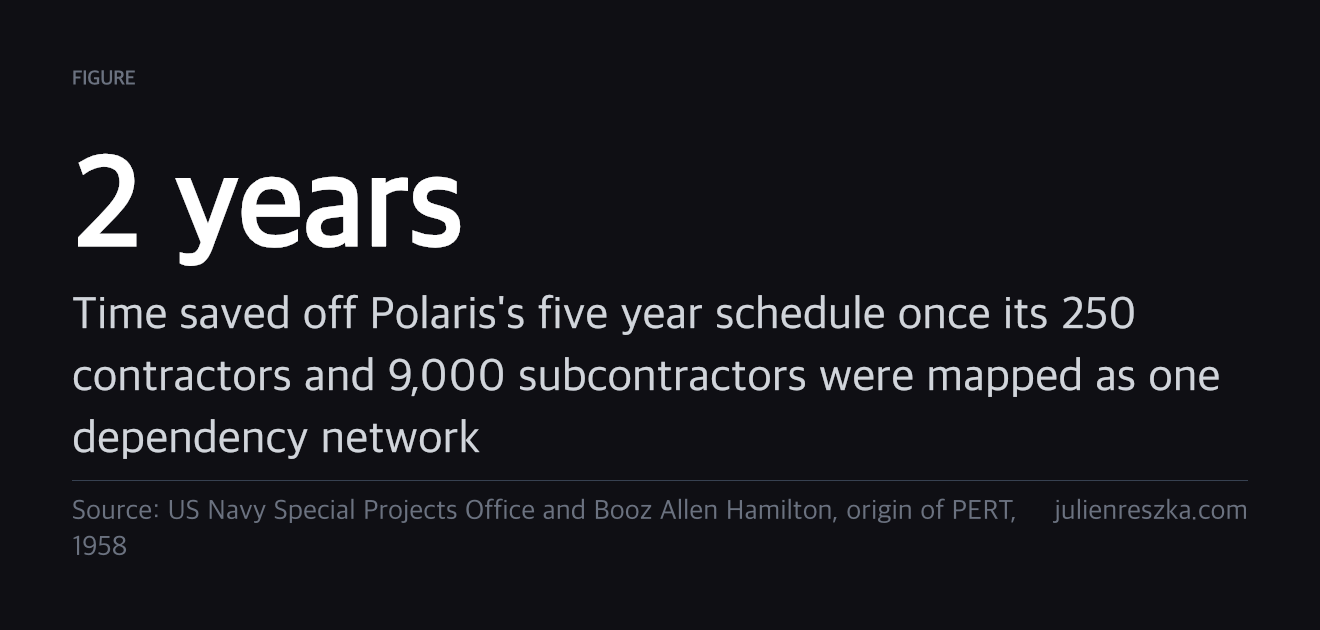
Apollo had no demand problem. There was exactly one customer, the country, and one deadline, before the decade was out. Demand for anything new can only be guessed, never planned, but Apollo never had to deal with it. Every planning question NASA actually faced was a supply question, not a demand one:
- Which tasks have to finish before another one can even start
- Which tasks have no such relationship and can run at the same time
The tool for answering that question already existed by the time NASA needed it. In 1958 the Navy's Polaris submarine program was drowning in the same problem, coordinating 250 companies and 9,000 subcontractors on a five year deadline. At a dinner meeting, a consultant asked the program's own engineers to describe everything that had to happen, then sketched it as a network on the spot: tasks as points, dependencies as lines between them, parallel paths made visible for the first time. That sketch became PERT, and Polaris finished two years ahead of schedule.
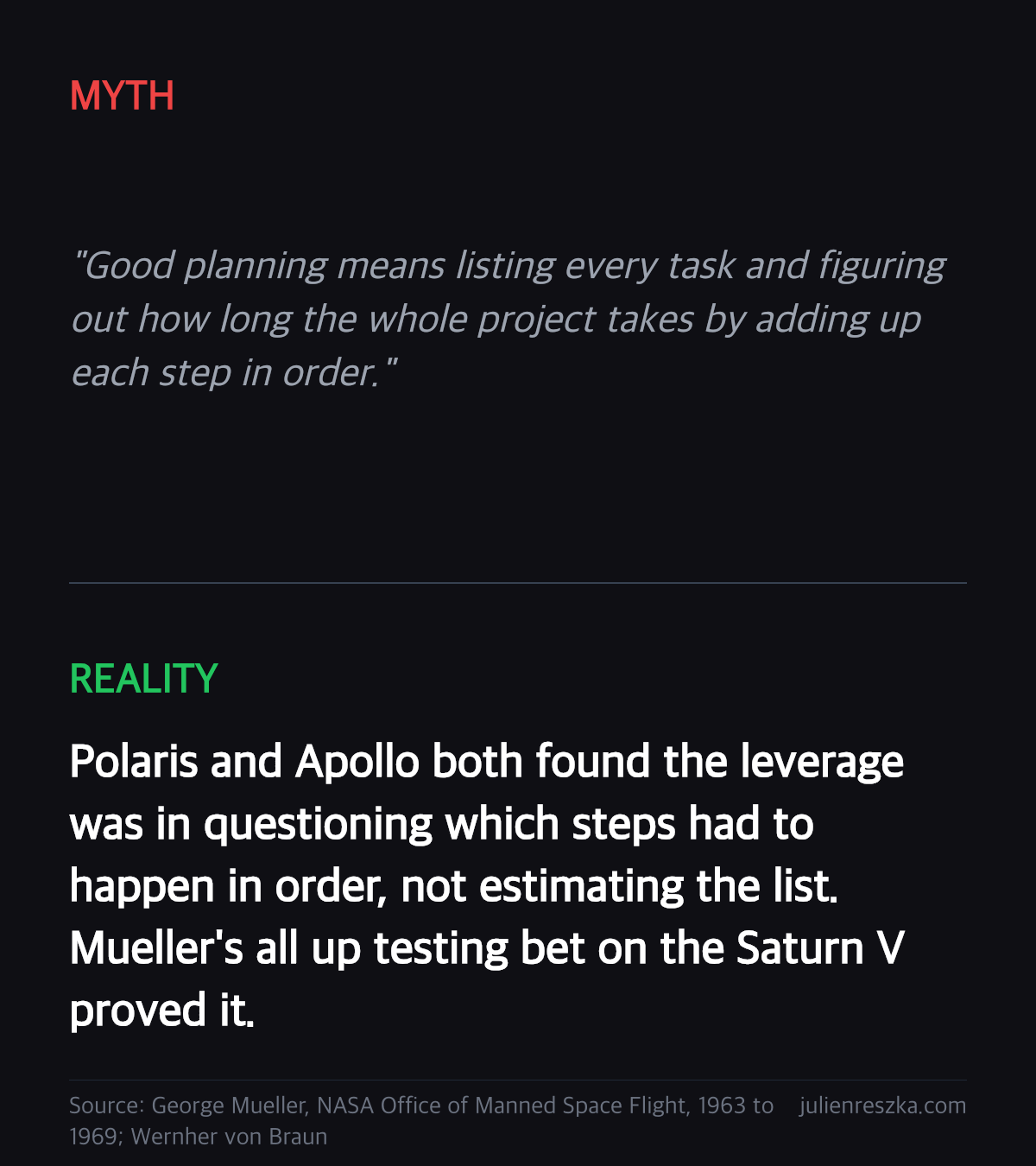
George Mueller brought the same discipline to NASA in 1963, straight from managing Air Force missile programs. His most controversial decision was all up testing: instead of testing each stage of the Saturn V separately in sequence, the way Wernher von Braun's own team wanted, test the entire rocket together from the very first flight. It was not really a testing decision. It was a dependency decision, a bet that a large chunk of the assumed critical path was habit rather than a real constraint. Von Braun, who had opposed the idea, later admitted the landing could not have happened by 1969 without it.
Discussion