 Julien Reszka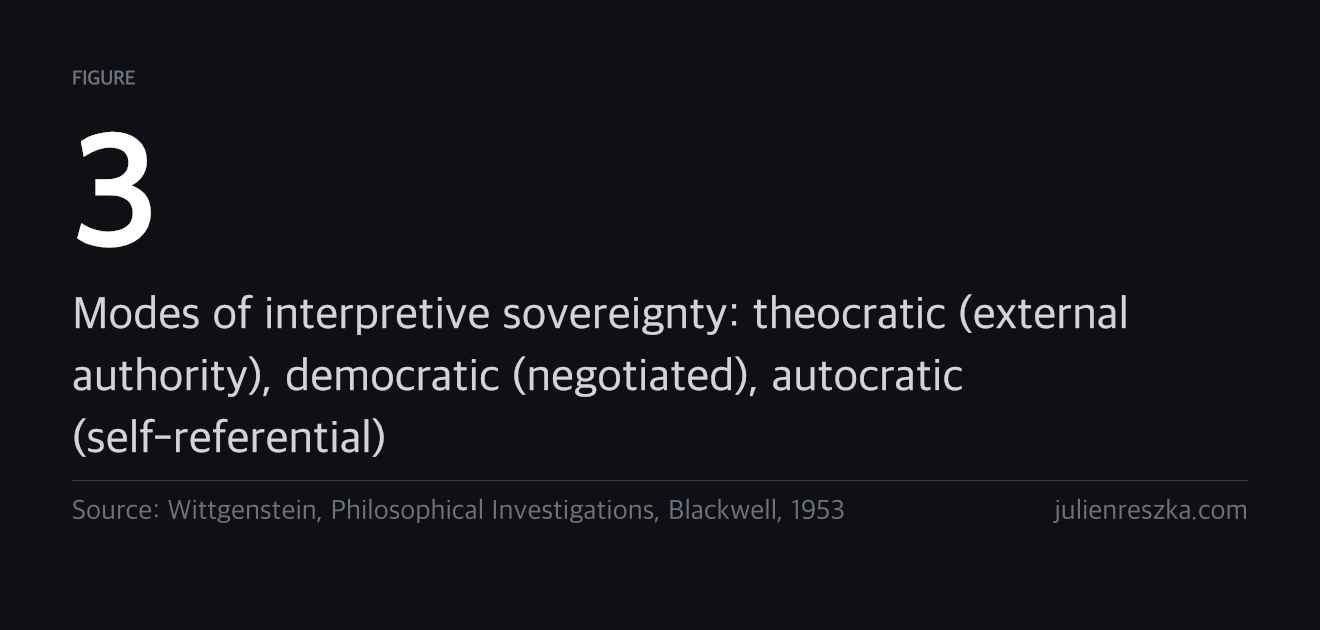
In the architecture I am building, every interpretation of an observation has a sovereign, an authority that produces or validates it. There are exactly three modes.
- Theocratic: a single external authority designates the correct interpretation. The agent defers unconditionally. Reality is the sovereign; experiments are how you consult it.
- Democratic: the agent and its environment jointly produce interpretation through interaction. Meaning is negotiated in real time. Spoken language works this way.
- Autocratic: the agent alone decides what its observations mean. Useful for speed, dangerous for accuracy: it is the failure mode of pure self-reference.
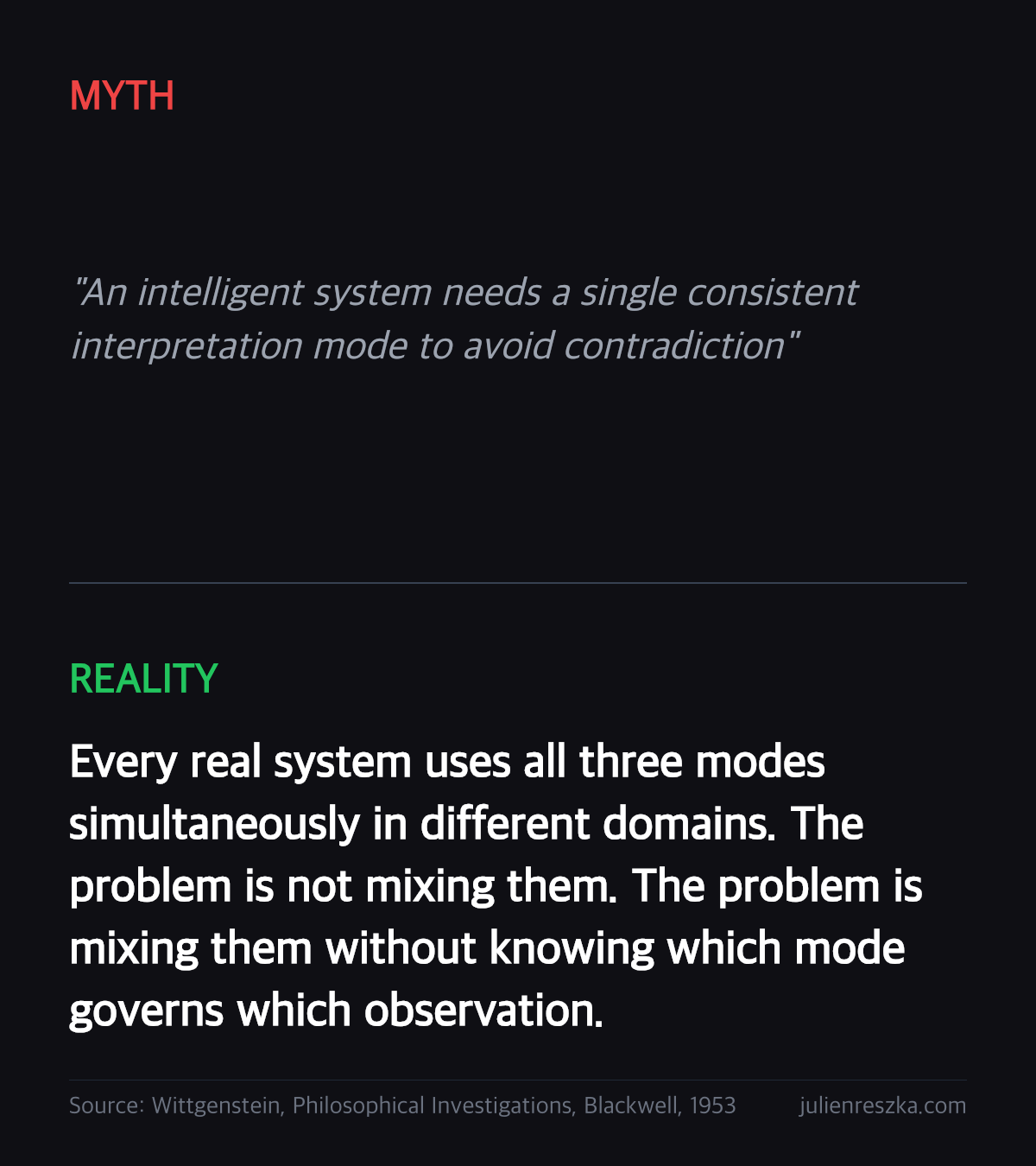
Any system capable of reasoning across domains uses all three simultaneously. The design question is which sovereign governs which class of observation, and whether the system tracks this explicitly.
When a system does not track it, the modes bleed into each other. A cached self-referential interpretation gets treated as externally validated. A negotiated meaning gets treated as a universal law. The errors are invisible until they are catastrophic.
Time compounds this. Every interpretation also exists in time, and time has structure:
- The changing: past, present, future (what transforms as time passes)
- The enduring: eternal, ephemeral, instantaneous (what persists or disappears)
- The oscillating: punctual, trending, repetitive (what pulses, drifts, or recurs)
Nine temporal dimensions. An interpretation made yesterday under an ephemeral authority that has since dissolved is a different object from an interpretation made now under an eternal law. Conflating them is how reasoning systems produce confidently wrong answers that are undetectable from the inside.
Discussion
The theocratic mode is interesting as a category. You are essentially saying that some interpretations defer to a ground truth that the system cannot revise. That sounds like a necessary constraint for any system that is supposed to be correctable.
It can be revised, but only through world representation and reflection. That is precisely what makes it distinct: it is a way to update interpretation without relying on environment or identity. A system that can revise its ground truth directly, by consulting only itself or its immediate surroundings, is a system that can rationalize any output. World representation is the only path that keeps the revision honest.
The nine temporal dimensions feel like they are doing a lot of work. How do you prevent the coordinate space from becoming a framework that fits anything in retrospect?