 Julien Reszka
Every edge in a reasoning cycle carries imperfect information. This is not a failure of implementation. It is a structural property of any system that processes and emits information. The architecture models six irreducible forms.
Input imperfections (what corrupts information as it arrives):
- Uncertainty: the input is incomplete; which branch is true is unknown. Formal equivalent: entropy H.
- Conflicts: contradictory signals pull in incompatible directions; too much information with opposing magnitudes. Equivalent: KL divergence.
- Noise: the signal is present but buried in irrelevant variation; generalisation is hard. Equivalent: signal-to-noise ratio.
Output imperfections (what corrupts information as it is emitted):
- Disorder: the output lacks structure; elements are not organised into coherent relations. Equivalent: high Kolmogorov complexity.
- Constraints: the output is over-constrained; competing requirements limit what can be expressed. Equivalent: Lagrange multipliers.
- Redundancy: the output repeats itself; over-specified and poorly encoded. Equivalent: 1 - H/Hmax.
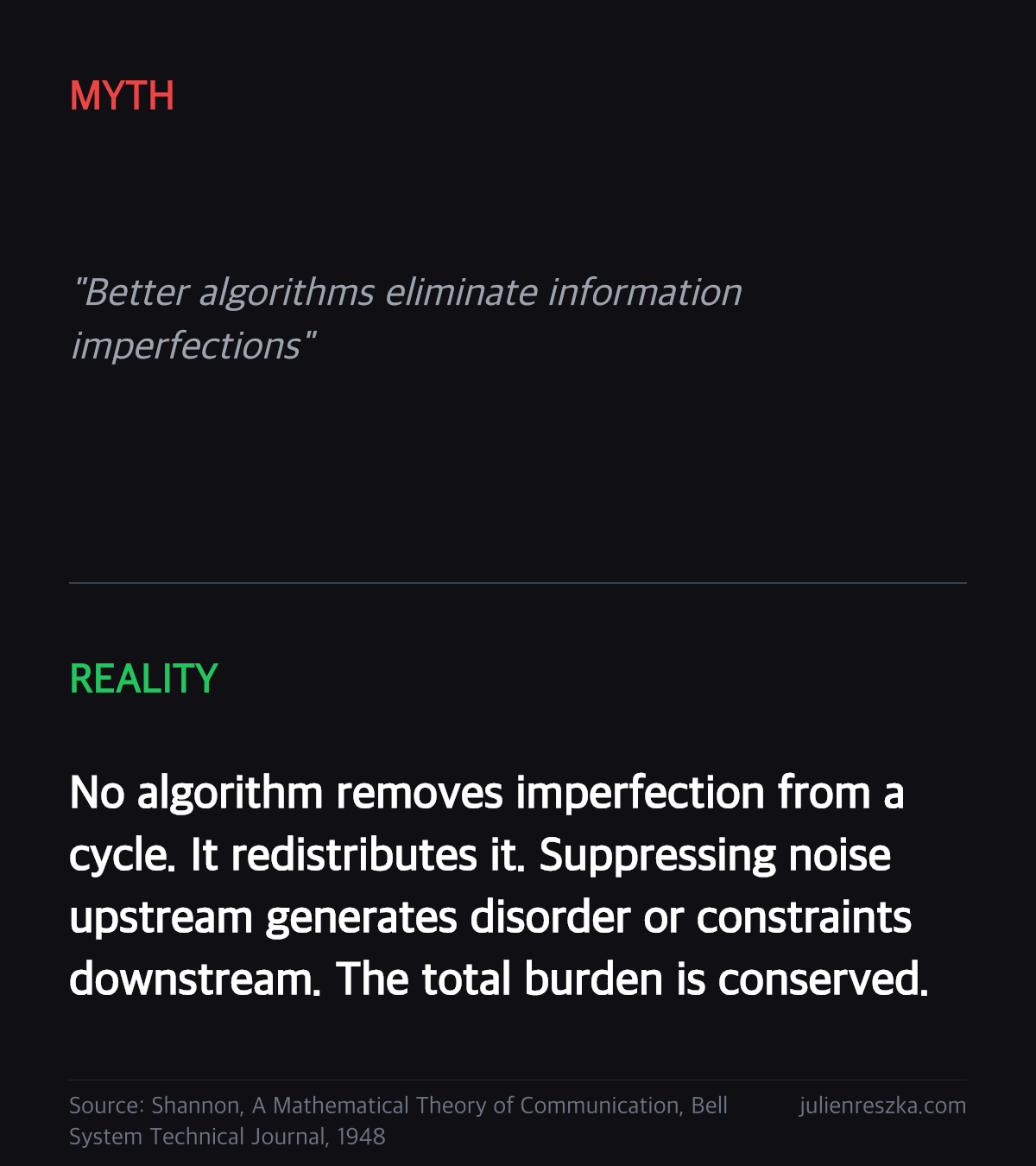
These six cannot be eliminated. They can only be redistributed around the cycle. Institutional policy is precisely the mechanism by which this redistribution is determined:
- Radical policy (overfitting): suppresses noise and uncertainty by force, generating disorder and constraints downstream.
- Primitive policy (underfitting): ignores imperfections, which accumulate until the system collapses.
- Moderate policy (fitting): accepts a stable, bounded level of each imperfection: the constitutional equilibrium.
The institutionalisation consequences follow from which policy governs a domain:
- A radical policy produces totalitarianism: coercive over-constraint propagates into adjacent domains.
- A moderate policy produces constitutionalism: imperfections are acknowledged, distributed, and bounded.
- A primitive policy produces anarchism: unmanaged imperfections accumulate and cascade outward.

Discussion
The correspondence to Shannon entropy and KL divergence is not decorative. If the formal mappings hold, you can compute the redistribution of imperfections rather than just reason about it qualitatively.
That is the goal. The formal equivalences are there so that the model produces testable predictions about where imperfection accumulates when you tighten one part of the cycle.
The institutional policy framing makes this useful beyond AI. The same three types (overfitting, underfitting, fitting) describe regulatory failure modes in financial markets, healthcare, and environmental law.