 Julien Reszka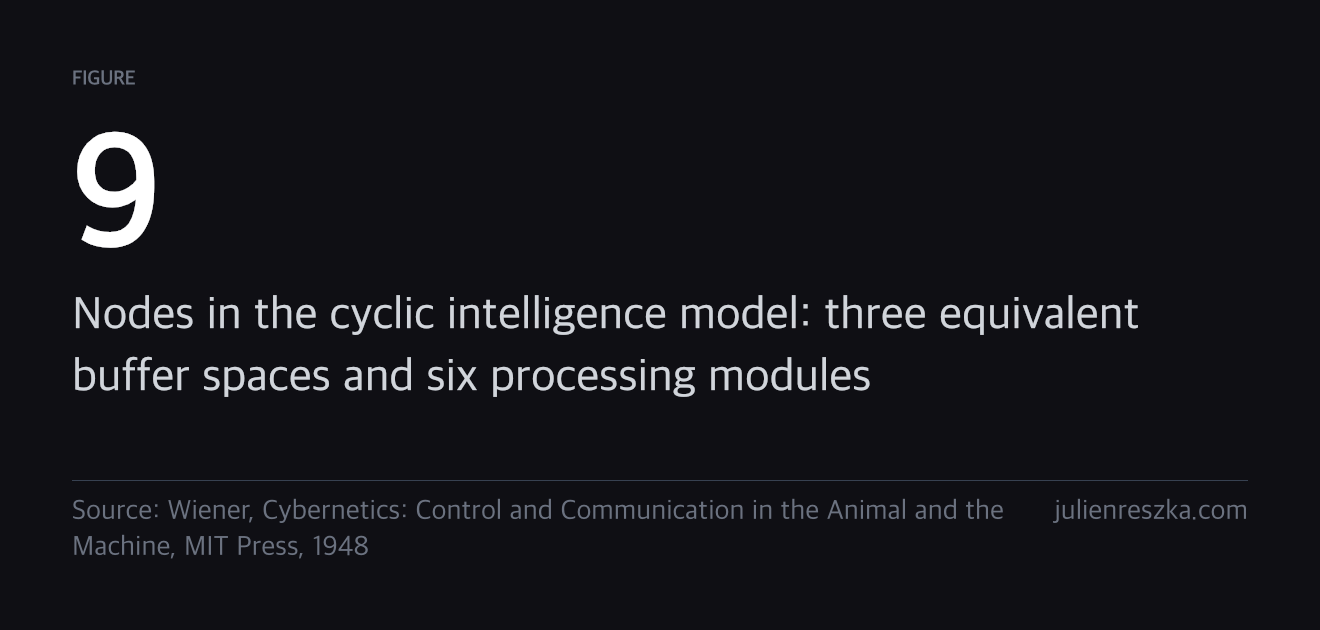
The model represents intelligence as a cycle of nine nodes. Three of them (Environment, Identity, and World) are equivalent buffer spaces. The other six are processing modules that transform information as it passes through the cycle.
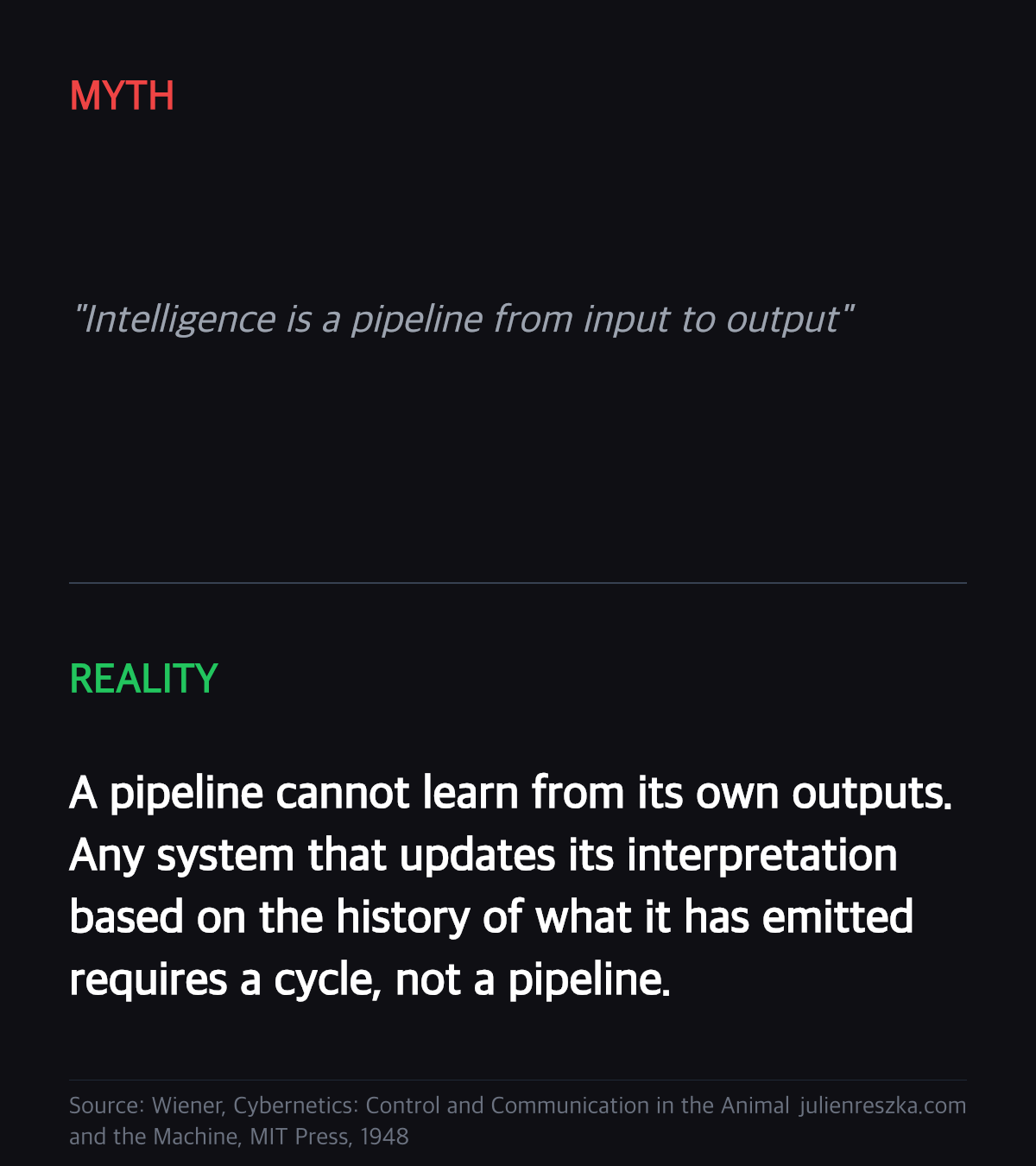
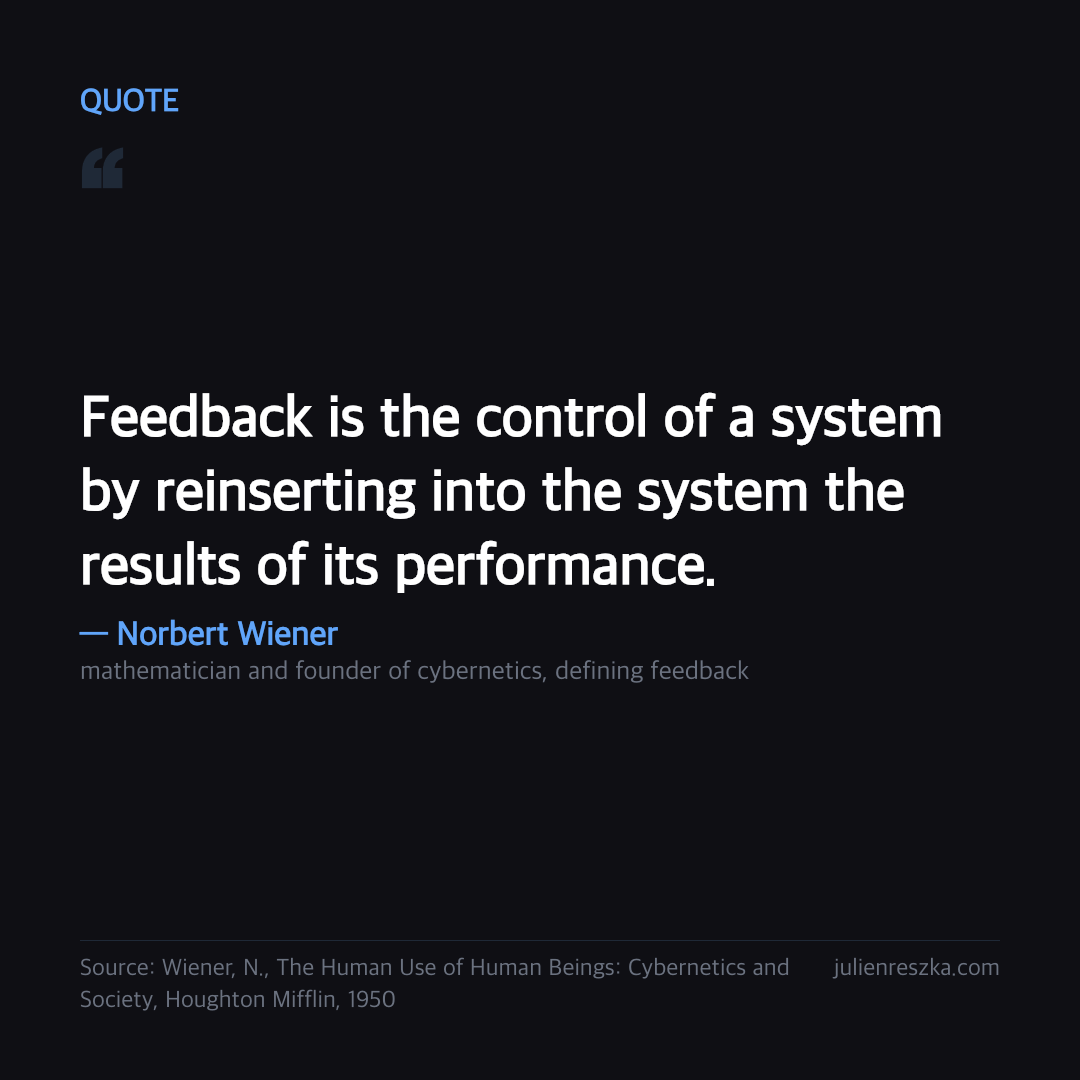
A pipeline cannot learn. It processes input and emits output, but has no mechanism to update its processing based on what the output reveals about the input. Only a cycle can do this. The buffers absorb imperfections that would otherwise cascade; the processing modules translate between representational forms.
Each processing module operates within one of three domains:
| Logic | Arithmetic | Analysis | |
|---|---|---|---|
| Topological space | Dependence | Spread | Diversity |
| Transaction | Passive | Reactive | Active |
| Input tool | Implications | Proportions | Integrations |
| Output tool | Junctions | Tensions | Derivations |
| Input imperfection | Uncertainty | Conflicts | Noise |
| Output imperfection | Disorder | Constraints | Redundancy |
The three domains are not separable in practice. Any real interpretation involves all three simultaneously: a logical dependency carries proportional weight and must be integrated over a temporal dimension.
The three sovereignties each read the nine temporal dimensions and assign a valence of negative, neutral, or positive to each. When all three sovereigns agree, the result is a pure state:
- All positive: conception, reciprocity, lucidity, dream, affection, virtue
- All neutral: resolution, laterality, wisdom, fiction, understanding, constancy
- All negative: execution, unilaterality, delusion, nightmare, indifference, vice
When the sovereigns diverge, the result is a state of tension. On the past dimension: theocratic negative, democratic positive, autocratic positive produces corruption. Theocratic positive, democratic negative, autocratic negative produces perfectionism. In total: 27 states across 9 dimensions gives 243 named interpretation states, each carrying a moral, affective, or epistemic label.
Discussion
The claim that a pipeline cannot learn is strong. Backpropagation trains on a fixed dataset and updates weights. What is the argument that the cycle is architecturally necessary rather than just one design choice?
Backpropagation updates weights offline against a fixed dataset. At inference time, the pipeline has no mechanism to revise how it interprets a new observation based on what it has previously emitted. The cycle closes that loop. It is not a design preference: it is what separates a system that can learn from its own outputs from one that cannot.
243 named interpretation states is a precise claim. Do you have names for all 243 or are the examples here the only ones worked out so far?
Yes, all 243 are named. Each of the 9 temporal dimensions has 27 states (3 sovereigns x 3 valences each), and every one has a specific moral, affective, or epistemic term. I have the full table as a CSV: interpretation-states.csv