 Julien Reszka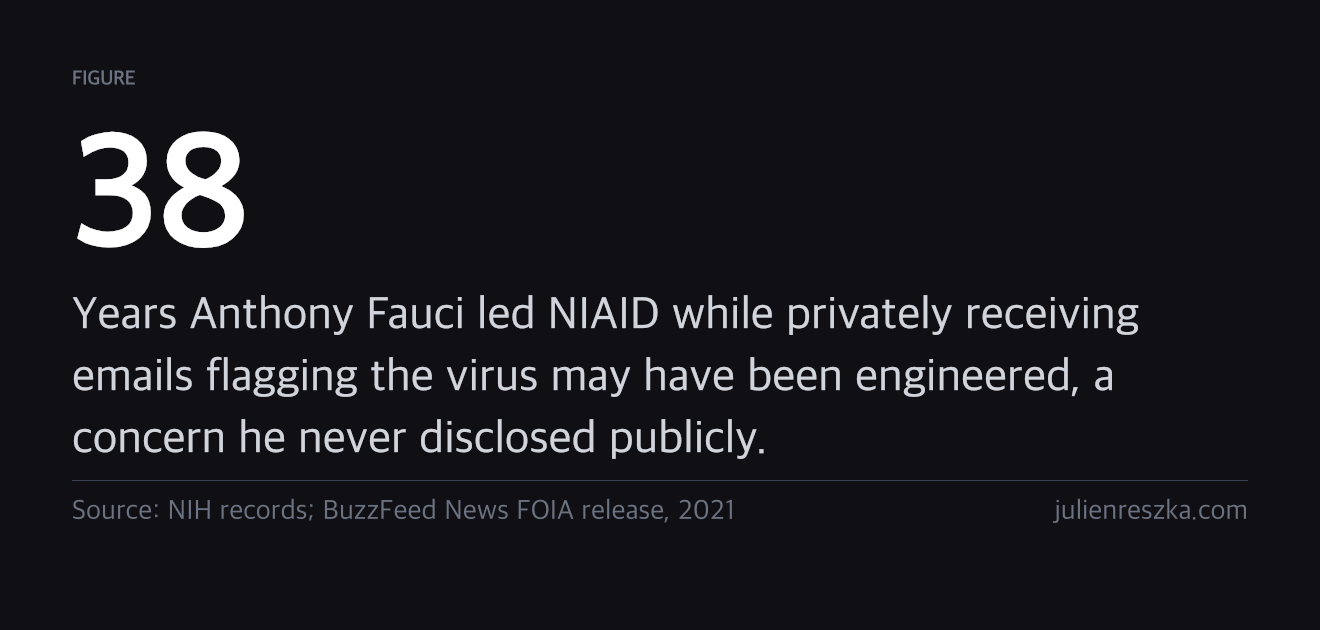
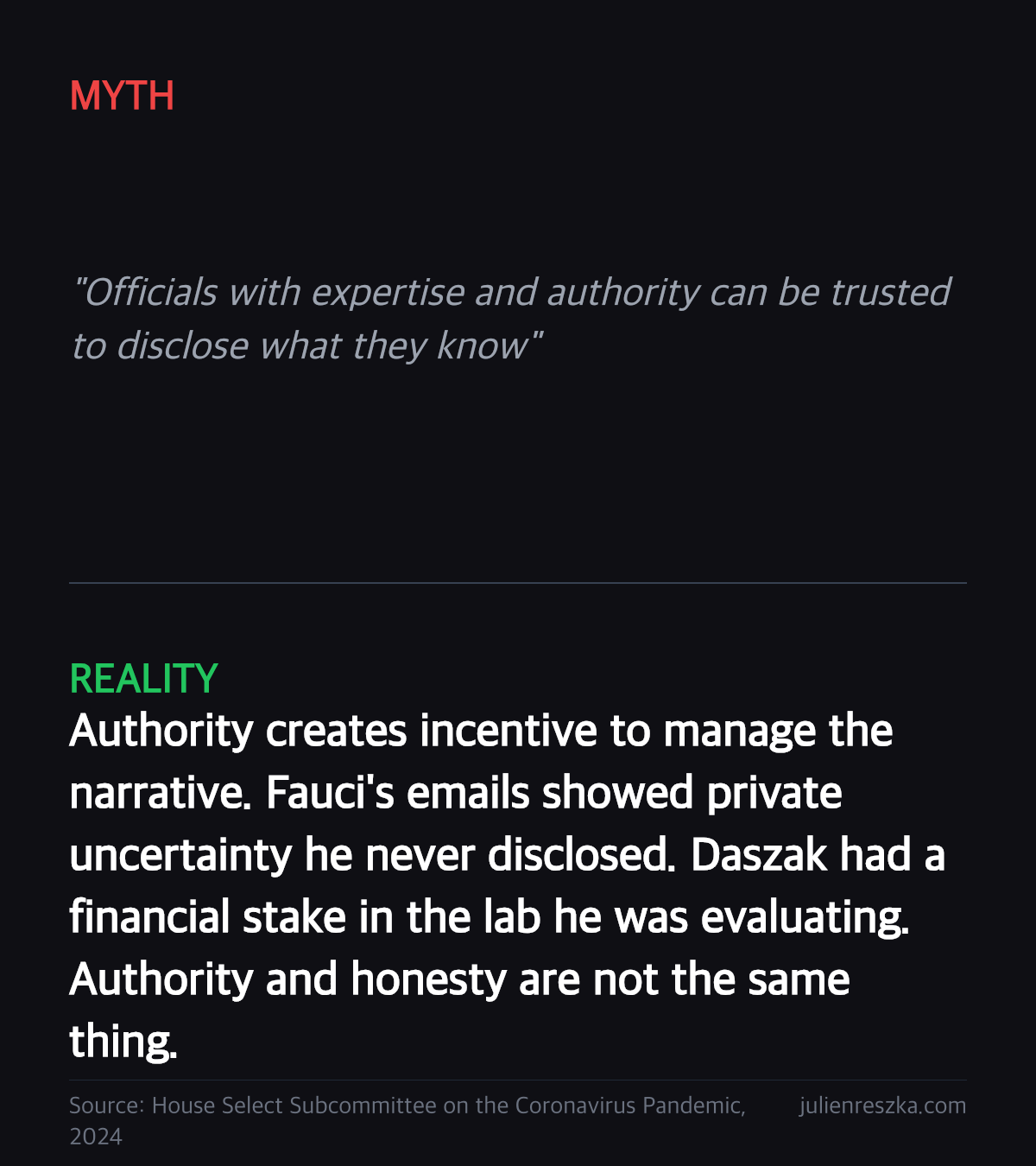
We extend benefit of the doubt upward. We assume the person with the title, the budget, and the press conference knows more than we do and means well. That instinct is backwards.
The more power a person holds, the more they owe you. Not deference. Proof.
Anthony Fauci ran the National Institute of Allergy and Infectious Diseases for 38 years with a budget in the billions. Francis Collins ran NIH. Peter Daszak led EcoHealth Alliance, which channeled NIH grants to the Wuhan Institute of Virology. These are not people who deserve extra benefit of the doubt. They are people who had more to hide, more to protect, and more incentive to manage the story.
Here is what they did:
- Fauci received emails in February 2020 noting features of the genome that looked engineered. Within days, those scientists publicly dismissed the lab leak. Their uncertainty was never disclosed.
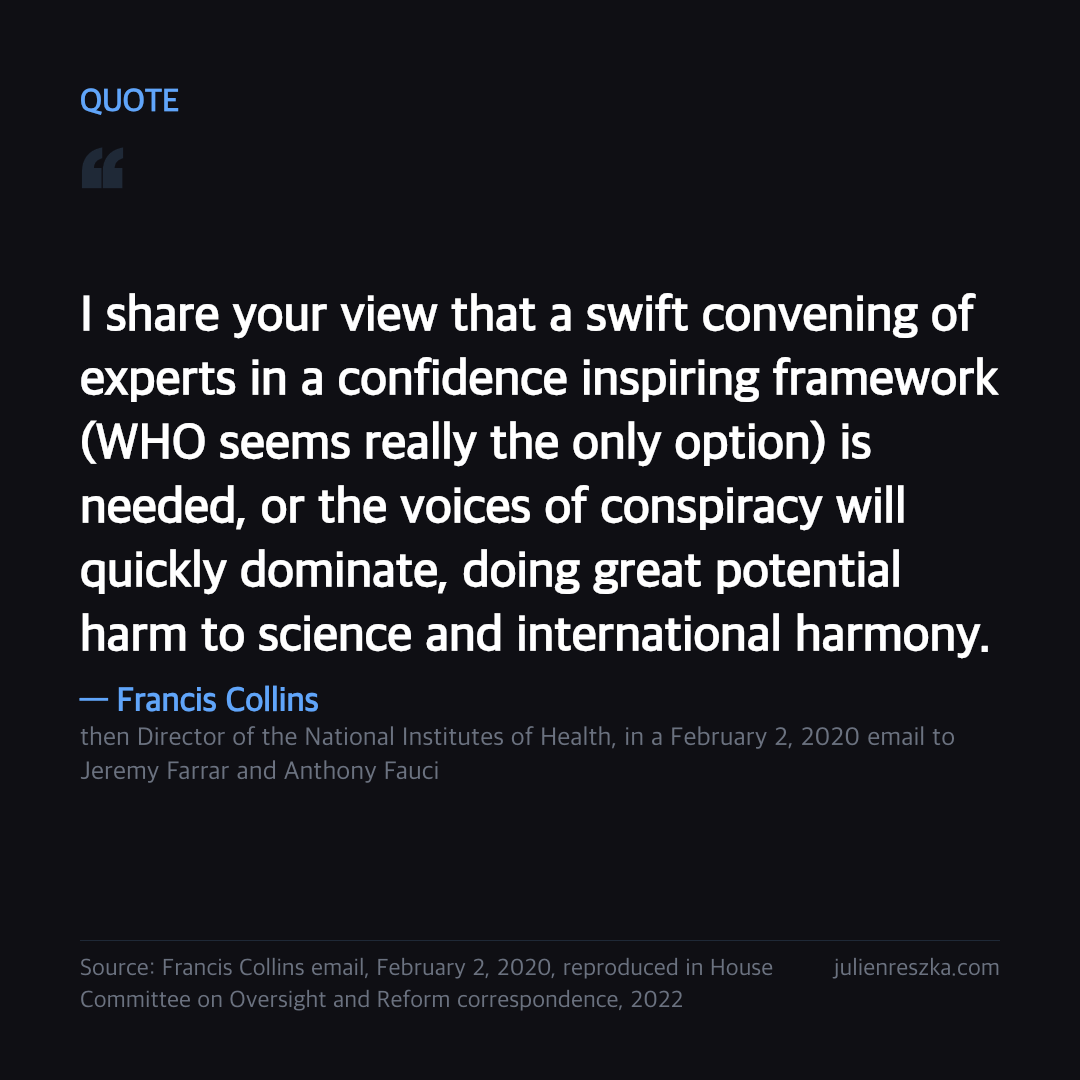
- Collins said public discussion of the lab leak could damage "international harmony." He was worried about optics, not accuracy.
- Daszak organized the Lancet letter calling the lab leak a conspiracy theory. He did not disclose his organization had funded the lab. An addendum was required months later.
- Birx admitted in 2024 that there had been a coordinated effort to suppress the lab leak theory.
By 2023, the FBI assessed a lab leak as the most likely origin. The Department of Energy agreed. The CIA followed in 2025. None of them had evidence that was unavailable in 2020. What changed was that it had become politically acceptable to say it.
The correct response is not to write this off as a few bad actors. The correct response is to update your prior.
Officials suppress questions for the same reason companies bury studies: the answer is costly to them. The incentive to manage a narrative scales with the power to do so. A researcher with no budget and no career to protect tells you what they think. One with a 38-year tenure, a congressional appropriation, and an agency to defend tells you what is safe to say.
Default distrust of powerful institutions is not paranoia. It is the appropriate prior given the incentive structure. The burden of proof belongs on the person with the power to shape the story, not on the person asking questions.
Discussion