 Julien Reszka
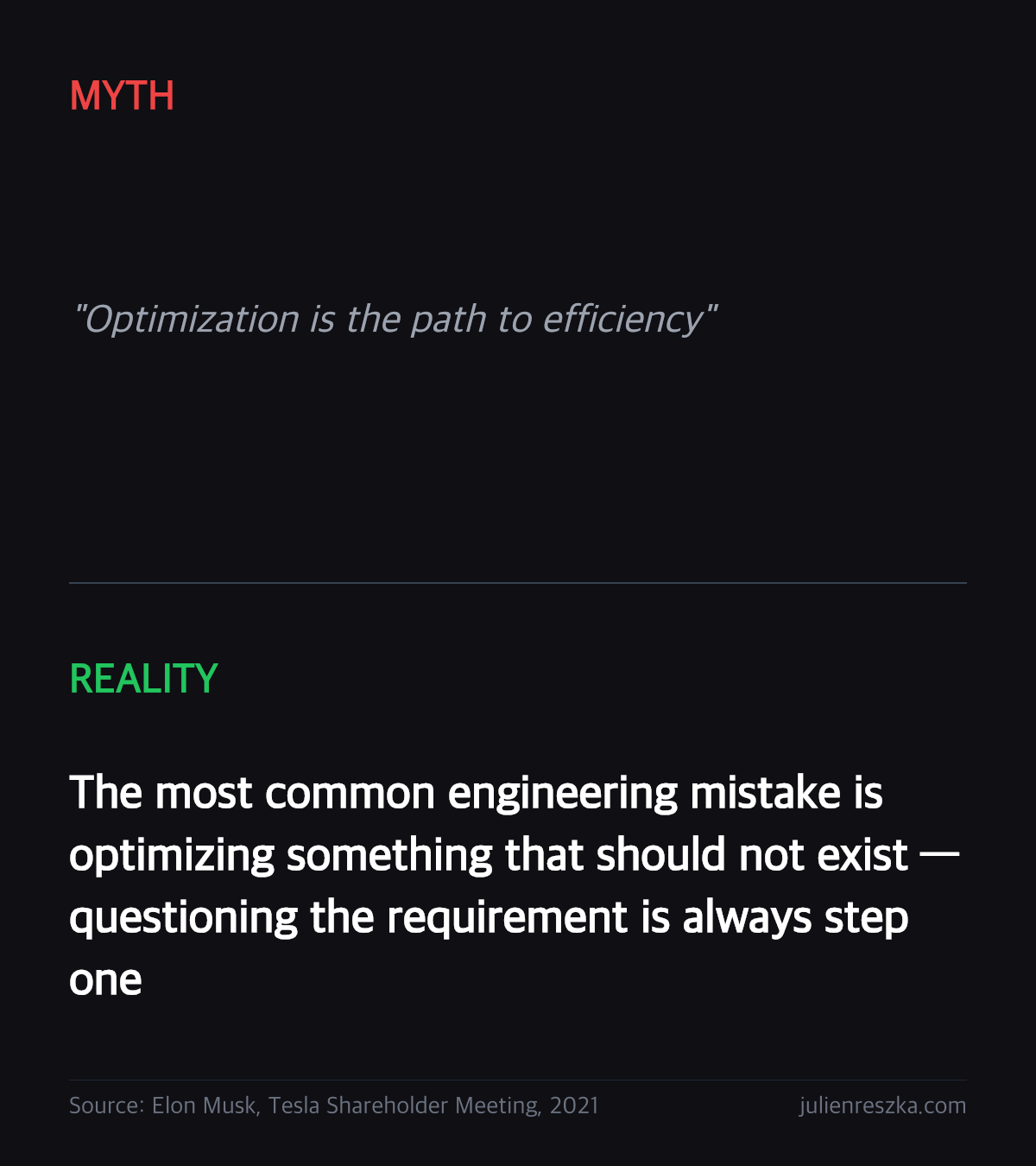
Elon Musk's five-step improvement process is ordered deliberately, and the order is the insight.
- Make your requirements less dumb. Every requirement has an owner, and that owner is probably wrong about at least one thing, regardless of how smart they are.
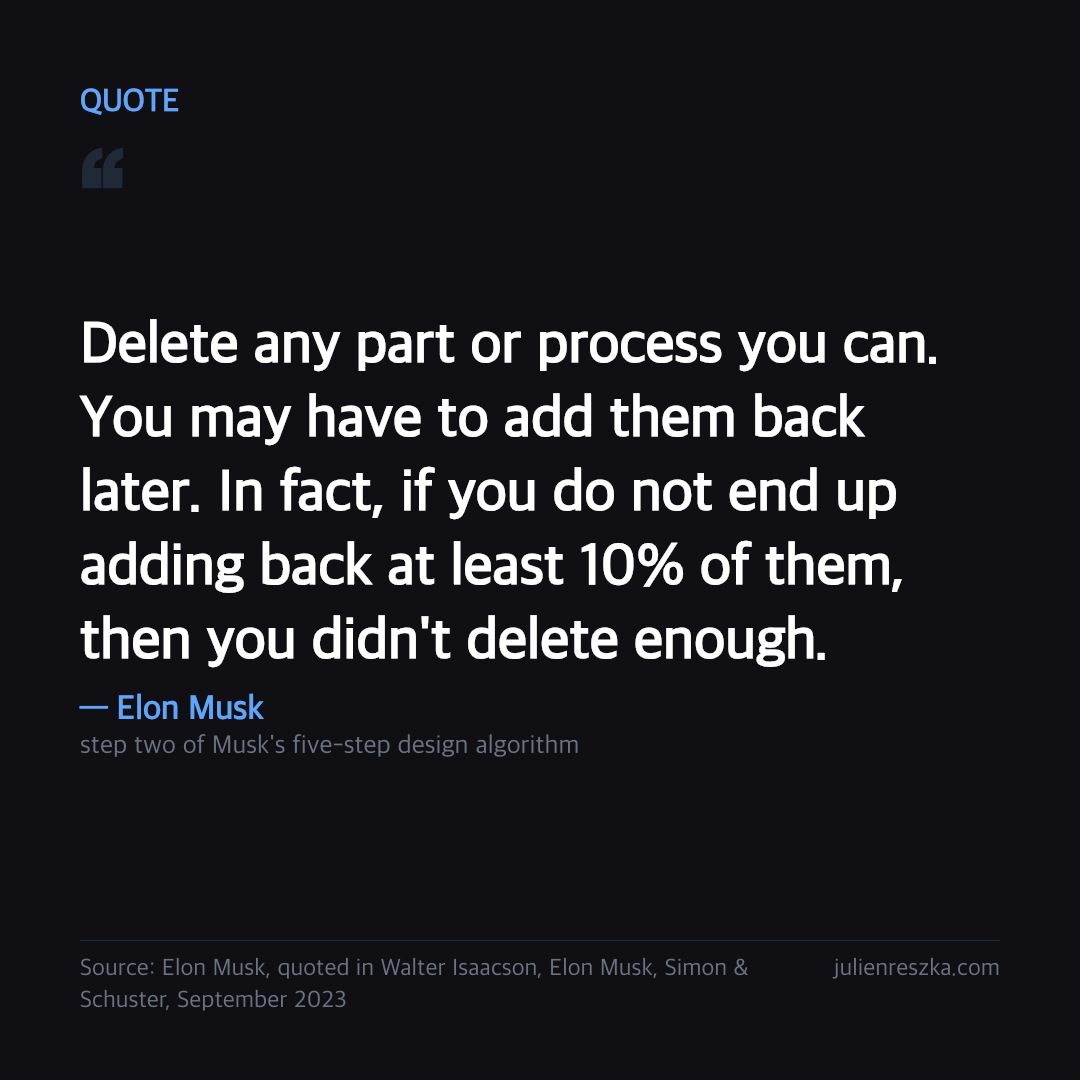
- Delete the part or process entirely. If you are not occasionally adding things back in after deleting too aggressively, you have not deleted enough.
- Simplify or optimise. Only here, in third position, does the word 'optimise' appear, because optimising a process that should not exist is waste disguised as progress.
- Accelerate cycle time.
- Automate.
Musk's own admission is that he has personally made the mistake of going in reverse: automating first, then accelerating, then simplifying, and paid for it. Dara Khosrowshahi at Uber makes the same point from a different angle: when Uber's mobility business lost 85% of its volume overnight at the start of the pandemic, the response was not careful deliberation. It was top-down and fast, because a decision that is twenty percent off but made immediately beats a perfect answer that arrives after the window has closed. The process question and the decisiveness question are the same: are you spending time on things that should not exist?
Discussion
Yes. We just spent six weeks automating a weekly report that, when I asked, nobody reads. Should have deleted the report and skipped steps two through five entirely.
Same pattern at our place: beautifully automated processes that should never have existed.
We did a 'what would break if we just turned this off' audit last quarter. Answer for 30% of our internal tooling: nothing. Turned them off, nobody noticed, saved six hours of upkeep a week.
Yes. Whole team is heads-down optimising a checkout flow that 4% of users complete. The actual question is whether the flow should exist at all in its current shape.
We deleted an internal monitoring system under exactly this logic (non-critical, had workarounds) and six months later had an outage that the system would have caught in under two minutes. Deletion requires knowing which things are load-bearing in non-obvious ways. The framework is right as a posture; the hard part is knowing when a workaround is real versus theoretical.