 Julien Reszka
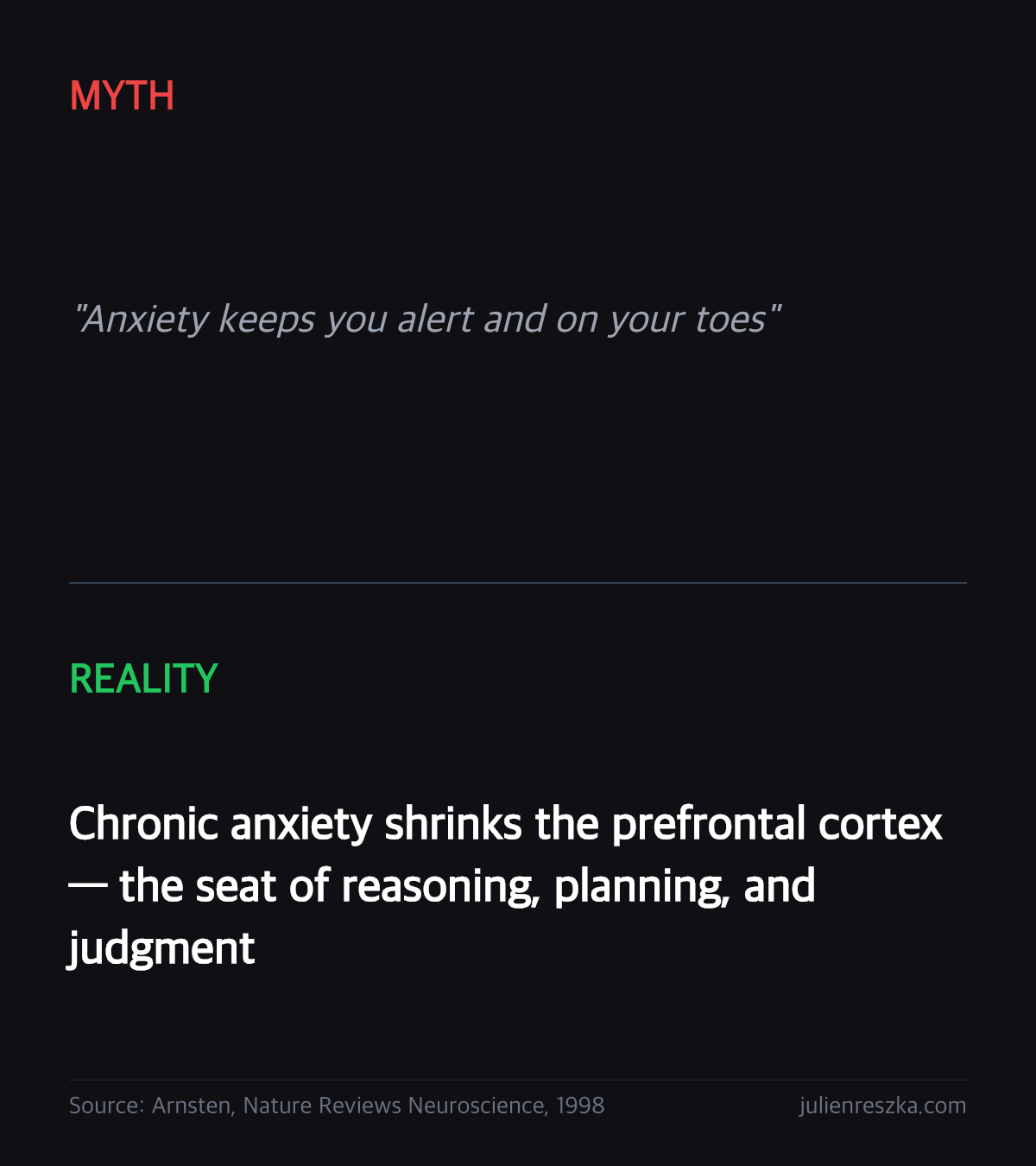
Chronic anxiety does measurable damage to the prefrontal cortex, the part of the brain responsible for reasoning, planning, and judgment. If your job requires intelligence, allowing yourself to stay anxious is a professional liability, not just a personal problem.
What makes this hard today is that platforms like X are architecturally designed to do the opposite of emotional regulation: outrage and threat perception drive engagement, so the feed is optimised to keep your amygdala running hot. Every scroll is a small vote to stay stupid. The propagandist's toolkit works because it hijacks the same survival instincts:
- emotional appeals
- us-versus-them framing
- deliberate simplification
- endless repetition
The practical response is to pull two levers you control:
- control your attention (Stoic dichotomy of control)
- control your physiology (regular physical activity)
The Stoic dichotomy is simple: separate what is under your control (your actions, effort, schedule, and attention) from what is not (other people's opinions, headlines, algorithm swings, macro events). Act hard on the first list, and deliberately release the second. Anxiety loses fuel when it has fewer uncontrollable targets to attach to.
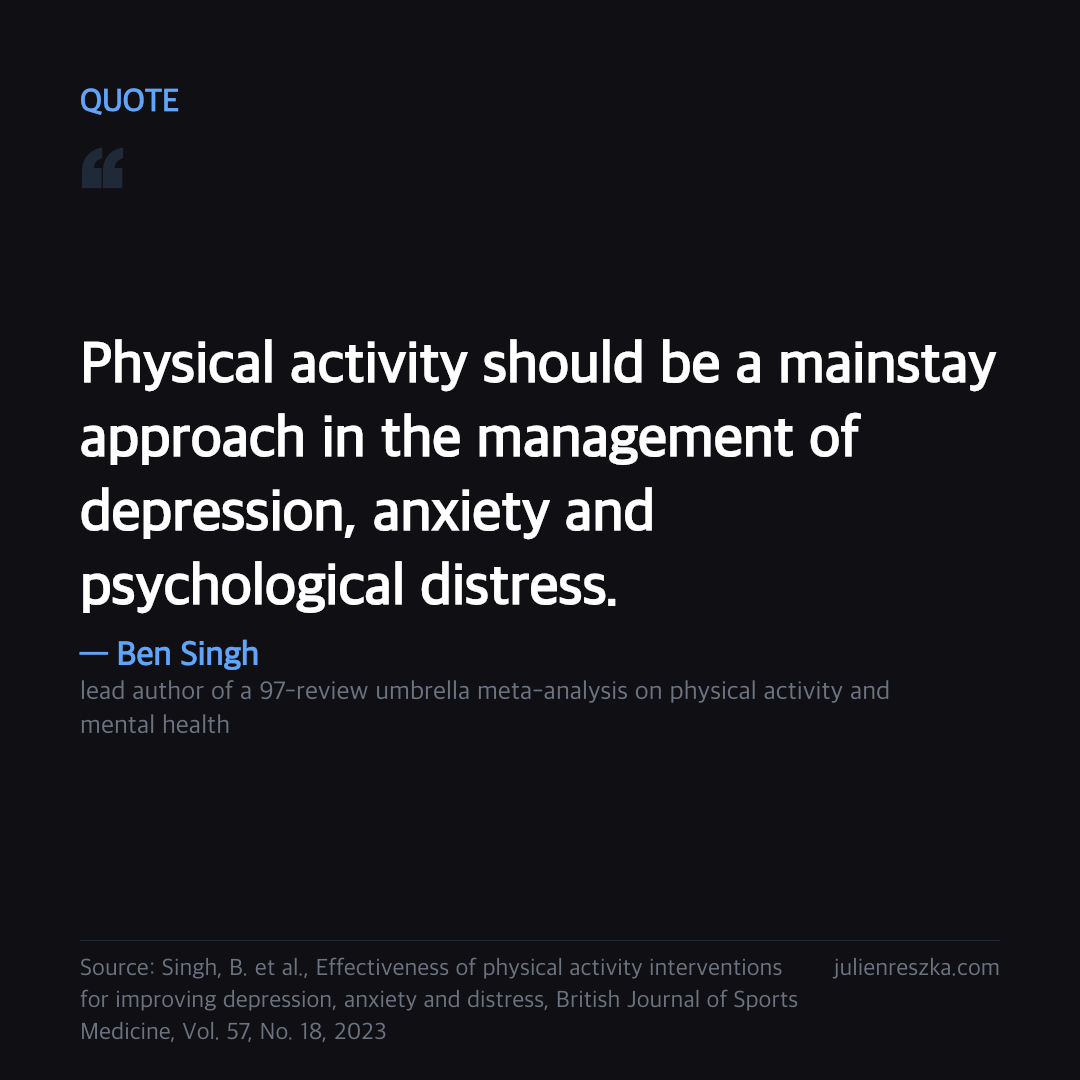
A major umbrella review published in the British Journal of Sports Medicine (97 meta-analyses, 1,039 randomised trials, 128,119 participants) found that physical activity reduced anxiety, depression, and psychological distress symptoms more than usual care, and reported effects stronger than psychotherapy and common medications for mild-to-moderate symptoms. In plain language: regular exercise can outperform psychiatric drugs for many people in this group. Source: bjsm.bmj.com/content/57/18/1203.
The mechanism is plausible and practical: movement lowers physiological arousal, improves stress regulation, and gives your nervous system repeated evidence that you are not under immediate threat. Fear circuits calm down, and higher-order thinking comes back online.
A practical baseline from the exercise evidence is about 150 minutes per week, using whatever format you will actually sustain: brisk walking, running, cycling, strength training, sport, or yoga. This is not a moral badge. It is maintenance for the organ you use to think.
Start with one daily control audit and one scheduled workout.
Discussion
Yes. I notice that on days when I'm scrolling X heavily I can't hold a problem in my head for more than two minutes. The mechanism is no longer abstract for me.
Same. Cut my feed to 30 follows last month, all people who give concrete advice, and my focus measurably came back.
Same. Whenever I notice I'm rereading the same paragraph three times, that's the signal: close the laptop, walk, come back. Trying to power through always costs more time than the break would have.
Yes. The doom-scroll → bad sleep → degraded thinking → more doom-scroll loop is real. Starting a Stoic morning write-down tomorrow.
The Stoic dichotomy is the most useful advice I've seen for low-grade situational anxiety. But it doesn't work for clinical anxiety, which isn't primarily a philosophical error. It's a physiological one. Telling someone with a dysregulated nervous system to 'decide what's in your control' is like prescribing willpower for a broken leg.