 Julien Reszka
When I am sad, I rarely look sad. I look angry.
For a long time, I did not even notice the difference. Something hurts, and a few hours later I am irritated, short with people, ready for a fight. Anger shows up so fast that the sadness underneath never gets a turn.
After my last breakup, I felt numb for a month. Then it all came at once: hurt and anger, mixed together, and shame about the anger. Looking back, most of that anger was sadness I did not let myself feel.
I do not think I am unusual. This is what I learned about why men turn sadness into anger, why that is risky, and what actually helps.
Anger is the emotion we are allowed
Most of us learn early which feelings are acceptable. For men, the list is short. Anger is on it. Sadness is not.
People hold this rule even when they do not say it. In a study of emotion stereotypes, Ashby Plant and her colleagues found that people saw sadness and fear as typical of women, and anger and pride as typical of men. Anger was one of the few emotions people expected more from men.
The training starts young. Tara Chaplin and her colleagues filmed 60 children playing a game with their parents at ages 4 and 6. Girls showed more sadness and anxiety than boys, and fathers paid more attention to those feelings in girls than in boys. Emotions that get attention get repeated. Emotions that get ignored go quiet.
So by the time we are adults, many of us have one channel left. Anger feels strong and in control. Sadness feels weak and exposed. When something hurts, the hurt comes out through the only channel that feels allowed.
Why sadness is so hard to allow
Being sad means admitting that something matters to you and that you could not control it. For a man raised to rely on himself, both feel like failure.
The cost of that rule is measurable. A review that pooled data from 19,453 people found that men who conformed more to traditional masculine norms had worse mental health and were less likely to seek psychological help. Self-reliance was one of the norms most consistently linked to poor mental health.
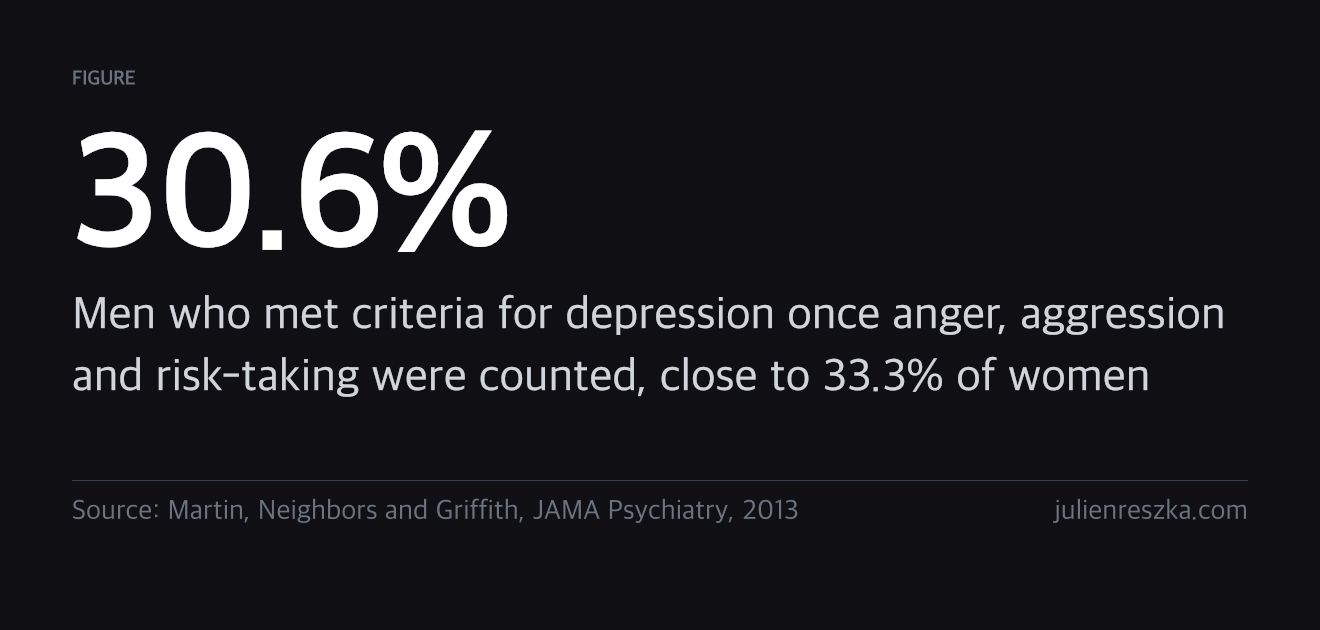
Hiding the sadness does not make it go away. It changes its shape. Lisa Martin and her colleagues analyzed a large American survey. Besides the classic symptoms, like sadness and loss of interest, they also counted symptoms that men report more often: anger attacks, aggression, substance use and risk-taking. With both counted, 30.6% of men and 33.3% of women met the criteria for depression, too close to call a real difference. The usual gap, where women seem far more depressed than men, mostly disappeared.
Not every angry man is depressed. But in many men, depression looks less like crying and more like irritation.
The frustration that comes with it
Holding sadness in is not a neutral act. It takes effort, and the effort itself is frustrating.
You feel something heavy, you cannot name it, and you cannot put it down. Everything starts to grate. Small things, like a slow driver, a late reply or a question asked twice, feel like attacks. You are not angry at them. You are angry because you are carrying something and no one can see it.
Hiding emotions also makes you worse at connecting with people. In two experiments where people discussed an upsetting topic, those told to hide their emotions communicated worse, built less rapport and raised the blood pressure of both people in the conversation. The feeling does not stay inside you. It leaks into the room.
The risk of lashing out
This is where it gets dangerous. Anger built from hidden sadness looks for a target, and it rarely picks the right one.
Psychologists call it displaced aggression: taking it out on someone who did not cause it. In three studies, Brad Bushman and his colleagues found that people who kept replaying something that had made them angry were more likely to lash out at someone else after a minor annoyance. The real cause came earlier. The person who took the blame just happened to be there.
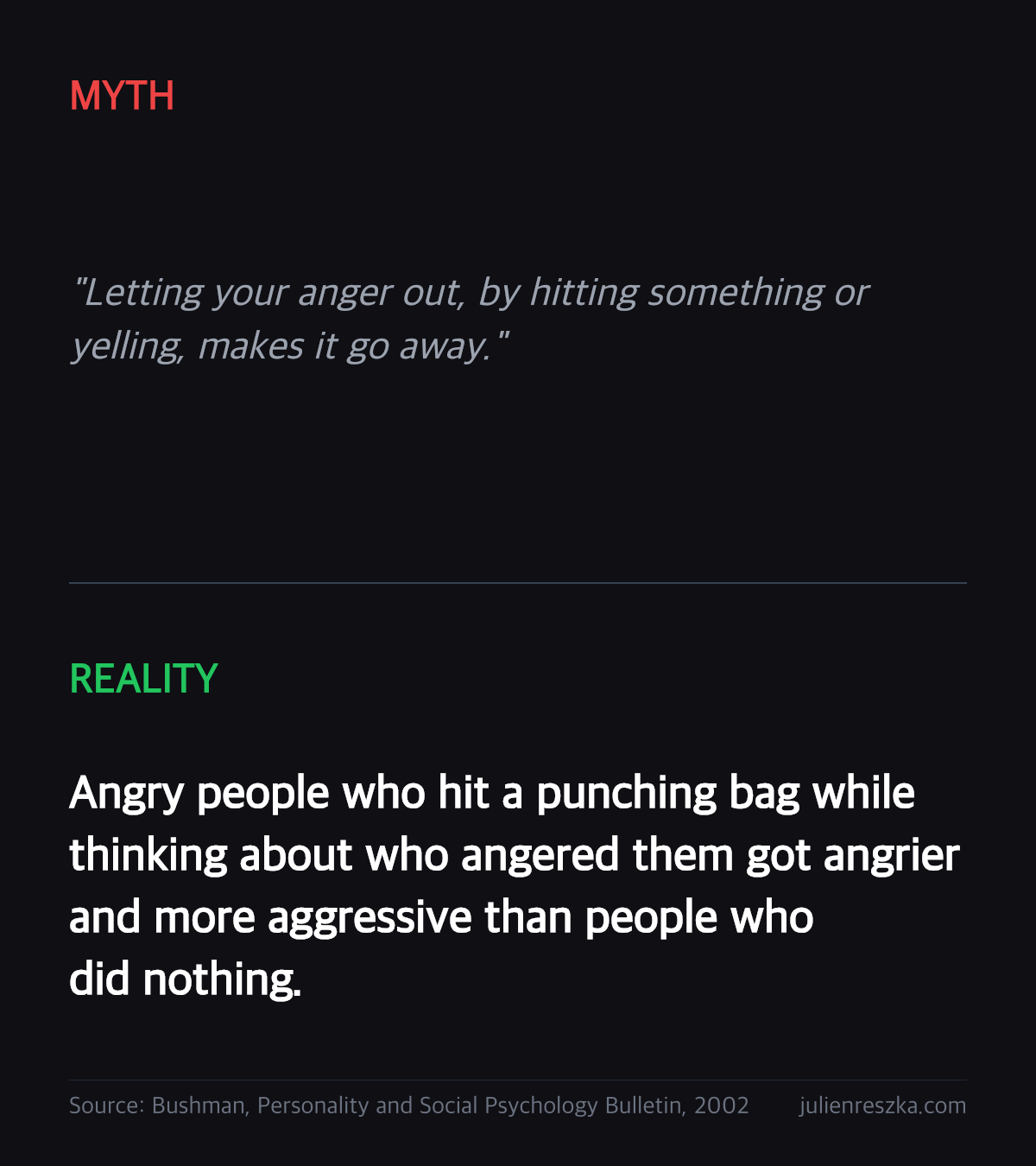
Venting does not fix it either. In a classic experiment, Bushman made people angry and then let some of them hit a punching bag while thinking about the person who angered them. They ended up angrier and more aggressive than people who did nothing at all. Letting it out by force kept it alive.
A review of 154 studies with more than 10,000 people reached the same conclusion. Activities that get your heart pumping, like hitting things or even jogging, did not reliably reduce anger. Activities that calm the body, like slow breathing, relaxation and taking a timeout, did.
The stakes go beyond a ruined evening. The people closest to you are the most likely targets, because they are there. And when sadness has nowhere to go, some men turn it on themselves. In the United States, men die by suicide at three to four times the rate of women.
What helps
The goal is not to stop being angry. Anger is useful when something is wrong. The goal is to stop using anger as a cover for everything else.
Name it. Saying what you feel, even silently, lowers its intensity. In a brain imaging study led by Matthew Lieberman, people looked at angry or scared faces. When they put a word on the emotion, their amygdala, the brain's alarm system, calmed down more than when they did other tasks with the same faces. "I am sad" is harder to say than "I am angry", but it is also more accurate, and accuracy calms.
Ask what is under the anger. When you are irritated for no clear reason, ask yourself what you lost, what you miss or what you fear. Often the answer is a sadness you skipped.
Calm the body first. Slow breathing, a walk without headphones, leaving the room before you say something you regret. The research favors calming down, not letting it out.
Tell one person. You do not need a crowd. One friend who can hear "I am not doing well" without trying to fix it is enough to start.
Deal with it now, from a distance. Do not wait for it to pass. Sadness you put off does not disappear. It sits there and turns into frustration. Deal with it right away, but from outside yourself.
In two experiments, Dominik Mischkowski, Ethan Kross and Brad Bushman made people angry, then asked some of them to replay the moment like a fly on the wall, watching themselves from a distance. Those people felt less angry and were less aggressive afterward than people who relived it through their own eyes.
Distance also leads to better decisions. In three experiments with 693 people, Igor Grossmann and Ethan Kross found that people reasoned more wisely about a friend's relationship problem than about their own: they considered other points of view and looked for compromise. When people thought about their own problem using their name instead of "I", the gap disappeared.
The easiest way I know to get that distance is writing fiction.
Writing fiction
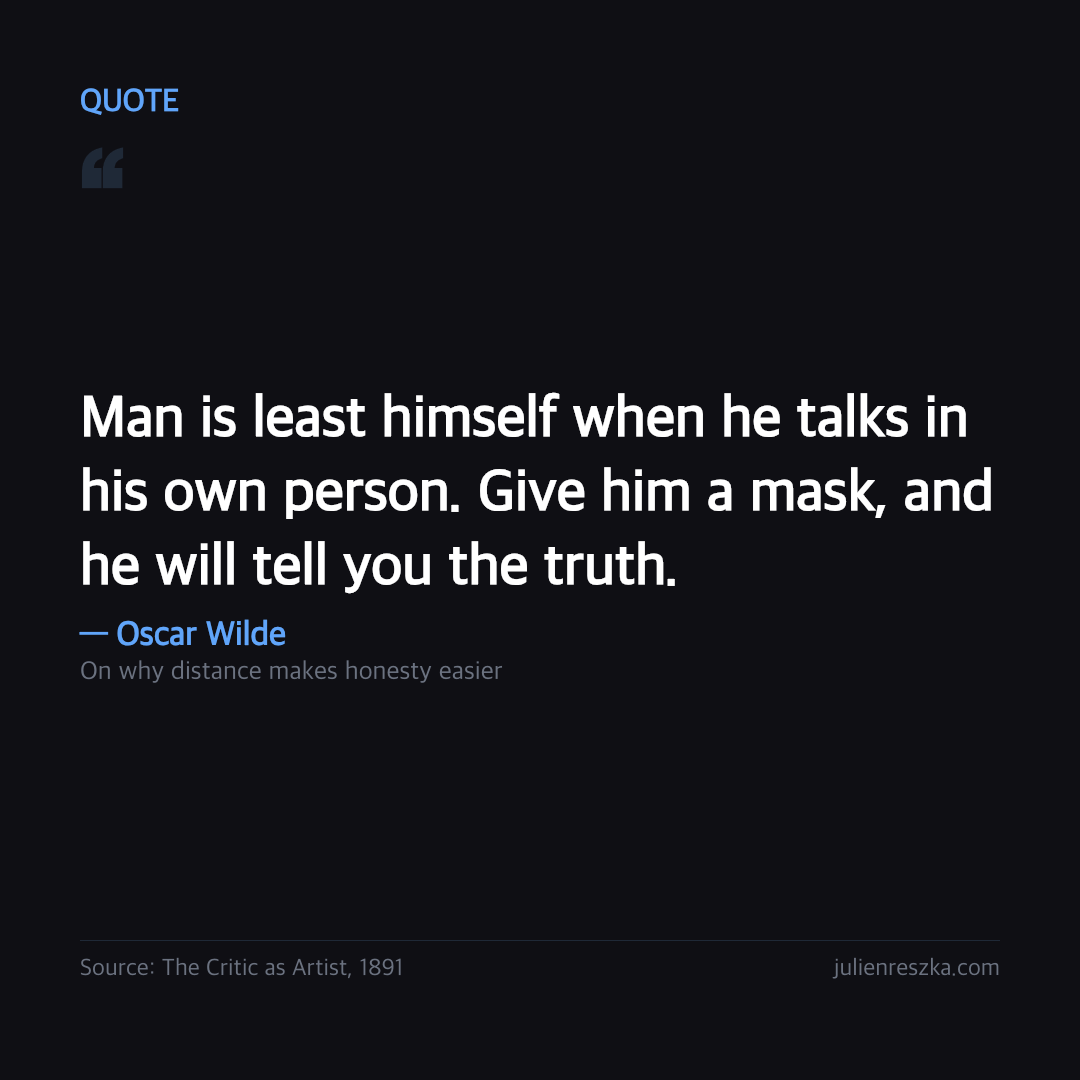
Fiction is a good escape, and it can be a way to heal, because it gives you distance. You do not have to say "I am sad." A character can be sad for you. You can give that character your loss, your anger and your silence, and watch what they do with them. That is easier to face than a blank page with your own name on it.
And once it is not you, you see more clearly. You can ask what the character should do next, the way you would advise a friend. The answer is usually wiser than what you would have done in the heat of the moment.
Research on expressive writing supports this. A meta-analysis of 146 randomized studies found that writing about emotional experiences had a small but real benefit for mental and physical health. More surprising, it may not need to be your own story. In a study by Melanie Greenberg and her colleagues, students were randomly assigned to write about a real trauma, an imagined trauma or trivial events. Those who wrote about imagined traumas showed health benefits too, and right after writing, they were less depressed than those who wrote about real ones.
You do not even need to invent a character. You can write about yourself in the third person. Not "I left the dinner angry," but "He left the dinner angry," or use your own name. In seven studies with 585 people, Ethan Kross and his colleagues found that people who reflected on themselves using their name and "he" or "she" instead of "I" saw stressful situations as more of a challenge and less of a threat, and gave better speeches when put on the spot.
It also takes little effort. In a brain study led by Jason Moser, people who talked to themselves in the third person while looking at upsetting images showed a smaller emotional response within a second, with no sign of extra mental effort.
So writing fiction does three things at once. It lets you escape for a while, into a world you control. It lets you work through real feelings without having to confess them directly. And it gives you enough distance to decide well. For men who struggle to say "I am sad," that may be the easiest door in.
In practice
When you notice anger that seems bigger than the situation:
- Name the feeling. Ask whether sadness, loss or fear is underneath.
- Do not vent by force. Hitting things and yelling keep anger alive.
- Calm your body first: slow breathing, a walk or a timeout.
- Tell one person you trust that you are not doing well.
- Do not wait for it to pass. Deal with it right away, from a distance.
- Write it down as fiction: give the feeling to a character and decide what they should do next.
- If inventing a character feels like too much, write about yourself in the third person, using your name.
- If the sadness lasts for weeks, or you think about hurting yourself, talk to a doctor or a therapist.
Sadness is not weakness
Many men grow up believing that anger is strength and sadness is weakness. It is closer to the opposite. Anger is the easy part. It takes no courage at all.
Letting yourself be sad means admitting that something mattered. That is not weakness. It is honesty, and it is usually the first step out.
Discussion