 Julien Reszka
She always wanted news. Where I was, who I was with, when I would be back. If I was slow to reply, she assumed something was wrong.
She also always thought I was about to cheat on her. I never did. Walking in the street was enough. If another woman looked at me, she got mad. Not at the woman, at me. All I had done was walk.
In the end, she was the one who broke up with me. She left because she thought I did not love her. I did.
I call her anxiously attached in this post. She never took a test, and I am not a psychologist, so read that word as my best explanation, not a diagnosis. This is what I learned, and what research says about it.
What anxious attachment means
Researchers measure attachment on two scales: anxiety, the fear of being left, and avoidance, the discomfort with being close. Everyone sits somewhere on both. When researchers tested this directly, attachment fit continuous scales better than separate types. Anxious is a position on a scale, not a box you are stuck in.
People high on anxiety deal with the fear of being left by turning the alarm up. Mario Mikulincer and Phillip Shaver call these hyperactivating strategies: watching the other person closely, asking again and again for signs of love, and reading small signals as big threats.
From the outside, it can look like control. From the inside, it probably feels like fear.
Always wanting news
The constant need for news was the first thing I noticed. It fits the research. In a study of women and their cell phone use with their boyfriends, those higher in attachment anxiety sent and received more text messages, both in their own estimates and in the actual counts.
The texts were never enough, because the need was not really about information. Psychologists call this excessive reassurance seeking: asking for proof that you are loved, even after you already got it. In two studies of 133 couples, Phillip Shaver and his colleagues found that attachment anxiety helped explain why people seek reassurance this way, and why it goes with depression and worse relationships.
An answer calms the fear for an hour. Then the fear comes back and needs a new answer.
Jealous in the street
The street was the hardest part to understand. I could control what I did. I could not control who looked at me.
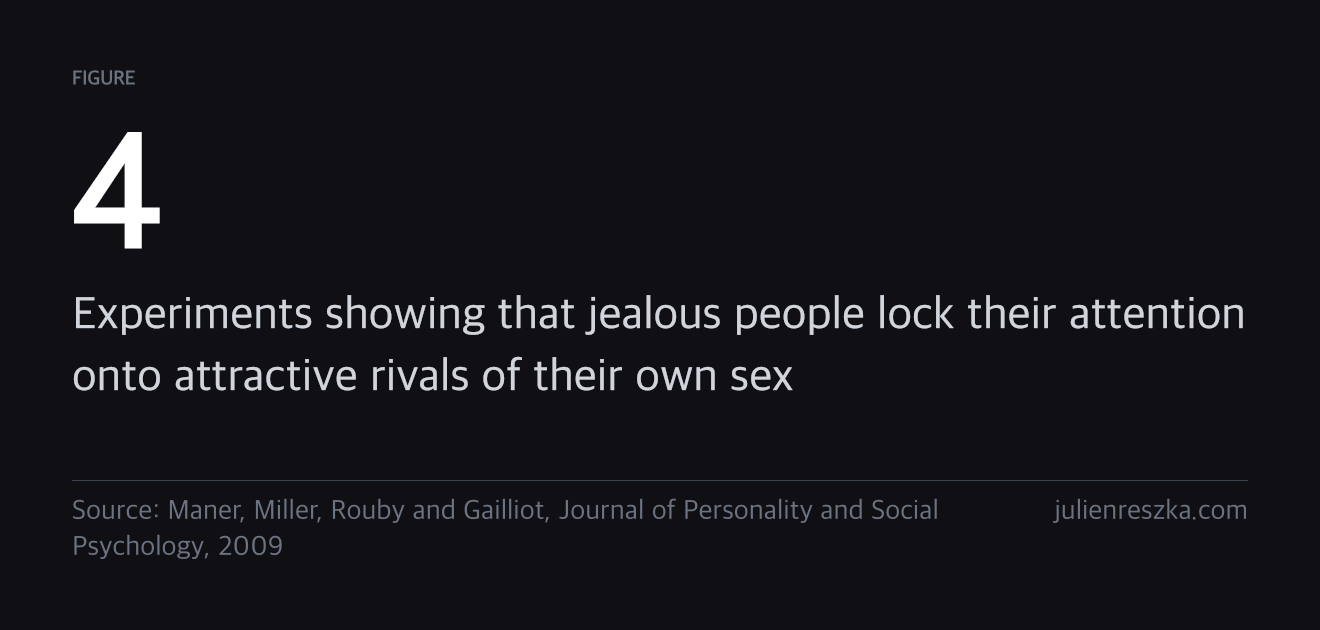
Research suggests she may have noticed those women before I did. In four experiments, Jon Maner and his colleagues found that people prone to jealousy, once they were thinking about infidelity, locked their attention onto attractive people of their own sex. They also remembered them better and judged them more negatively. They did not choose to do this. It happened early, before conscious thought.
So when we walked together, her mind may have been scanning for rivals. Every woman who glanced my way was a possible threat, and I was the one who had to answer for it.
Seeing clearly did not help either. In a study of dating couples, each person rated photos of attractive people of the opposite sex while the other watched, and then tried to guess what their partner had been thinking. More anxious people guessed better. But they also felt more distress and less confident in the relationship. Being accurate hurt them.
The same pattern shows up online. In a study of Facebook users in relationships, more anxious people felt more jealousy and checked their partner's page more, partly because they trusted their partner less. On days they felt jealous, they checked more.
Why was she mad at me and not at them? I can only guess. The women in the street were strangers. I was the one she could reach, and the one she was afraid to lose.
Why my reassurance did not work
I am a confident person. I did not cheat, so I told her the truth: she had nothing to worry about. I said it many times. It never lasted.
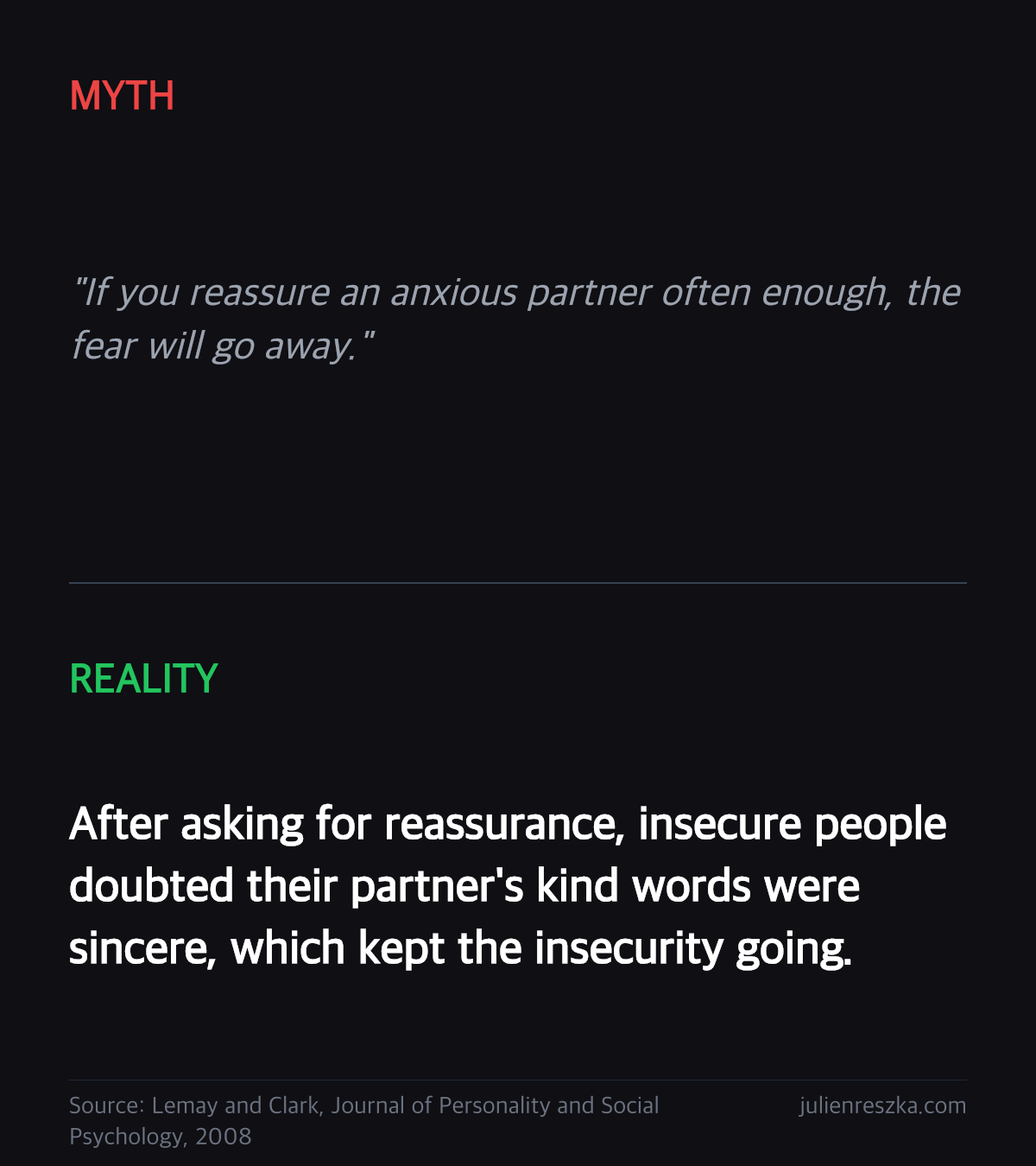
Research explains why. Ed Lemay and Margaret Clark studied what happens when insecure people express their insecurity. Once they had asked for reassurance, they started to believe their partner saw them as fragile. Then they doubted the kind words they got back: he is only saying that because I asked.
So the more she asked, the less my answers counted. Reassurance she had to ask for felt like reassurance she had forced out of me.
The same behavior can also mean very different things depending on who sees it. In a study by Nancy Collins, people read about a boyfriend or girlfriend who did not respond to a cuddle or wanted an evening alone, and then explained why. Anxious people gave more negative explanations. A slow reply was not a busy afternoon to her. It was a sign.
Why she left
This is the part that still surprises me. She was afraid of losing me, so she left.
It makes more sense with the research. Sandra Murray, John Holmes and Dale Griffin studied couples and found that people with low self-esteem badly underestimated how positively their partner saw them. They read ordinary problems as signs that the love was fading. Then they protected themselves by pulling away.
Geraldine Downey and her colleagues found something similar with people who expect rejection. In their studies of dating couples, women who were sensitive to rejection acted in ways during conflicts that made their partners more rejecting afterward, and the relationships of people who expected rejection were more likely to end. The fear helped create what it feared.
In our case, I was not the one rejecting. She decided I did not love her, and she left before I could leave her. If you are sure the end is coming, ending it yourself at least feels like control.
What it might have looked like from her side
Only she can tell this part. But the research allows some educated guesses, and they make the story fairer.
To me, asking where I was all the time felt like being watched. To her, it may have been the only way to calm down. Not knowing was the hard part, and news was the cure, at least for a while.
When women looked at me, she probably did not see strangers. She saw women who could take her place. Her anger may have been fear with nowhere else to go.
My calm may have looked like not caring. I did not react much to her worries because I knew there was nothing behind them. But to someone anxious, a partner who does not share the worry can look like a partner who does not care enough to worry.
She probably would not call herself anxiously attached. She would more likely say she loved me more than I loved her. I do not think that was true. But I believe she felt it.
In practice
If you are with someone who always needs proof that you love them:
- Do not treat their fear as an accusation, even when it sounds like one. It is usually about them, not you.
- Reassure without being asked. Unprompted affection is harder to doubt than an answer to a question.
- Be predictable. Say when you will be busy and when you will be back, before they have to ask.
- Do not accept blame for things you did not do, like being looked at in the street.
- Notice if no amount of reassurance is ever enough. That is a sign the fear needs help from a therapist, not more answers from you.
- If they say you do not love them, take it seriously. People who believe it may leave, even when it is not true.
How it ended
She left because she thought I did not love her. I did.
Her fear was that I would leave or cheat. I did neither. She left instead. That is the trap of anxious attachment: the fear of losing someone can make you lose them.
I could not prove my love to someone who had already decided the answer. Love can be given. It cannot be proven to someone who will not believe the proof.

Discussion