 Julien Reszka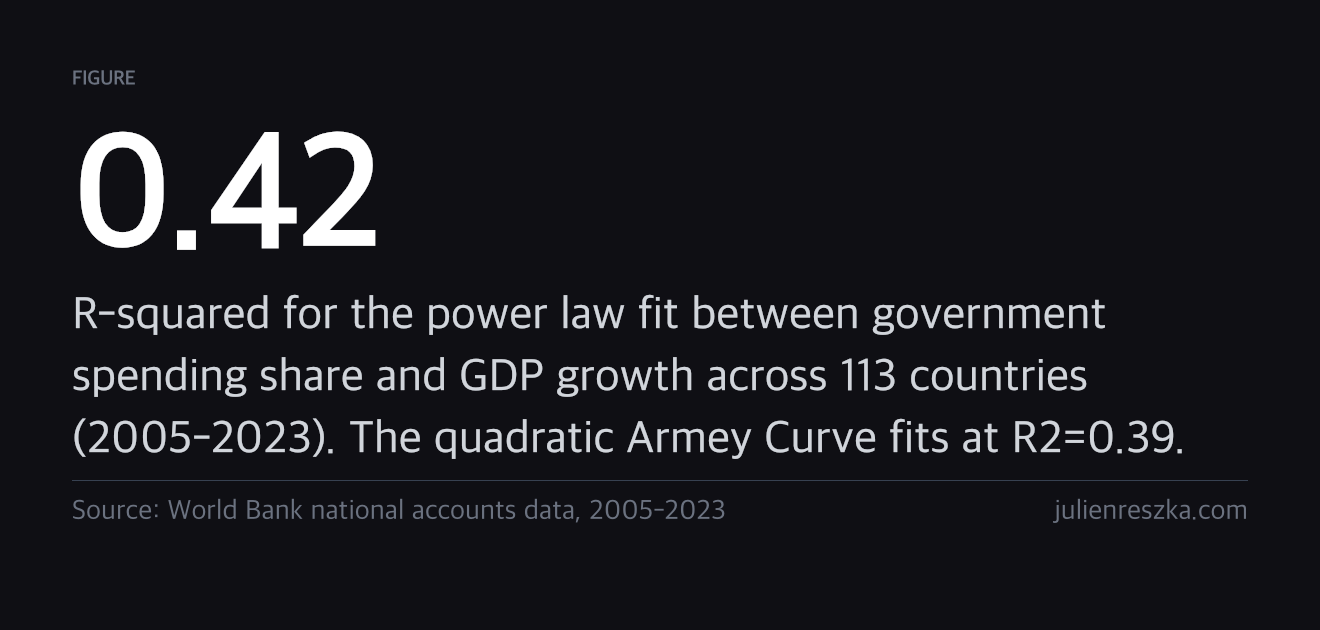
The Armey Curve proposes an inverted-U relationship between government spending as a share of GDP and economic growth. The logic is intuitive: too little government and you have no property rights or courts; too much and you crowd out private investment. Somewhere around 20-30% of GDP is the sweet spot.
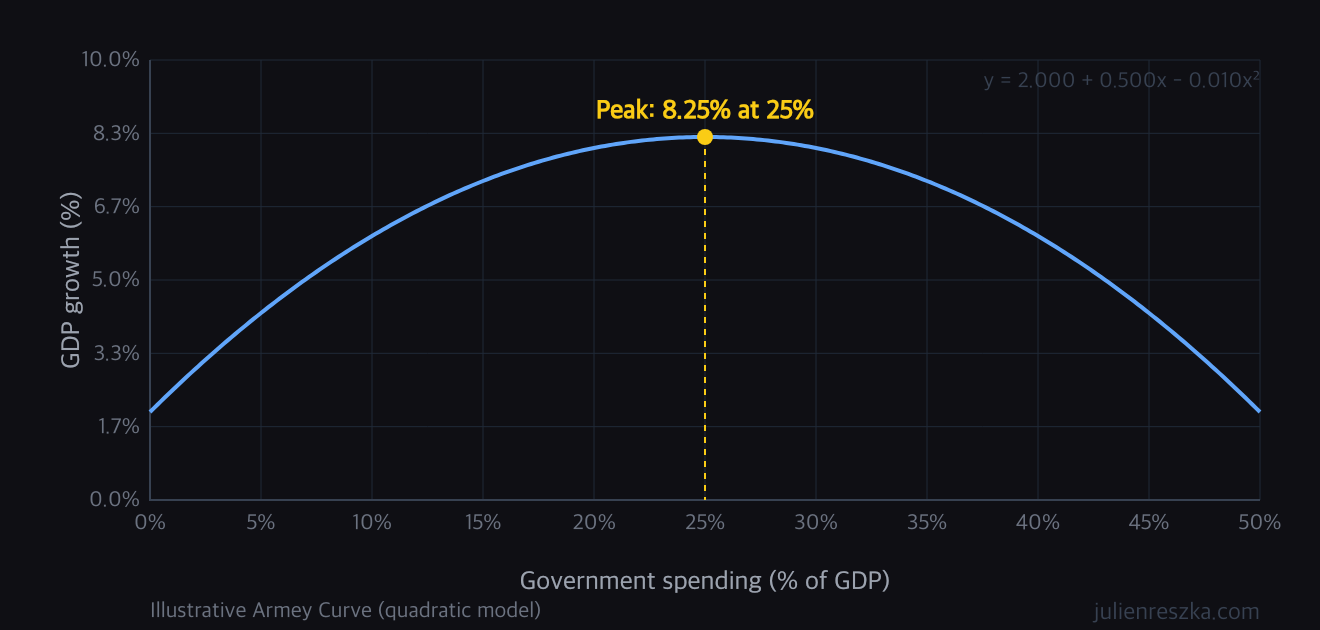
That is the theory: a quadratic (y = 2.000 + 0.500x − 0.010x²) peaking at 25% of GDP with a predicted growth rate of 8.25%.
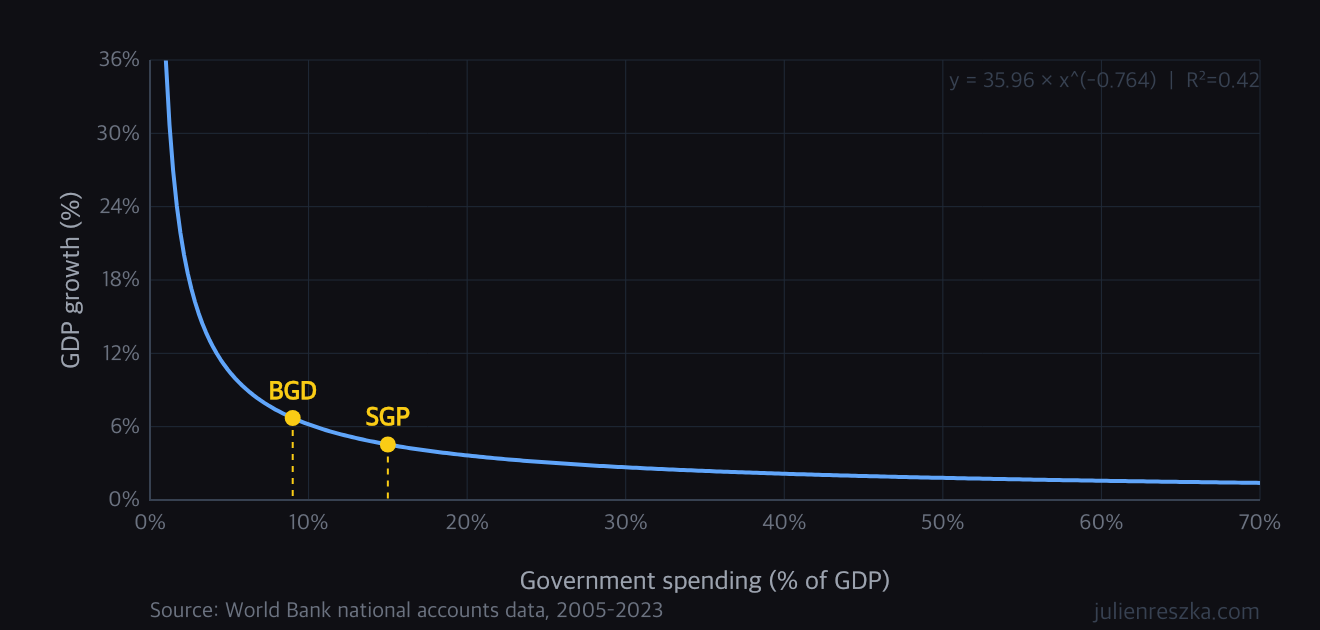
The data does not support a sweet spot.
Cross-country World Bank data from 113 countries over 2005-2023 fits a power law better than any quadratic. R2=0.42 for the monotonically decreasing power law versus R2=0.2490 for the traditional Armey curve. The relationship is not U-shaped. It just goes down.
Some reference points:
- Singapore: government spending around 15% of GDP, persistent above-average growth over decades
- Bangladesh: around 9%, one of the fastest-growing economies of the past two decades
- South Korea built its high-growth phase with government under 20%
- High-spending OECD economies consistently underperform on growth relative to their income level
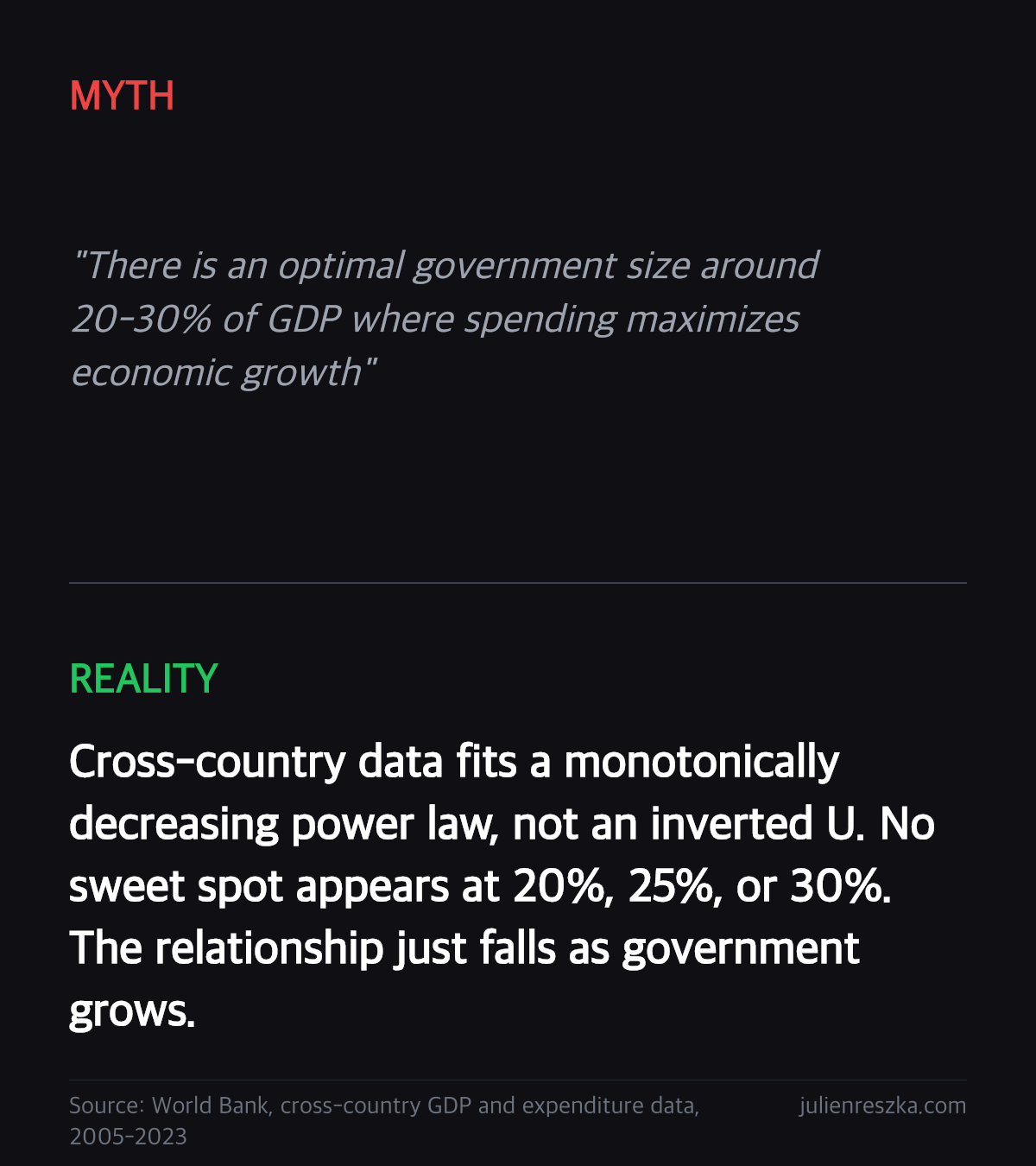
No sweet spot appears at 20%, 25%, or 30%. The curve keeps falling.
A country like France sitting on the flat end of this curve is not evidence that its spending is costless. France can sustain high spending because it is drawing on wealth built up over centuries: infrastructure, institutions, education, accumulated capital. GDP is a flow, the income produced in a given year, not the stock of wealth a country holds. People routinely confuse the two. A country can post weak growth for years and still look rich, because the stock built before is large enough to mask it for a while. But a weak flow sustained long enough draws the stock down. The curve above measures the flow. It says nothing about how much stock a high-spending country is spending down to sustain it.
This answers how much but not on what. If spending reliably slows growth, the question becomes when the brake is worth pulling.
Two conditions must both be met for an intervention to be justified.
First, the activity must impose a net wealth loss on external parties (people who bear cost without being participants in the transaction), summed across all capital kinds: produced, human, natural, knowledge, and institutional. A factory that poisons a river fails this test. A business that outcompetes a rival does not, because the rival was a voluntary participant in the market.
Second, the intervention must be cost-effective: the deadweight loss from the regulation, plus enforcement cost, plus the probability of regulatory capture multiplied by its expected damage, must be less than the external wealth loss it prevents. A regulation that costs more to enforce than the harm it stops fails this test even if the harm is real.
Activities that satisfy both conditions are genuine negative externalities:
- Pollution that degrades shared resources beyond self-repair rates
- Resource extraction that exceeds regeneration, destroying future productive capacity
- Systemic financial risk, where institutions privatize gains and socialize losses
Activities that fail one or both conditions (licensing requirements that protect incumbents, subsidies that redirect investment toward a demand forecast that nobody can actually plan, only guess, spending programs that transfer wealth without addressing an external cost) slow growth without a welfare justification.
The two-condition test does not require a macroeconomic model. It requires identifying who is bearing cost they did not choose to bear, across what kinds of capital, and whether the intervention is cheaper than the damage it prevents.
The formal criterion is implemented in shouldBreak.js, including the certainty-equivalent pricing rule, the trustworthiness gate, and the required insurance coverage calculation.
Discussion