 Julien Reszka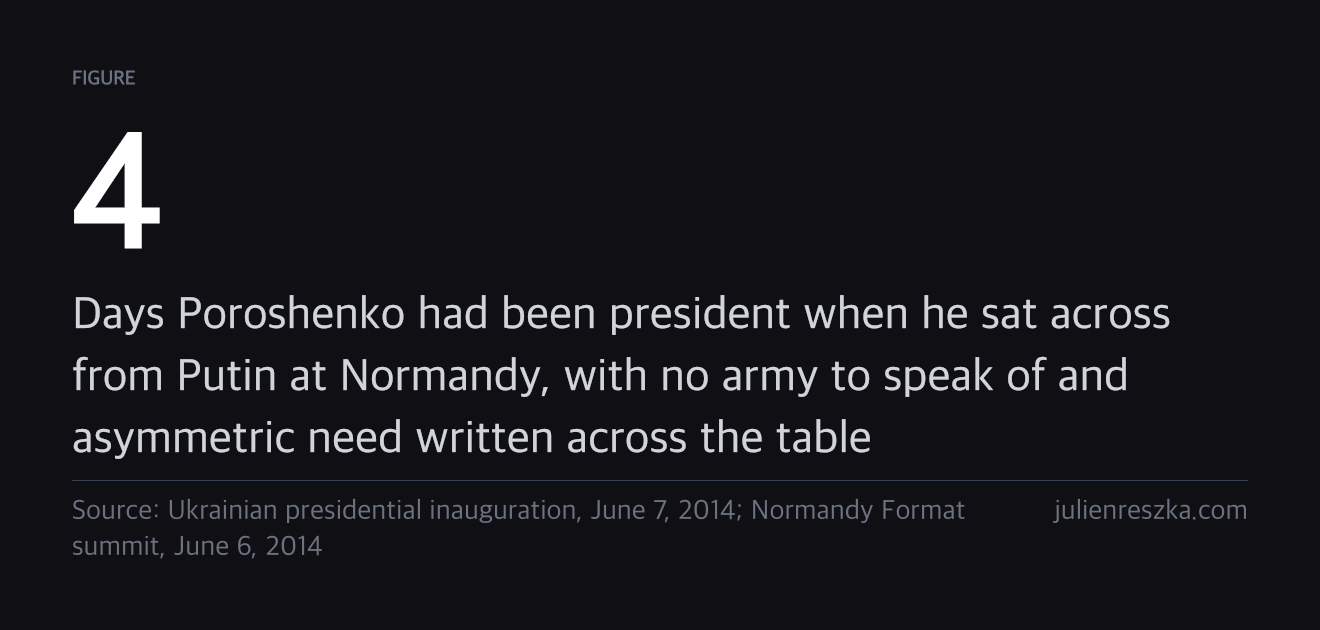
The Normandy summit happened yesterday. I watched the coverage and read the joint statement. My conclusion is that it will produce nothing durable, and the reasons are structural, not diplomatic.
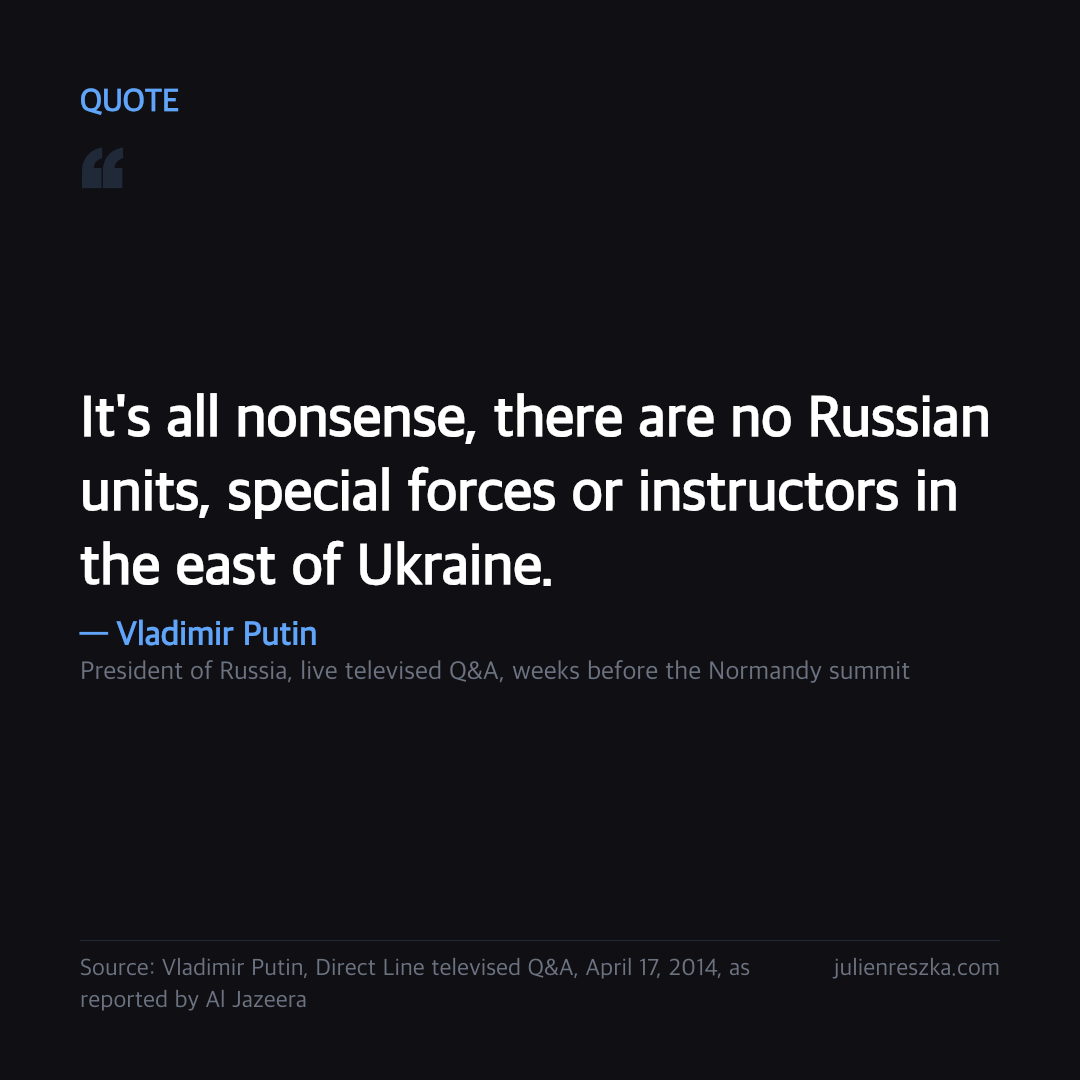
For context: three months ago Russia annexed Crimea. The playbook was the same one now visible in Donbas. Unmarked soldiers in Russian military equipment appeared without insignia, took control of government buildings and military installations, and denied being Russian forces. Putin called them local self-defense volunteers. The referendum that followed was held under military occupation with no independent observers and produced a 97% result in 11 days. Western governments called it illegal. Nothing happened. The lesson Putin drew from Crimea was that the tactic works, denial holds, and the cost stays below the threshold that triggers a real response. Donbas is Crimea with a longer script.
Four things were visibly broken before anyone sat down.
Putin's definitional block
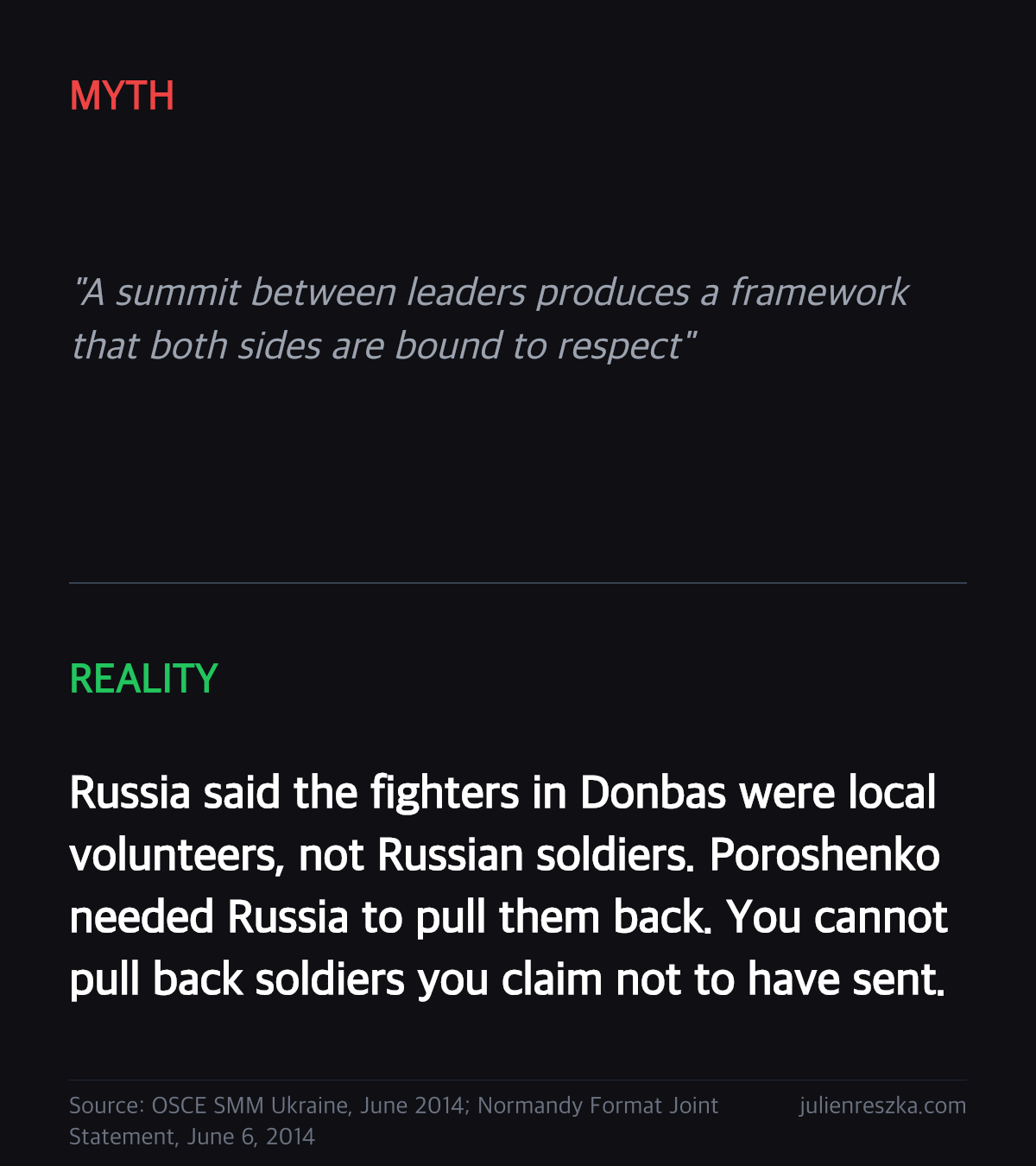
Putin has consistently referred to the fighters in Donbas as local self-defense forces. He said it again at Normandy. This framing is not a negotiating position. It is a structural block. You cannot order a ceasefire on forces you claim not to command. Poroshenko arrived asking Russia to pull back its people. Putin arrived denying those people existed. There is no agreement available between those two descriptions of reality. Any text they sign will use language each side will interpret to mean the opposite thing, and the side with men on the ground will use the ambiguity first.
The timing
The dinner happened June 6. By that point Russian special forces and equipment had already been documented in Donetsk and Luhansk for weeks, using the same tactics first deployed in Crimea. The OSCE and journalists on the ground were filing reports of Russian military hardware crossing the border while the heads of state were passing the bread. Putin did not come to Normandy to stop something. He came to be seen trying to stop something.
Poroshenko's impossible position
Poroshenko had been president for four days. Ukraine's military was in a genuinely degraded state after years of underfunding and Russian penetration of its officer corps. He needed the meeting more than Putin did, and that asymmetry was visible across the table. Asymmetric need in a negotiation always telegraphs the outcome. The party that needs it less sets the terms, and the party that needs it more accepts them or leaves with nothing.
The mediators had no enforcement tools
Merkel and Hollande arrived with goodwill and diplomatic weight. They had no mechanism to compel compliance. Sanctions were discussed but not yet imposed at a level that would change Russian calculations. Nord Stream 2 was already a live project. Germany's structural energy dependence on Russia was sitting in the room, unacknowledged, and it meant Merkel could not credibly threaten the thing that would have mattered.
Hollande arrived with a constraint of his own, less discussed but equally disqualifying. France had a live contract to deliver two Mistral-class helicopter carrier warships to Russia, worth over a billion euros, with the first vessel scheduled for handover later that same year. Cancelling meant returning the money and absorbing the political cost at home, where Hollande was already governing with historically low approval ratings and an economy that had no appetite for expensive confrontation. A mediator who has an arms contract with one of the parties is not a neutral party. They are a creditor hoping the situation stabilises before the invoice comes due. Merkel could not threaten the energy relationship. Hollande could not threaten anything at all without first explaining why France was still scheduled to hand Putin a warship in November.
A mediator who cannot say what happens if you do not comply is not a mediator. They are a witness.
What to watch for:
- Whether the OSCE monitors are given access to the border crossings where Russian equipment has been documented
- Whether the ceasefire text includes a mechanism for attribution when it breaks
- Which side calls the first violation and how the other responds
If the monitors are denied access, the agreement is already dead. If the text has no attribution mechanism, the next violation will be blamed on the other side and the cycle continues. If the first violation produces no consequence from Merkel and Hollande, Putin will have confirmed that the enforcement cost is zero.
The war in eastern Ukraine is not upcoming. It is underway. The question is whether Europe decides to see it.
Discussion