 Julien Reszka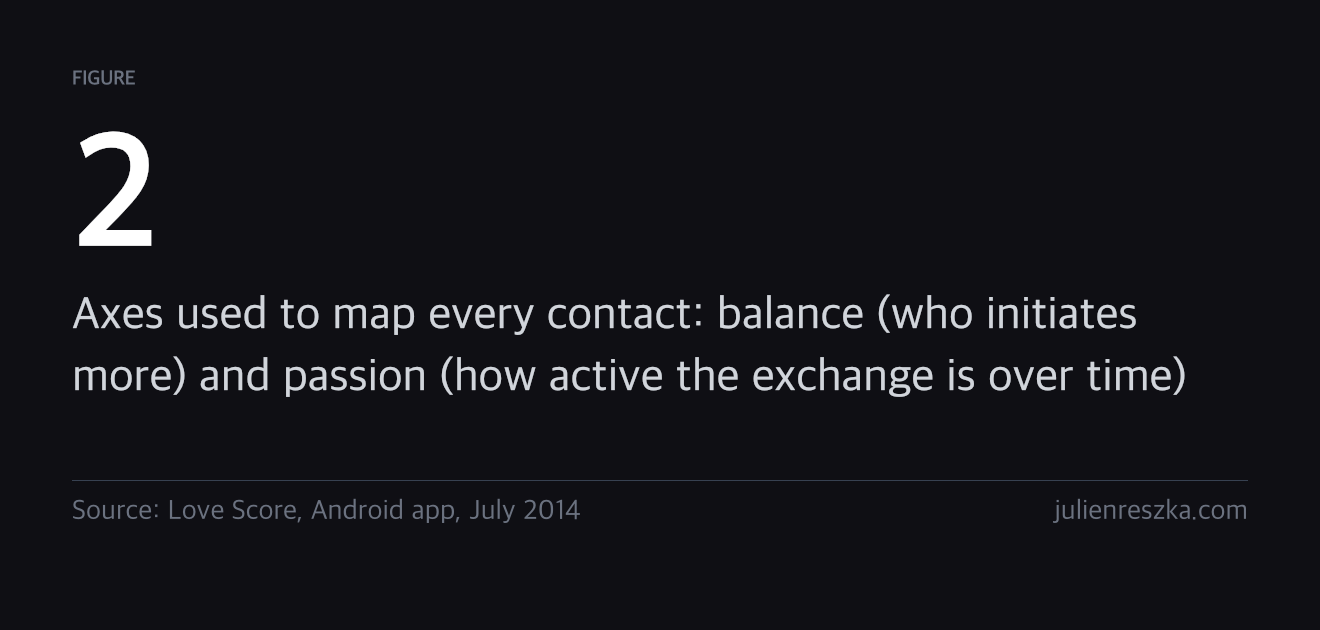
Thomas Jannaud and I released Love Score today on the Android Play Store.
Thomas had been working at Google before we decided to team up. We met at an event for entrepreneurs. That background shaped how he approached the data pipeline: methodical, well-instrumented, and with a clear sense of what mattered at scale.
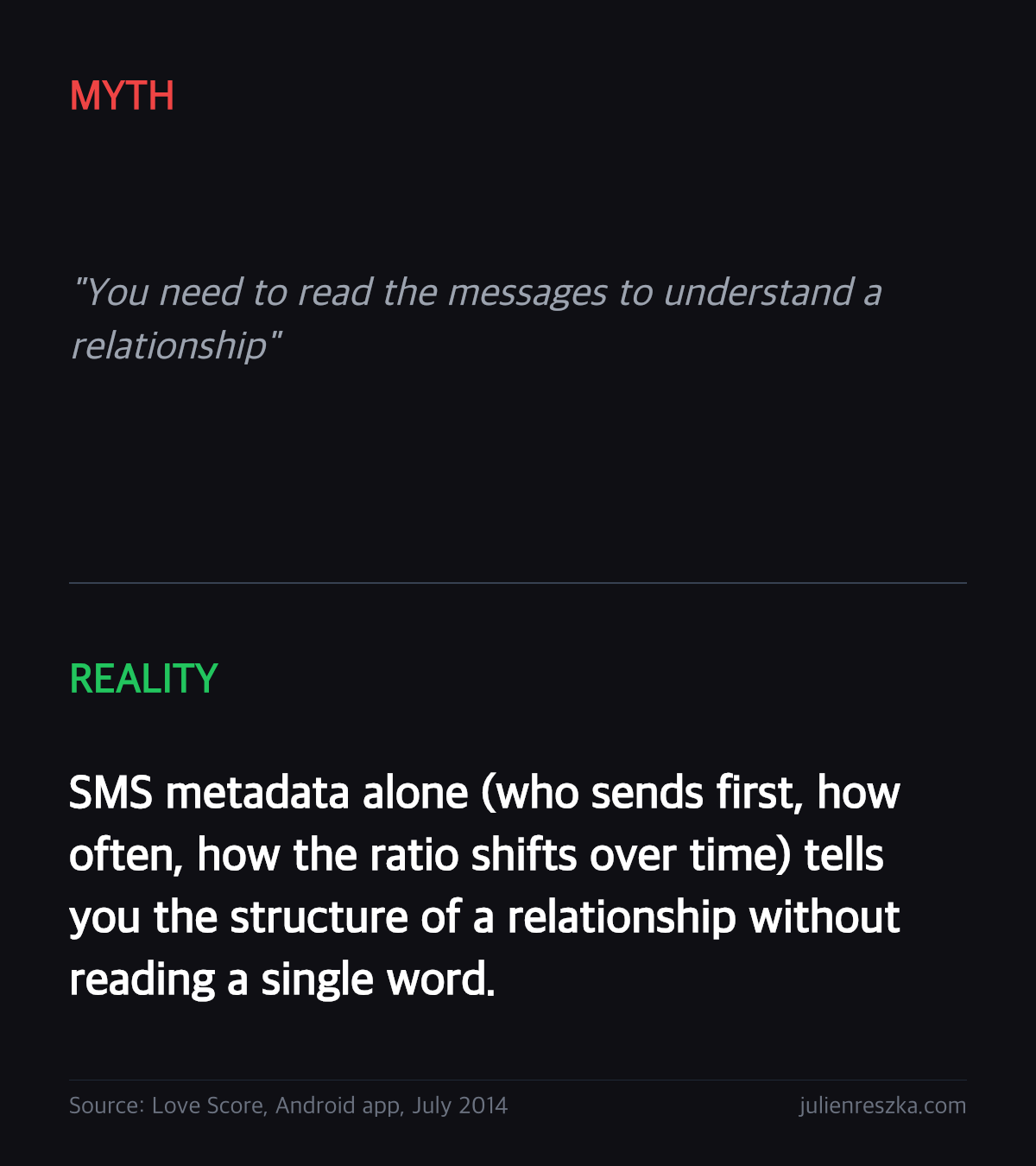
The idea is simple: your phone already contains a record of every relationship you have maintained. Not the content of the messages. The metadata. Who texts whom first. How often. Whether the ratio is equal or lopsided over time.
Love Score reads that metadata and plots every contact as a point on a two-axis chart.
The two axes:
- Balance: the ratio of messages sent to messages received. A contact in the center is an equal exchange. A contact far to one side means one person is doing most of the initiating.
- Passion: the total volume and recency of the exchange. A contact high on this axis has an active, frequent thread. A contact at the bottom is someone you have drifted from.
When you see your contacts plotted together, patterns appear immediately. You can see who you are investing in asymmetrically, who has gone quiet, who the relationship has stayed consistent with for years.
What I learned building this:
- The most revealing data is usually the data you already have. You do not need to instrument new behavior to understand old patterns.
- Two axes is the right number for a first look. More than two and people lose the thread. Fewer and you lose the nuance.
- People are curious but also nervous to see their relationships quantified. The visualization surfaces things they already felt but had not articulated.
- Android at this point was fragmented enough that SMS data access worked differently across manufacturers. A lot of the build time was normalization.
- Thomas and I divided the work well. He handled the data pipeline and I handled the visualization and product decisions.
I did most of the user testing. The pattern was consistent: people were curious about the chart until they saw their own data. Then something shifted. Seeing your contacts mapped by how balanced and active each relationship is turns out to be more confronting than interesting. People did not want to sit with what it showed them. Most sessions ended with the person closing the app rather than exploring further.
We also could not figure out a business model that did not compromise the thing that made the app trustworthy. Charging for the app was the only clean option. Anything involving data (even anonymized aggregate insights) felt like it broke the promise of the product, which was that nothing left your device. The app's integrity and any revenue model based on data were mutually exclusive.
I do not know how many people will use it or whether it will matter. But building it clarified something: the gap between the data you already have and the insight you could extract from it is almost always larger than you think.
Discussion