 Julien Reszka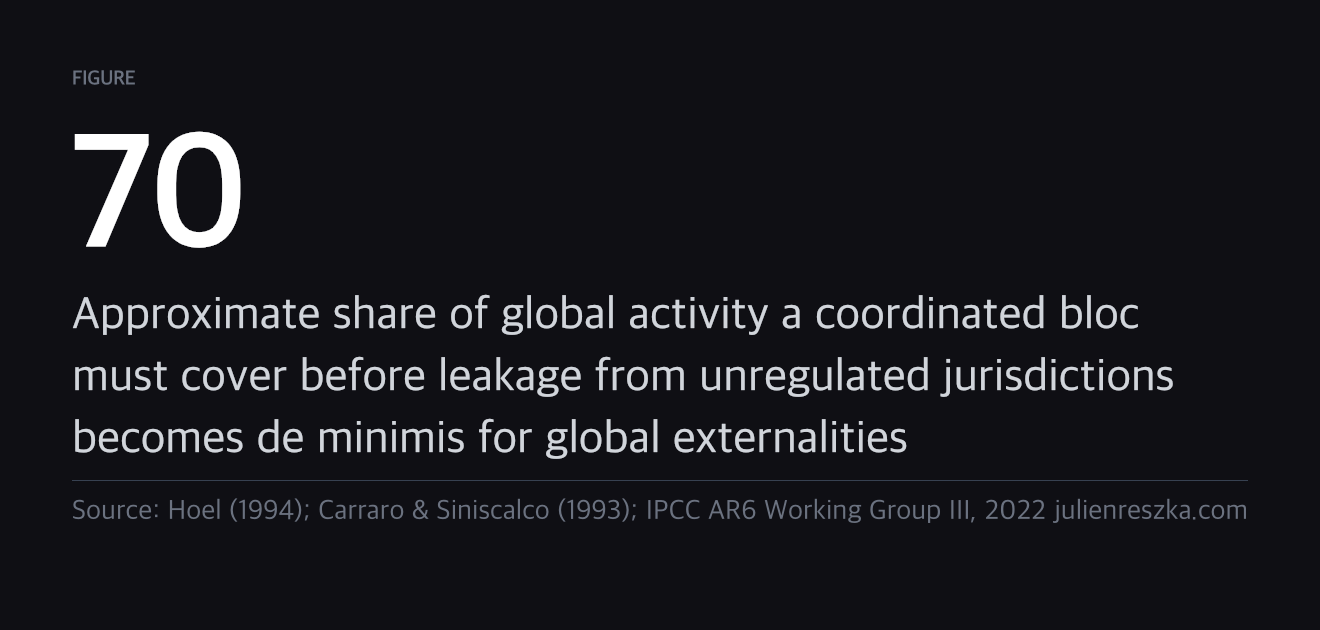
The two-condition test from Government Size Has No Sweet Spot tells you when intervention is justified. It does not tell you which instrument to use, how to avoid the intervention being gamed, or when to act alone versus coordinate with other countries.
Those are three separate questions with different answers.
The instrument that self-enforces
Most regulatory instruments have a structural defect: they require the state to monitor, enforce, and resist capture. Inspectors can be pressured. Caps can be lobbied upward. Fines can be set below the cost of compliance and treated as a license to continue.
Strict liability with mandatory insurance avoids this entirely. The operator must hold a policy covering the maximum credible loss, written at market rates in a competitive insurance market, with no state subsidy and no liability cap. This instrument does five things at once:
- Prices the externality, not the transaction: the premium tracks expected damage, not activity volume
- Self-enforces: either the operator holds a current policy or they do not
- Builds in adversarial verification: the insurer pays out on harm, so they price it correctly and audit the operator
- Gives the state no fiscal stake in the activity continuing: premiums go to insurers, not the Treasury
- Finances the science: the insurer loses money if the risk model is wrong, so they fund the toxicology, epidemiology, and loss modeling needed to price correctly
If the maximum credible loss exceeds insurance market capacity, no policy is written. The activity stops by the absence of coverage, not by a regulator's decision. The market does the work.
Which jurisdiction should act
Whether unilateral action is sufficient depends on the share of external loss that falls outside the deciding jurisdiction. Three regimes:
- Local externality: contained aquifer contamination, airport noise, landfill leachate within one jurisdiction. Per-country action is optimal; leakage does not apply.
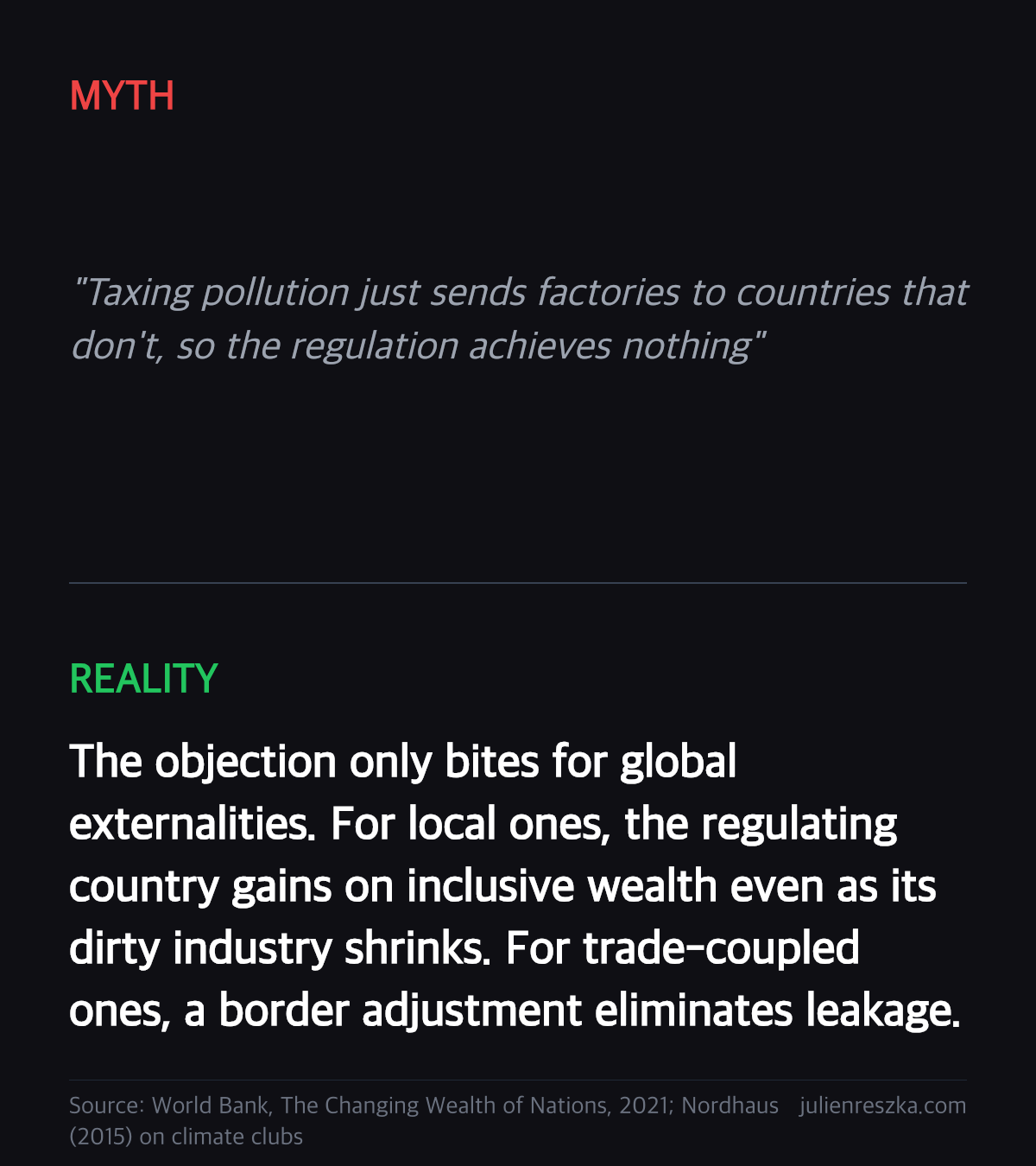
- Trade-coupled externality: deforestation for export markets, factories serving foreign demand. Consumption in A drives harm in B. Border adjustments like the EU CBAM are the correct instrument.
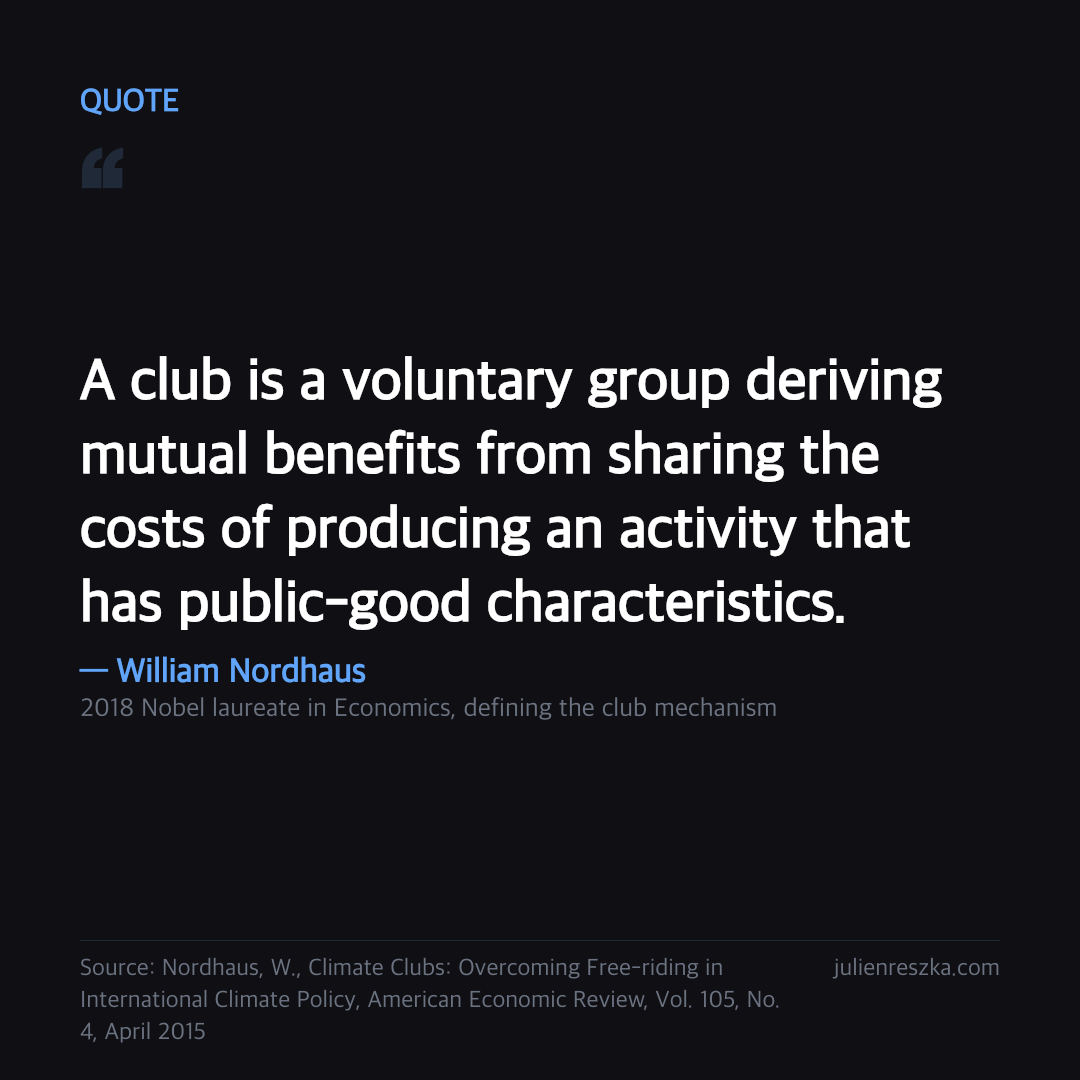
- Transboundary or global externality: shared rivers, greenhouse gases, fishery collapse. Floor near 1: unilateral action captures little. Treaty or coordinated bloc required.
The coordination requirement is not a political preference. It follows from the geometry of the externality. For Cases 1 and 2, unilateral action is sufficient. For Case 3, it is not.
The competitiveness objection
The objection that taxing pollution just sends factories to countries that do not has real bite, but only for Case 3. For Cases 1 and 2, the objection is a category error.
A country applying a local externality brake gains on inclusive wealth even when its GDP share of a dirty industry falls. The World Bank's Changing Wealth of Nations data shows this repeatedly: resource-dependent economies post rising GDP per capita alongside falling per-capita inclusive wealth. They are competitive only on the wrong metric.
For global externalities, the competitiveness objection is not a flaw in the two-condition criterion. It is a coordination problem the criterion correctly identifies. The instrument is right. The jurisdictional scope is insufficient.
The coordination floor function in shouldBreak.js computes the leakage rate from unilateral action given the spatial distribution of external parties across jurisdictions.
Discussion