 Julien Reszka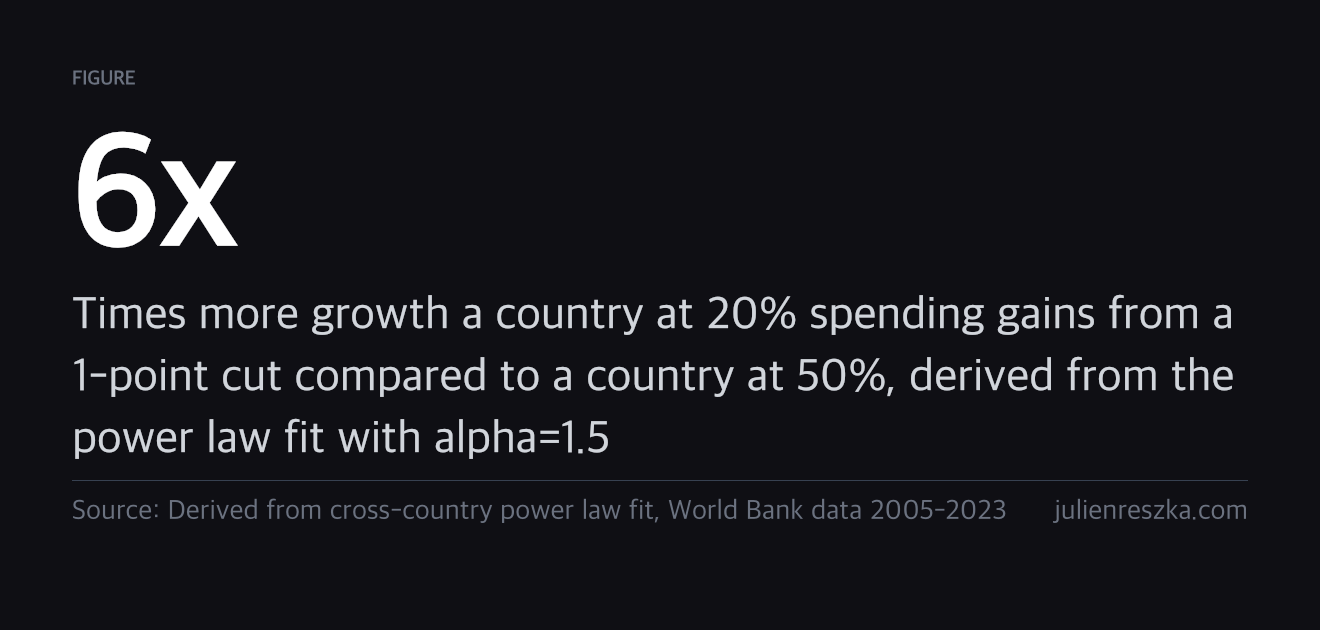
Government Size Has No Sweet Spot showed that cross-country data fits a power law better than the Armey Curve. The curve falls monotonically as spending rises. That seems like good news: cut spending, gain growth.
The bad news is in the shape of the curve.
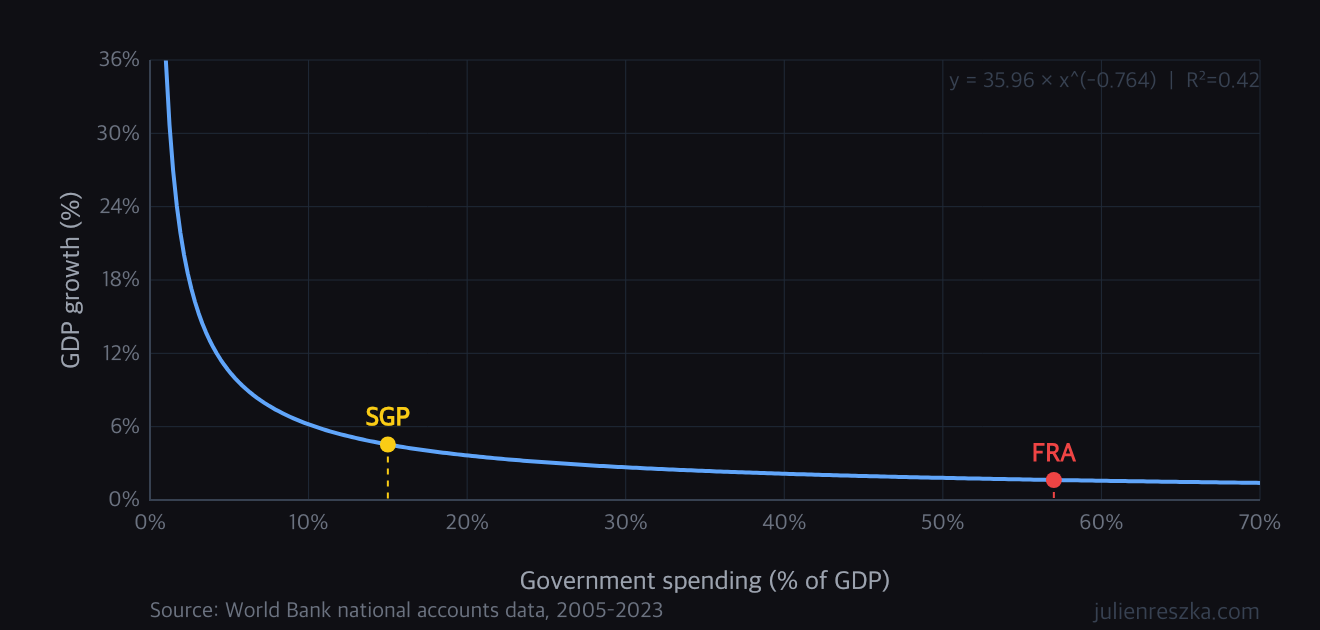
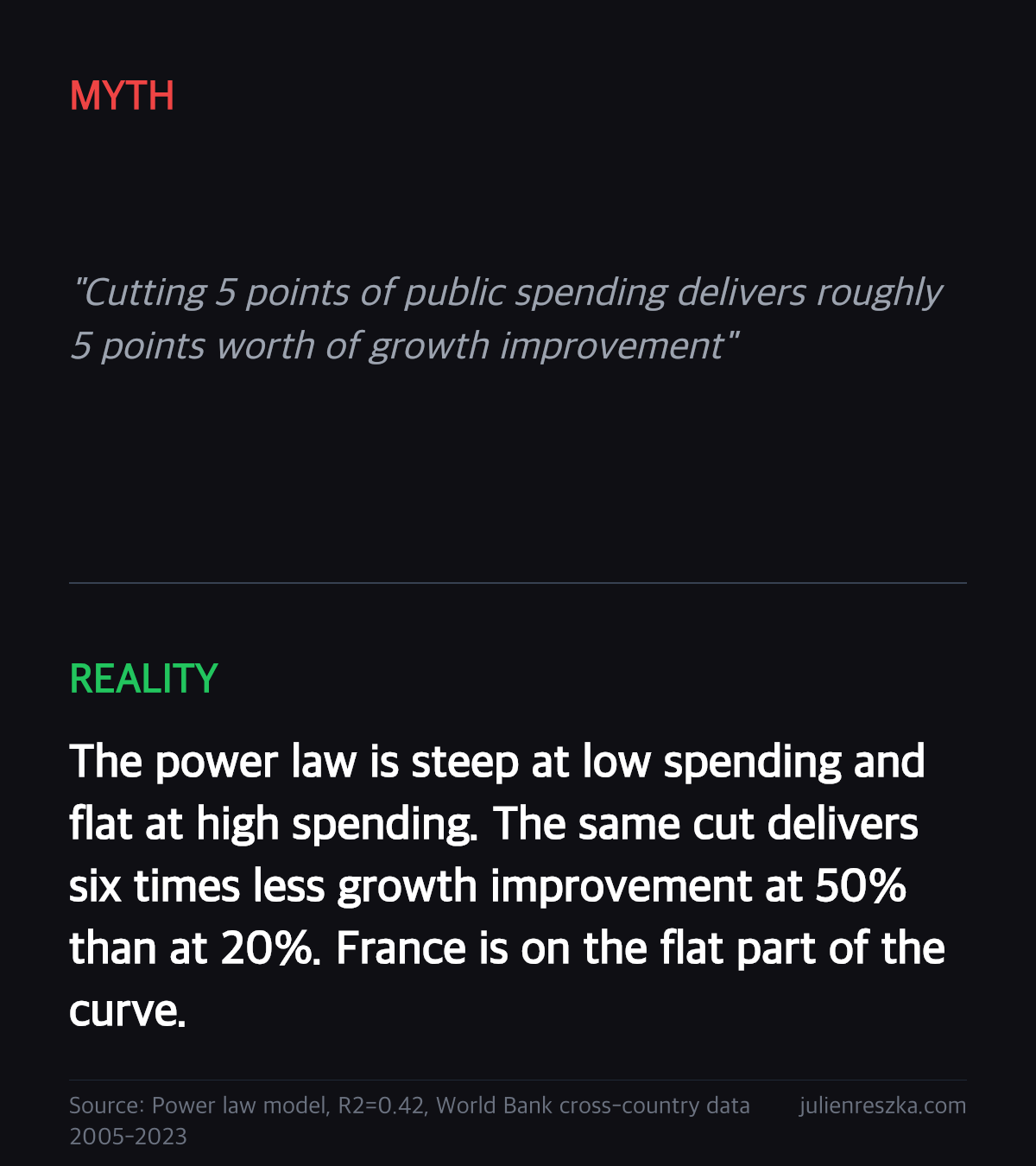
A power law is steep at low spending levels and flat at high ones. The marginal growth gain from cutting one point of spending is proportional to spending^(-(alpha+1)). With alpha = 1.5, the exponent on the marginal term is 2.5. A country at 20% spending gains roughly (50/20)^2.5 = about 6 times more growth from the same cut than a country at 50%.
Singapore at 15% would gain more still. France at 57% is near the flat end of the curve.
This creates a trap. The cure is real. The payoff is small. The disruption is large. That combination is what makes it politically impossible to cut.
Three paths out:
- Cut fast and deep: a large one-shot consolidation (10+ points) moves the country to a steeper part of the curve. Canada cut roughly 10 points in three years in 1995-1997.
- Hold spending flat and let GDP growth do it. The ratio falls by about 2% per year as a proportion when real GDP grows at 2%. This is the Sweden post-1993 playbook, and it took 15 years.
- Do nothing. The ratio stays high. Growth drag compounds. Debt rises. Future cuts become more expensive.
The math on the slow path is brutal.
France currently spends around 57% of GDP. At 0% real spending growth and 1.5% real GDP growth (optimistic for France's recent record), the spending-to-GDP ratio falls by about 1.48% per year as a proportion of its current level. To reach 30% takes roughly 45 years. To reach 20% takes over 90.
Canada and Sweden succeeded because they combined spending freezes with structural reforms that pushed real GDP growth above 2%. France has not done either.
The conclusion from the model is uncomfortable. Incremental annual cuts of 0.5 to 1 point are arithmetically real but economically invisible. They do not move the country far enough along the power law curve to produce a detectable growth response in a political cycle.
Cut fast, or wait 40 years. There is no comfortable middle path that produces visible results.
Discussion