Machines destroying jobs is easy to debunk. Japan is among the most roboticised major economies and has one of the lowest unemployment rates in the G10.
2.5% Japan's unemployment rate alongside world-leading robot density Statistics Bureau of Japan
In theory, automation destroys jobs; in practice it creates more than it destroys, because every reduction in startup costs lets more businesses form, and more businesses means more jobs to fill. The clearest proof is Japan: one of the world's most heavily roboticised major economies, it consistently posts one of the lowest unemployment rates among G10 nations, not despite its robots but alongside them. The real limit on job creation has never been the number of tasks humans can do. It has been the upfront capital required to start a business. Automation lowers that floor:
More founders can enter.
More companies get built.
The net result is more employment, not less.
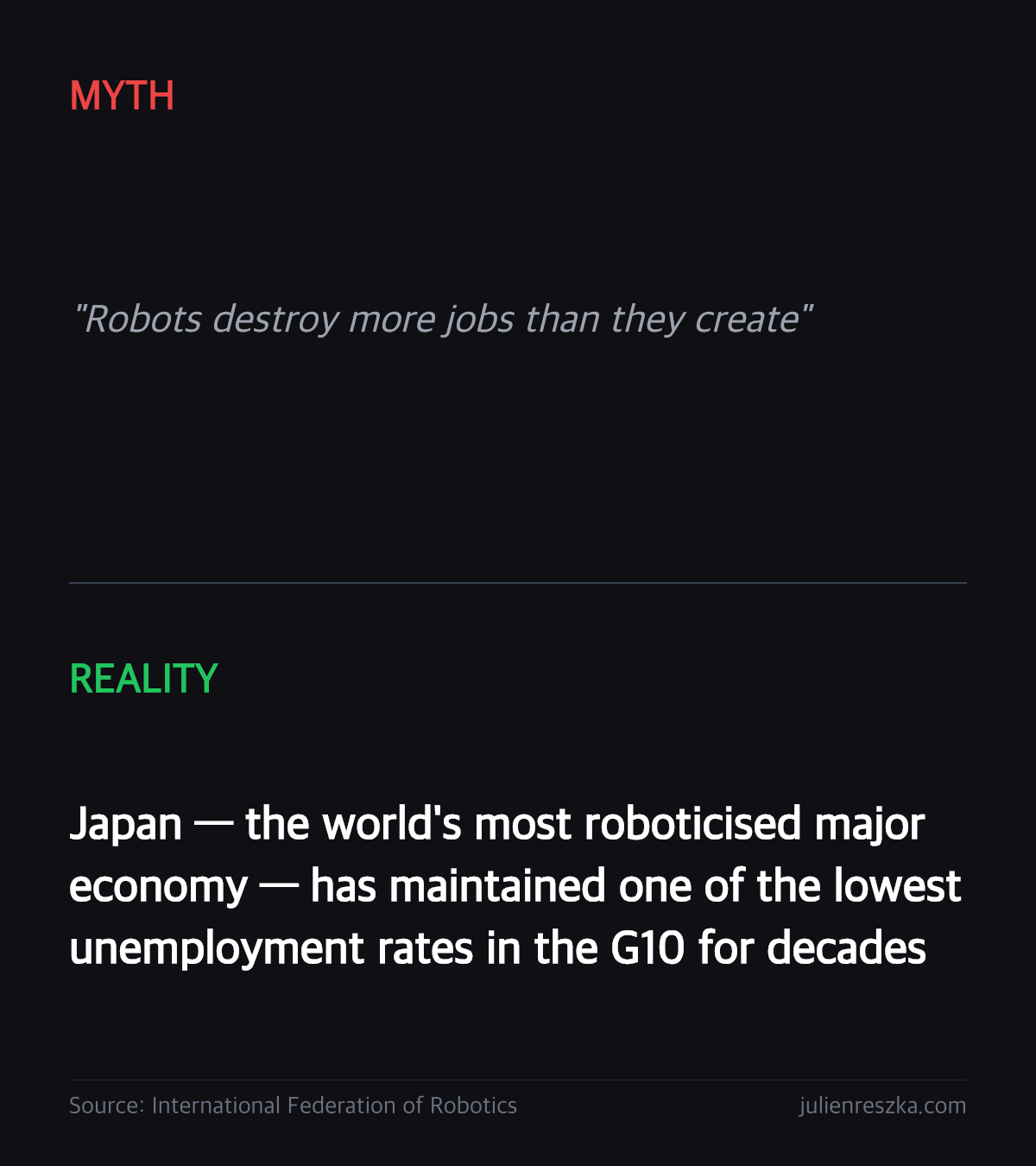
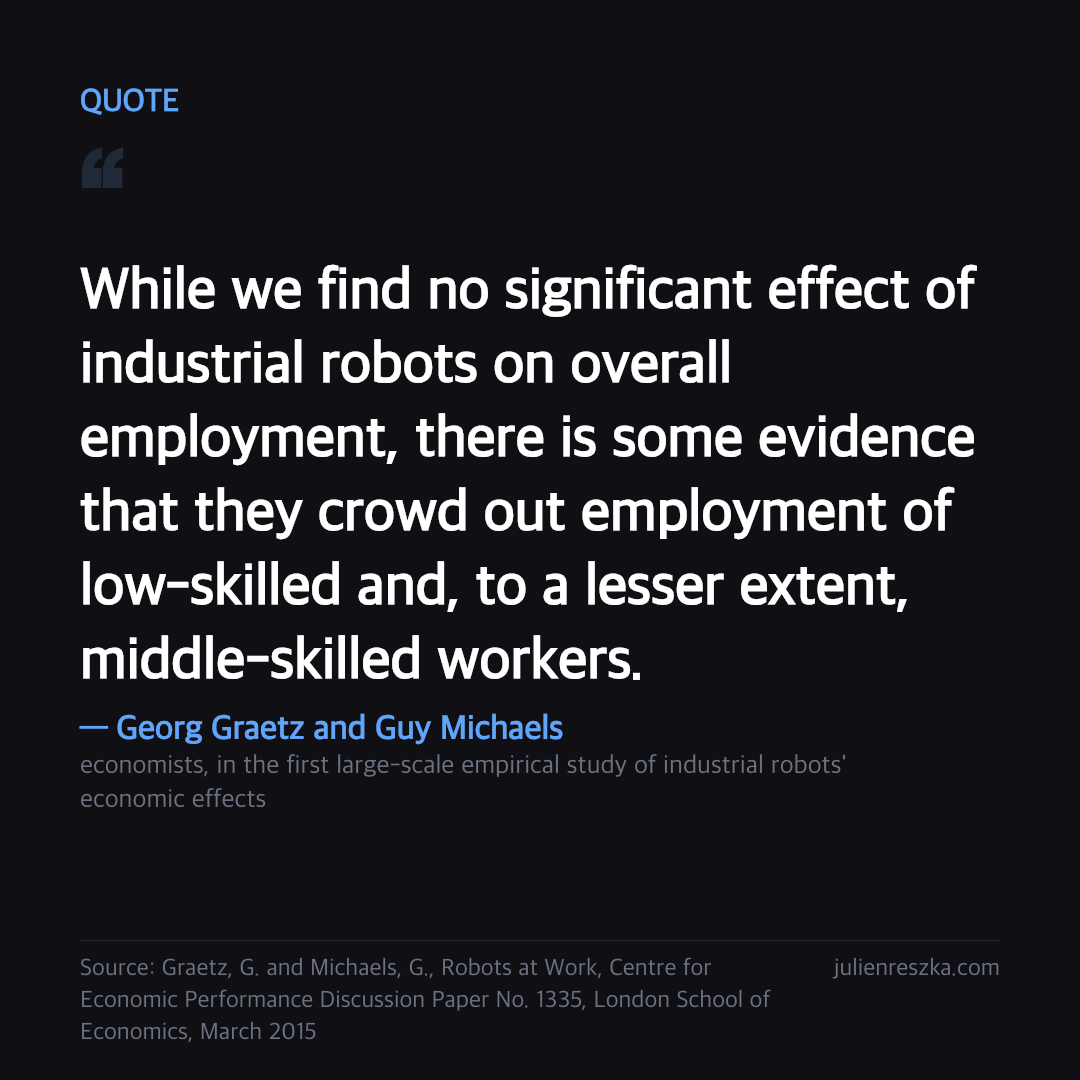
Myth: Robots destroy more jobs than they create Reality: Japan, the world's most roboticised major economy, has maintained one of the lowest unemployment rates in the G10 for decades.International Federation of Robotics“While we find no significant effect of industrial robots on overall employment, there is some evidence that they crowd out employment of low-skilled and, to a lesser extent, middle-skilled workers.”Georg Graetz and Guy Michaels, economists, in the first large-scale empirical study of industrial robots' economic effects
If you want to start something, focus on reducing your startup cost rather than waiting for a safe market. Automation is the cheapest it has ever been. Use it to lower the floor on what viable looks like.
Yes. I keep almost-starting a small manufacturing business and the upfront cost is the only blocker. The automation-equals-cheap-floor argument is the unlock I needed.
Yuna C.Singapore
Same: the economics that killed the idea two years ago are different now. Time to revisit.
Mateo L.
Yes. Was waiting for a 'safer market' that never came. The honest move is to lower my startup cost and just begin.
Elena V.Rome, Italy
Japan's low unemployment is largely explained by demographics. The working-age population has been contracting for thirty years. Japan would have low unemployment with or without robots because there aren't enough workers to fill available roles. Using Japan as evidence that robots create jobs confounds two unrelated trends.
Julien ReszkaParis, France
Singapore proves the pattern holds (ranks second globally in robot density, 2% unemployment) even with a growing workforce (2% annual growth). And for shrinking-population countries, automation is what converts demographic decline into maintained employment rather than stagnation.
 Julien Reszka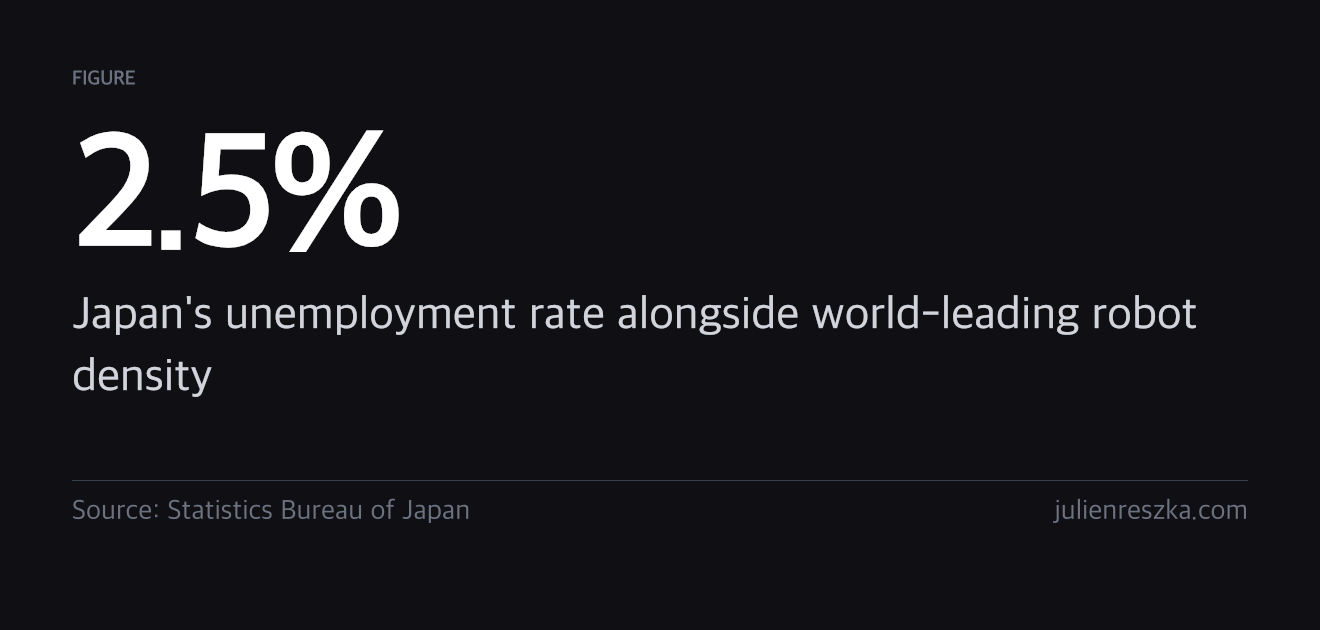
Discussion
Yes. I keep almost-starting a small manufacturing business and the upfront cost is the only blocker. The automation-equals-cheap-floor argument is the unlock I needed.
Same: the economics that killed the idea two years ago are different now. Time to revisit.
Yes. Was waiting for a 'safer market' that never came. The honest move is to lower my startup cost and just begin.
Japan's low unemployment is largely explained by demographics. The working-age population has been contracting for thirty years. Japan would have low unemployment with or without robots because there aren't enough workers to fill available roles. Using Japan as evidence that robots create jobs confounds two unrelated trends.
Singapore proves the pattern holds (ranks second globally in robot density, 2% unemployment) even with a growing workforce (2% annual growth). And for shrinking-population countries, automation is what converts demographic decline into maintained employment rather than stagnation.