 Julien Reszka
You block your ex and the phone goes quiet. It feels like the argument is over. It is not over. It has moved to rooms you are not in.
Blocking does one thing well, and it is worth being clear about it. A 2012 study of 464 people found that checking an ex's Facebook page after a breakup went with more distress, more longing, and less personal growth. If watching someone's profile keeps reopening the wound, cutting the feed helps you heal. Threats are a different matter: if someone threatens your safety, cutting contact is protection. Insults are not threats. If you behaved like an idiot, hearing it said bluntly is part of being held to account.
The illusion starts when blocking is used for something else: not to stop harm, but to stop hearing something you would rather not hear. The block removes the message from your screen. It does not remove it from the world.
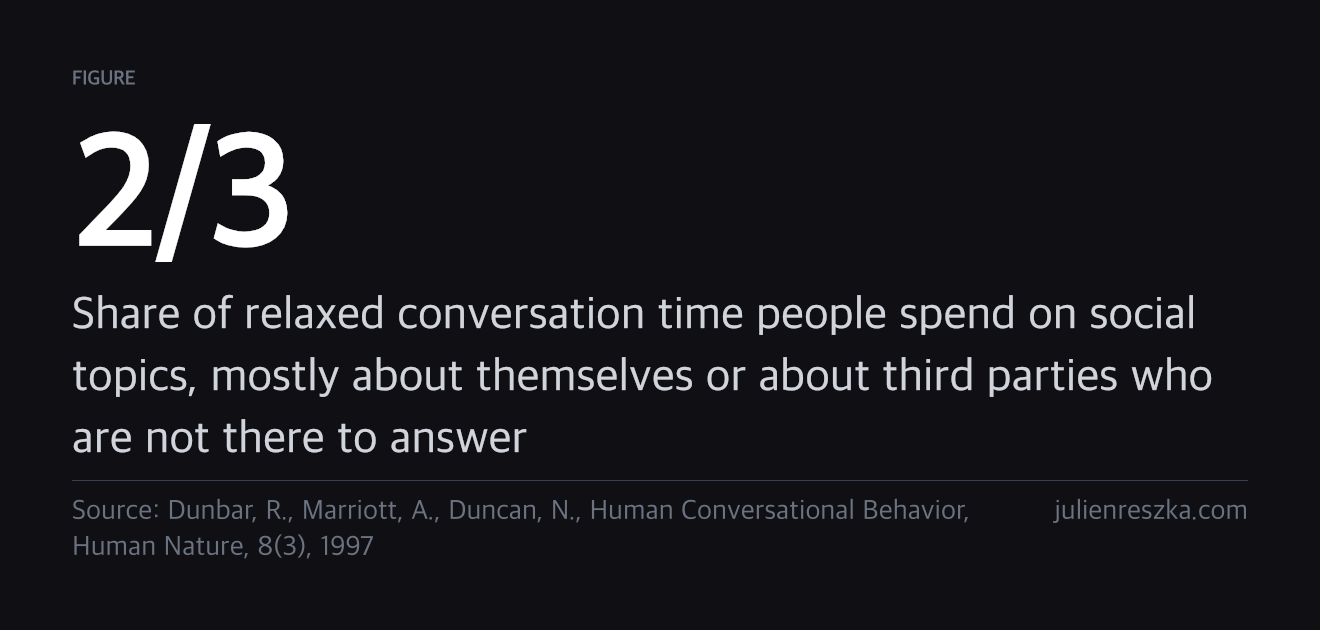
Your ex still talks to your mutual friends, their family, their next partner, and people spend a lot of their talking on exactly this. In a 1997 study of everyday conversations, Robin Dunbar and colleagues found about two thirds of conversation time went to social topics, mostly about the speakers themselves or about people who were not there.
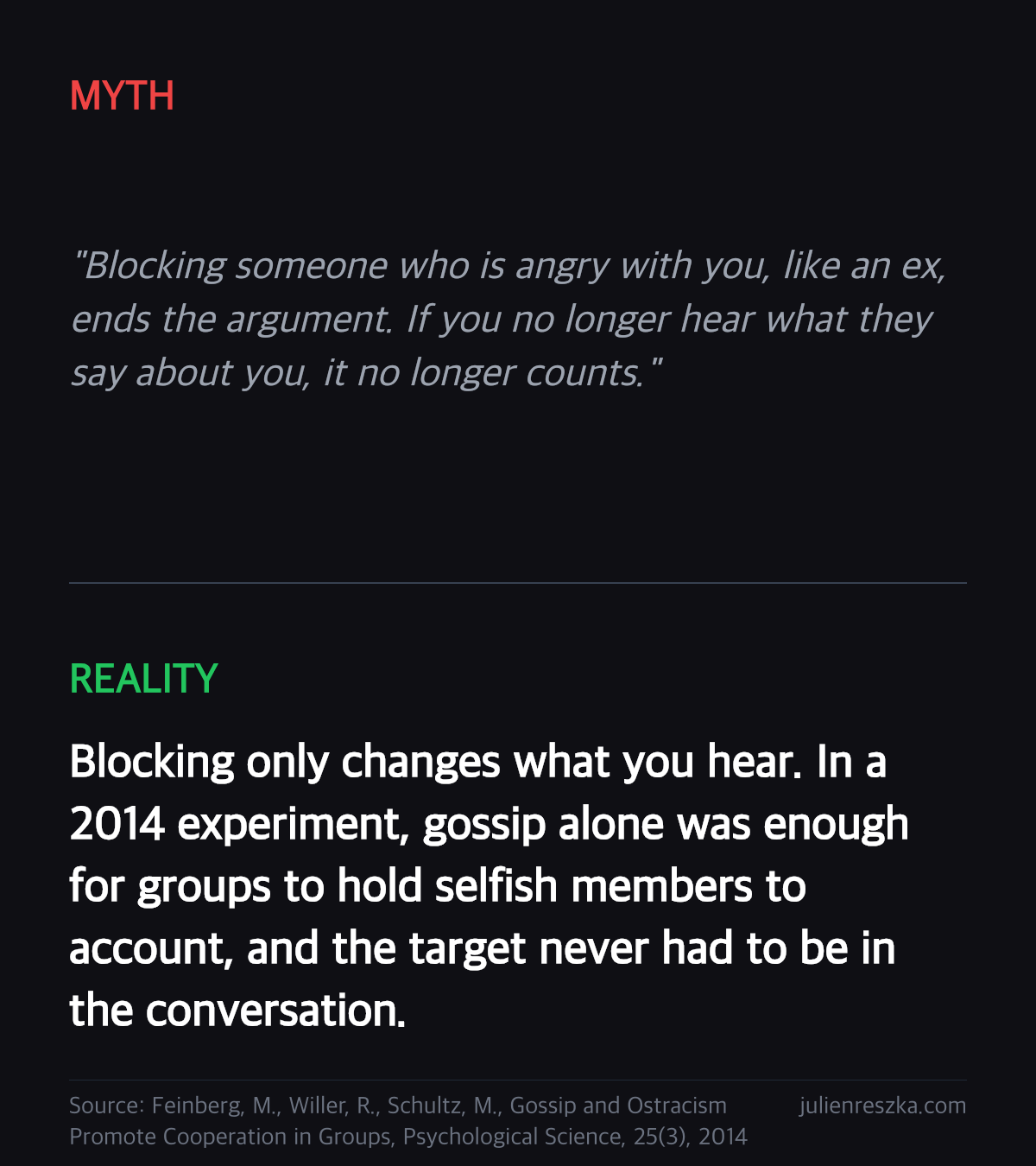
That talk is not idle. In a 2014 experiment with 216 participants, groups allowed to gossip sustained cooperation and deterred selfishness better than groups that could not. The person being talked about never had to be in the conversation for it to work. That is what accountability looks like between people: not a message you receive, but a reputation that forms whether you read about it or not. And it is what keeps a group together. Remove it and cooperation erodes; keep it and people stay.
So blocking to dodge criticism trades one thing for another:
- You stop hearing the accusation, but the people around you keep hearing it
- You lose your chance to answer, correct, or apologize, so their version is the only one in circulation
- You lose the information itself, including the part that might be true
That last cost follows you into the next relationship. Park and MacDonald compared the self-reported personalities of 332 people's current and past partners and found them consistently similar. If your next partner is likely to resemble your last one, the conflicts you never worked through are likely to find you again.
Couples show the same thing from the inside. A 16 year study of 373 married couples found that withdrawing from conflict in the first year of marriage predicted divorce at years 3, 7, and 16. The researchers singled out one pattern as particularly toxic: one partner tries to talk it through, the other withdraws. Blocking is that withdrawal made permanent.
Withdrawal also escalates. A meta-analysis of 74 studies and 14,255 people tied the push and withdraw pattern to lower satisfaction and poorer communication, and its lead author noted that the more couples use it, the more intractable it becomes. Being shut out also breeds hostility: in 2001 experiments, people told they had been rejected turned more aggressive, even toward strangers. A blocked ex does not go quiet. They take it to the people who can still hear them.
What helps people move on is not silence, it is processing. In Larson and Sbarra's 2015 study, 210 recently separated young adults who repeatedly reflected on their breakup over nine weeks rebuilt a clearer sense of who they were, which went with less loneliness. Research on ghosting points the same way: in Dubar's focus groups, about half of those who had ghosted someone reported guilt or remorse, and the researchers warned that skipping the hard conversation means skipping the conflict that builds trust.
The French playwright Philippe Destouches gave this a line in 1717 that became a proverb: the absent are always in the wrong. Blocking makes you absent from every conversation about you.
None of this means you owe an ex endless access. It means hearing the case. Read the last long message. Find the line you would least like repeated to a friend, and ask whether it is true. If it is, answer it. Relationships, and the groups around them, last because people are held to account, not because they found a way out of it.

Discussion