 Julien Reszka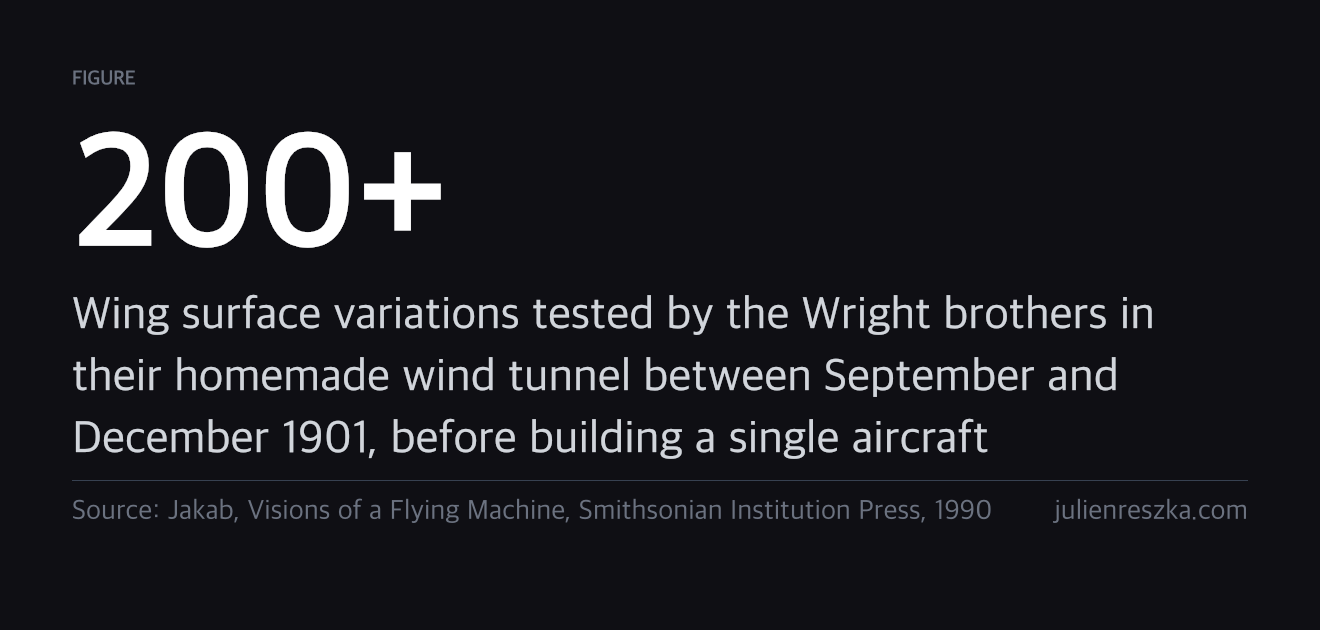
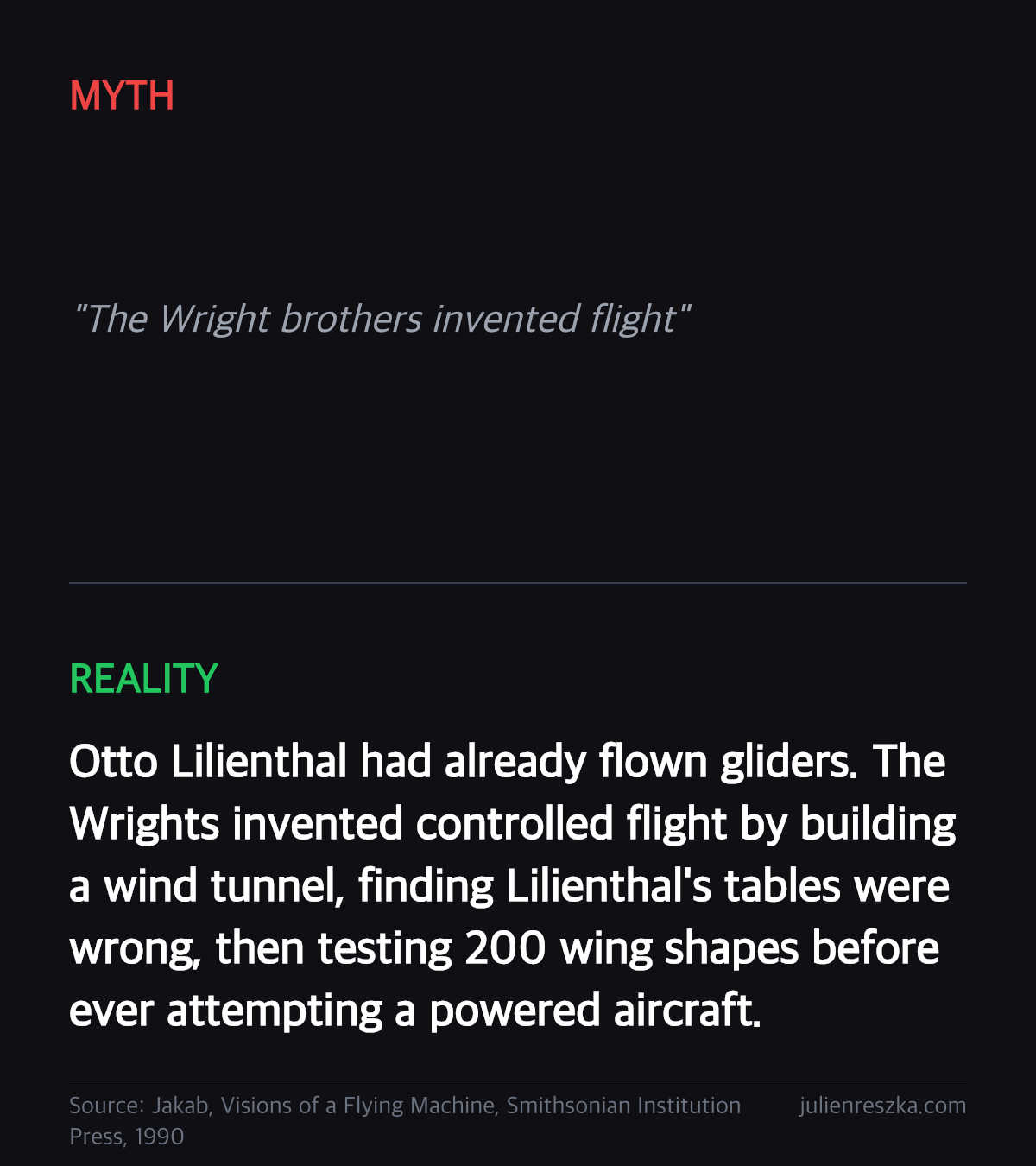
Everyone credits the Wright brothers with inventing flight. That is not quite right. Otto Lilienthal had been flying gliders since 1891. He logged over 2,000 flights before dying in a crash in 1896. The Wrights were not first to fly. They were first to fly under control.
The distinction matters because the paths to those two achievements are completely different.
Lilienthal's approach was iterative failure. Fly, crash, adjust, fly again. His aerodynamic tables, published in 1889, were the best data available on lift and drag for curved surfaces. Every serious aviation experimenter of the era used them, including the Wrights initially.
In 1900 and 1901, Wilbur and Orville built gliders using Lilienthal's tables. The gliders underperformed badly. Instead of flying more gliders and crashing more often, they stopped.
They built a wind tunnel.
It was six feet long, made of wood, powered by a fan. Between September and December 1901 they tested over 200 wing surface variations and studied around 45 shapes in detail. They discovered that Lilienthal's lift coefficient was off by a factor of roughly two. The tables that every other experimenter was trusting were systematically wrong.
With corrected data, they built a new glider in 1902 that performed exactly as predicted. Then they built the Flyer. On December 17, 1903, it worked on the first attempt.
This is the part the failure-analysis narrative misses entirely. The Wrights did not succeed because they crashed a thousand times and learned from each crash. They succeeded because they found a way to test their assumptions without crashing at all. The wind tunnel let them run controlled experiments where the only variable was wing shape. The crashes were someone else's data collection method.
You do not learn to fly by crashing planes. You learn by building an instrument that lets you isolate variables and accumulate small, verified wins before the first real test.
The pattern is general:
- Test assumptions in a controlled environment before exposing them to real-world noise
- Treat existing data as a hypothesis, not a foundation
- Design experiments where failure is cheap and the signal is clean
- Aim to succeed on the first real attempt because everything before it was already a test
Failure is not the teacher. Controlled experiments are. Failure is just what happens when you skip them.

Discussion