 Julien Reszka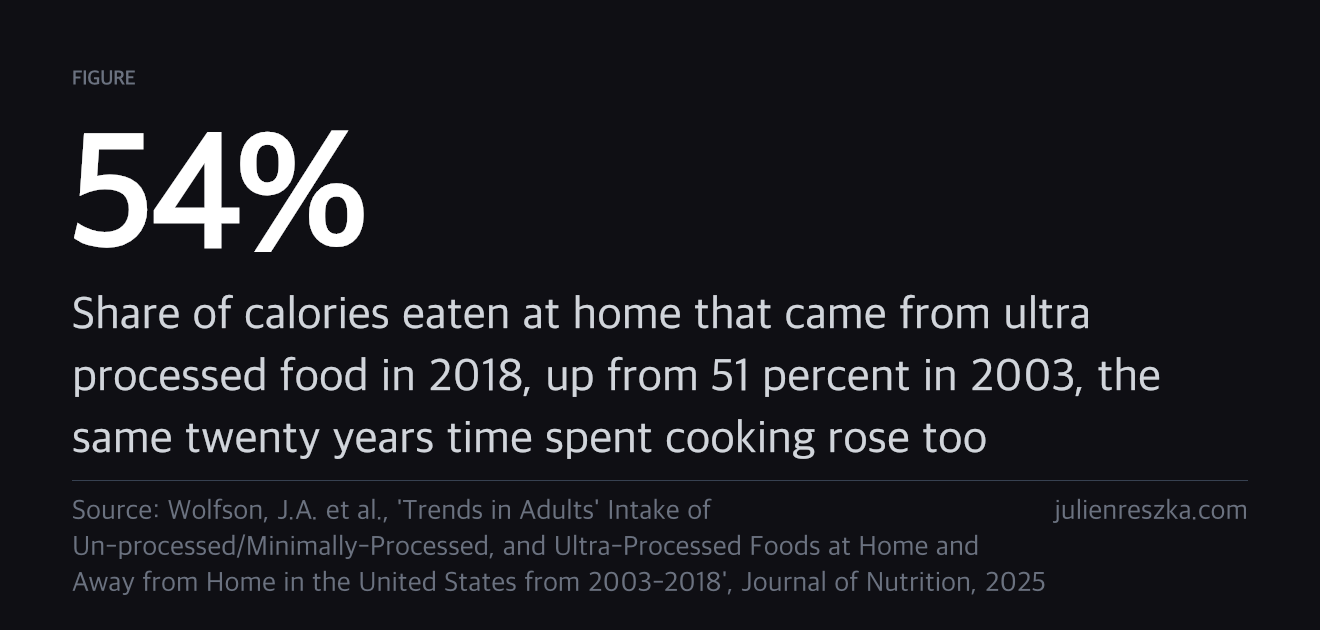
Ask someone whether people cook less than they used to and most will say yes without hesitation. The government's own time use data says otherwise. The share of American adults who cook on a given day rose from 53 percent in 2003 to 62 percent in 2023, and the increase was sharpest among college educated men, up from 36 percent to 52 percent over the same twenty years.
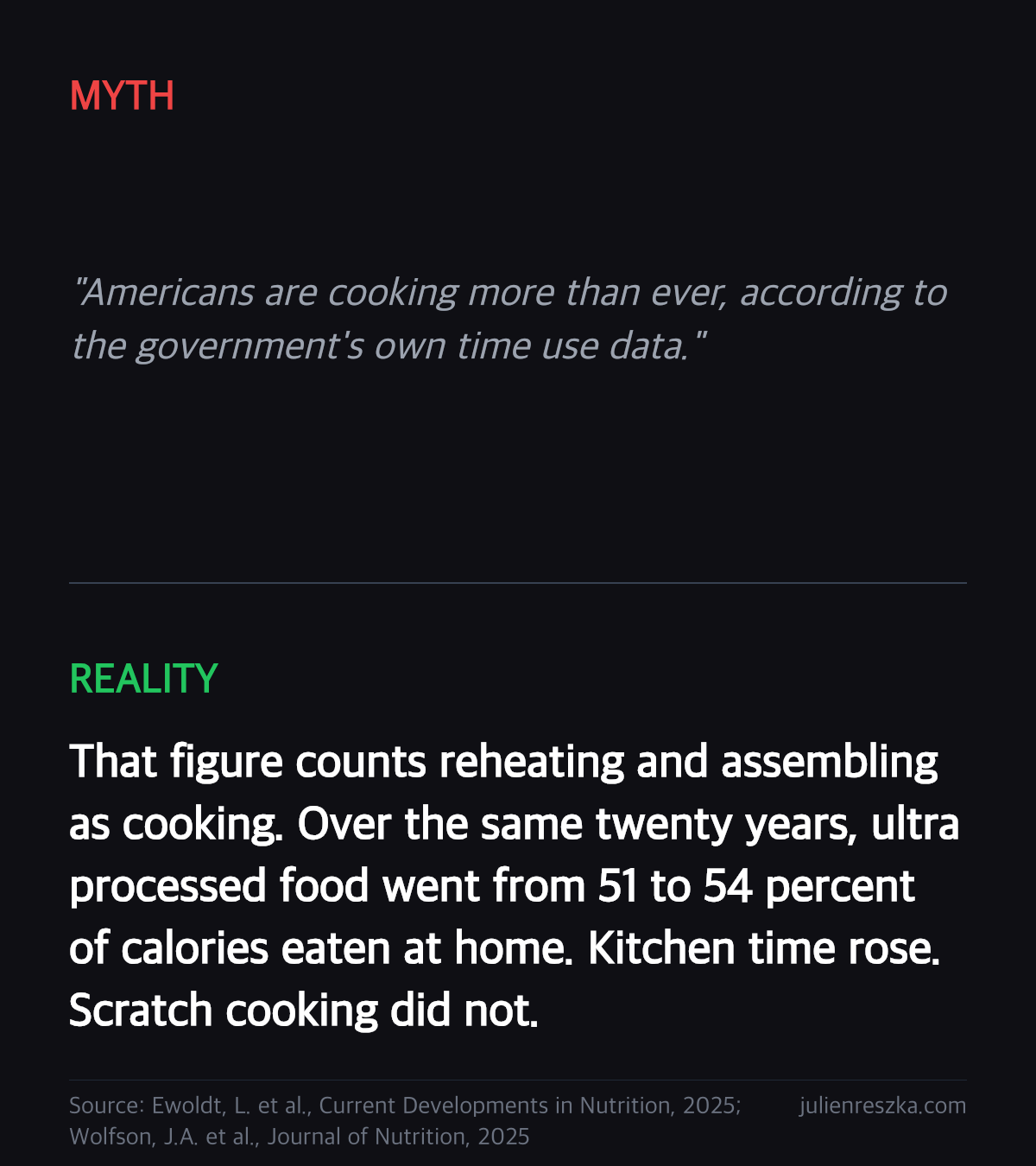
That number survives contact with reality only if reheating counts as cooking. The American Time Use Survey defines food preparation as any food and drink preparation, presentation, and cleanup, with no distinction between someone dicing an onion and someone microwaving a frozen dinner. The number of Americans standing in a kitchen went up. What they were doing there changed.
- Calories eaten at home from ultra processed food rose from 51 percent in 2003 to 54 percent in 2018, almost the same twenty years as the cooking time increase
- Adults nationally now get roughly 53 to 55 percent of total daily calories from ultra processed food, among the highest shares recorded anywhere
Both numbers come from the same twenty year window, one tracking time spent and the other tracking what actually ends up on the plate. Kitchen time rose. Scratch cooking, the kind that starts with whole ingredients rather than a bag that only needs heat, did not rise with it.
Something upstream of the kitchen changed too. Family and Consumer Sciences, the modern name for home economics, used to be a default part of American secondary education. The supply of new teachers for it collapsed from 852 graduates nationally in 1986 and 1987 to 315 a decade later, and today whether a school even offers the class depends heavily on which state a student lives in, from close to universal in Tennessee and Washington to under half of schools in Florida and California.
We Got Better at Keeping You Alive. Not at Keeping Healthy. named depression and anxiety among the largest drivers of the widening gap between how long people live and how long they stay healthy. A 2024 umbrella review in The BMJ, covering close to ten million participants, found ultra processed food consumption associated with 48 percent higher odds of anxiety and 53 percent higher odds of common mental disorders overall. The two trends did not have to be related. The data says they plausibly are.
None of this means nobody cooks. It means the art that used to get taught, deliberately, at home and at school, was the part in between owning a kitchen and owning a microwave: what to do with raw ingredients once you are standing in front of them. That part did not survive the twenty years the data covers as well as the time spent standing there did.
Discussion